Trekking the Himalayas, part 5 – coming down via Chukhung Ri

This is the fifth and final part of a series of posts on my time up in the Himalayas, so if you haven’t read the earlier ones, then you’ll kind of miss most of the point of the trip.  So here’s parts one, two, three and four.

After eleven days of proceeding to higher and higher altitudes each day (more or less), and having now had time for our bodies to adjust (somewhat) to the reduced oxygen content of the air, it was fascinating to see how we went on the way back down.  It’s incredible how much difference a couple of hundred metres of altitude makes when you’re descending.  And combine that with the satisfying realization that we’d achieved what we wanted, that we’d done it without illness, without problems, and without anything to stop us just enjoying the ride…  Our trek back down to lower heights was a particularly effervescent one.

Suddenly, everything was easy.

Walking back down from Gorak Shep

Whee! Downhill!

Most of the walking was downhill, not up.  And when there was an uphill section, now that we’d already acclimatised to even higher altitudes, it was finally as easy as it looked like it should be.  No more spotting a simple-looking short incline only to find ourselves inexplicably out of breath, with unfathomably heavy legs, only a third of the way up.

Even better:  seeing how much easier it was for us, now, than for those making their way in the opposite direction.  Any time we felt even vaguely under-rested, all we had to do was look at the weary faces coming our way on the trail to realise that hey, this is the easy bit!  We tried to help out their moods, offering cheery “g’day”s to all and sundry, attempting to convey with our facial expressions a sense that what they were walking towards was something they’d be excited to have experienced.  But the most common response was an eye-contactless grunt and more feet-focussed trudging.  There were a few people, I couldn’t help but think, who were not really making the most of the scenery.  And it’s possible, of course, that our sunny dispositions might on occasion have come across as gloating.  Not deliberately, of course.  Well, except for that one time, towards that one guy.  He was a dick.

So, anyway, it was easy.  Except of course that on the way down, with no altitude restrictions and no more acclimatisation to worry about, there’s nothing stopping you roaming far and wide.  And so it was that on the first day out of Gorak Shep we walked all the way to Chukhung:  about 15km, a distance that would have taken at least three days in the other direction.  As it was, the walk took us six or seven hours – longer than we’d walked on pretty much any other day.

And of course, while I say that it was all downhill from here, the reason to divert out to Chukhung was another sunrise climb, this time up Chukhung Ri.

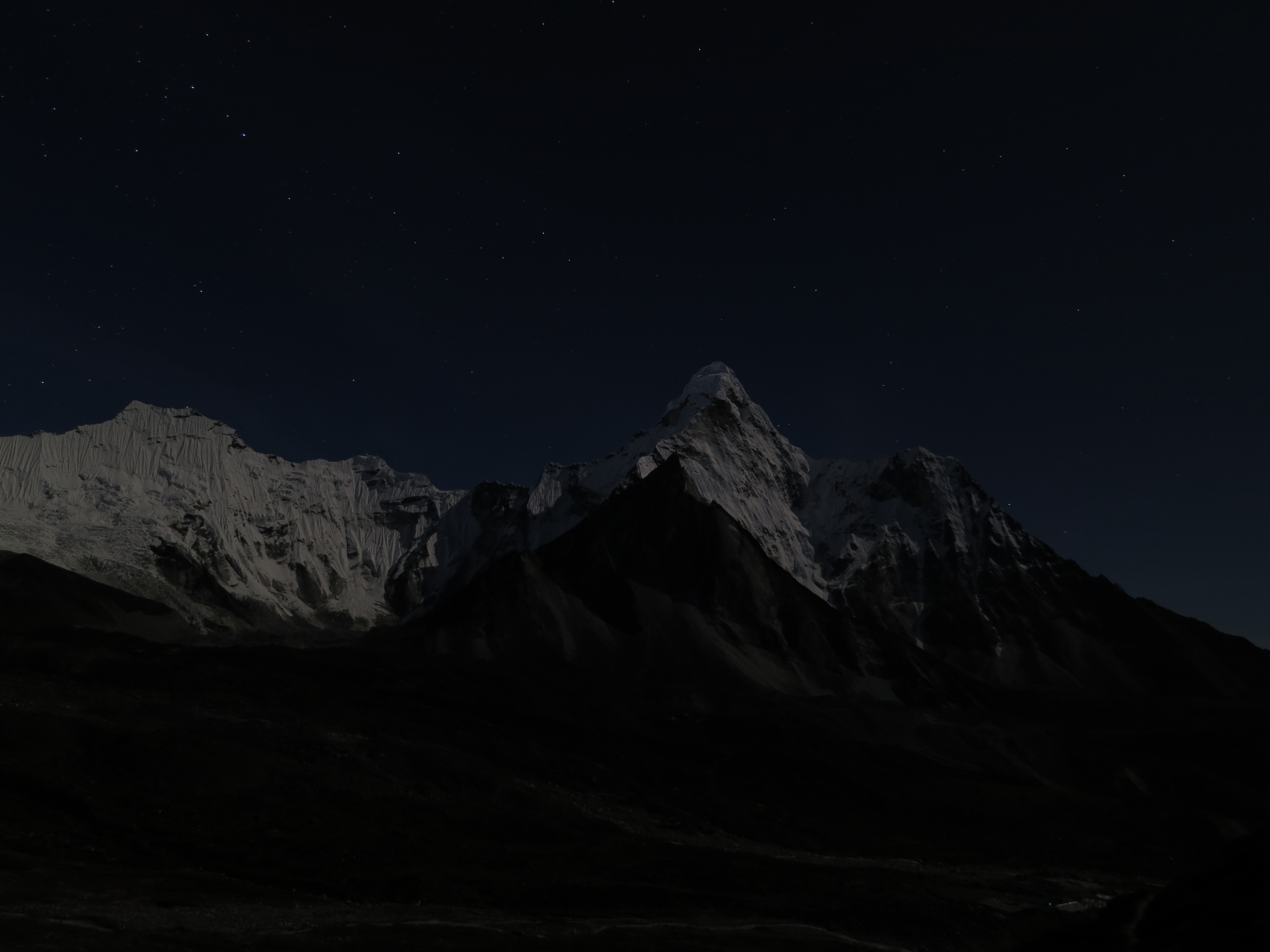
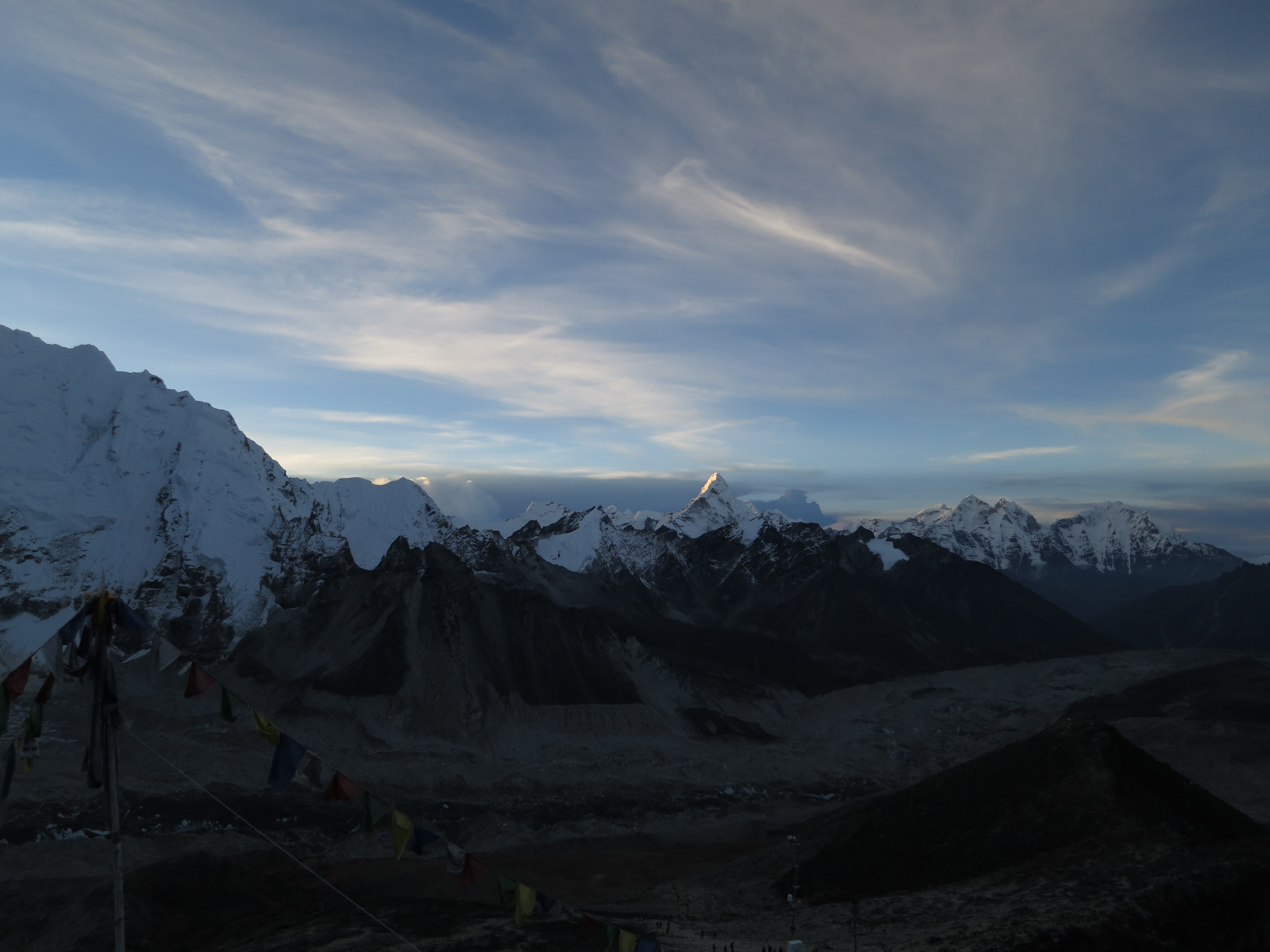
The night sky before dawn at Chukhung, just before we started our climb up Chukhung Ri

The night sky before dawn at Chukhung, just before we started our climb up Chukhung Ri

After an uneventful night, we awoke for a 4.30am start on day twelve, and we took a good two hours to make it up the 800m or so to the peak from which we would view the sun’s ritual ascent over the mountains and valleys.  Unlike the other two early mornings, we were the only ones doing this one:  an entire peak to ourselves, just us and our heavy panting and plodding footfalls.  It might have been easier than before, yes, but it was still hard work.  800m up is a long way at any altitude!

The view from the peak, though, was incredible.  Khala Patthar, two days before, had been stunning for its postcard-like view of Everest.  Chukhung Ri doesn’t have a view of the world’s highest peak – Lhotse is in the way – but it does have a stunning panorama nonetheless.  Even more beautiful than we’d seen so far.  The isolation, with only three of us at the top, made it even more breathtaking.

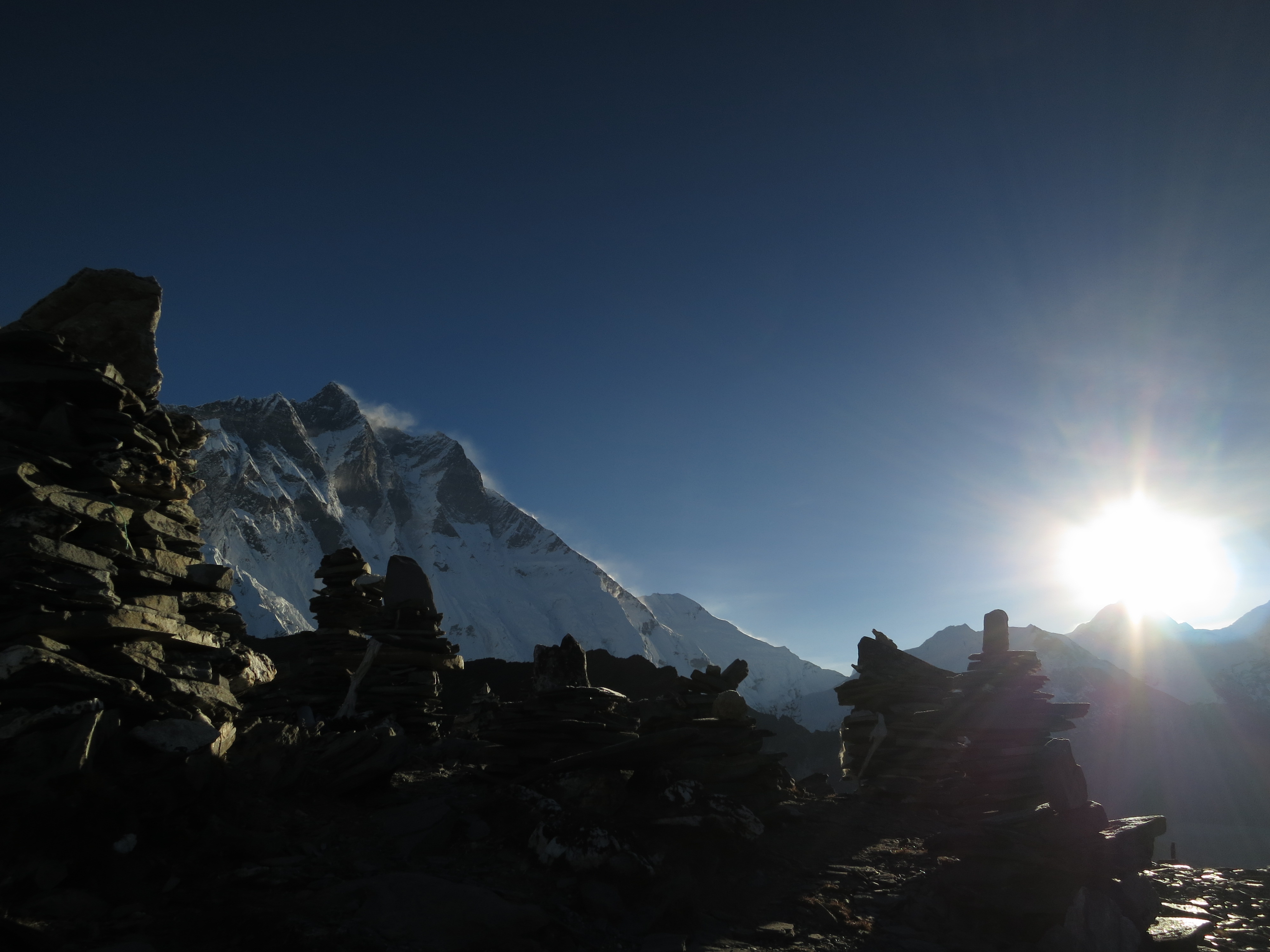
Another sunrise over the mountains, this time seen from Chukhung Ri

Another sunrise over the mountains, this time seen from Chukhung Ri

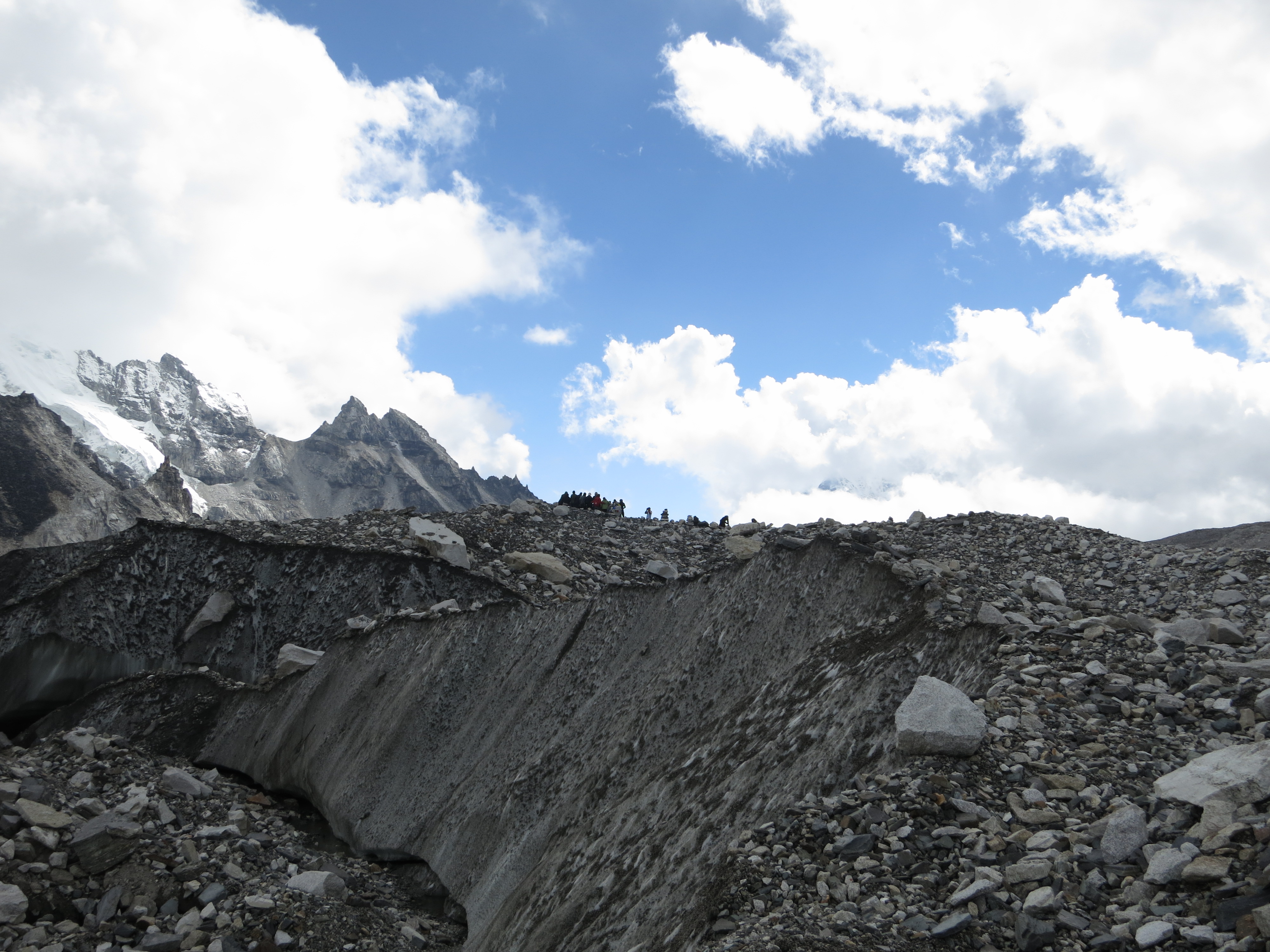
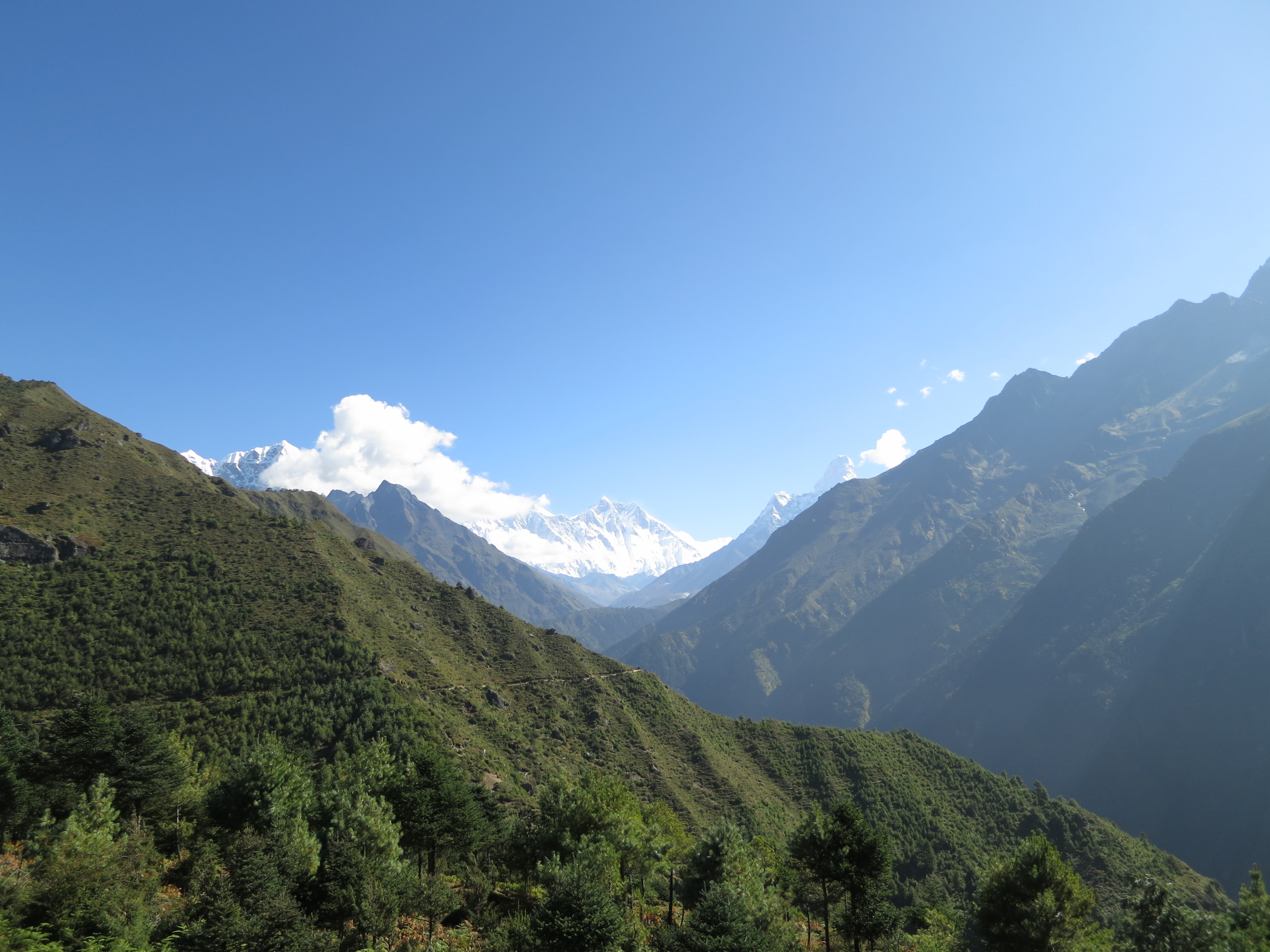
And still from Chukhung Ri, the view along our path back to Lukla, a path which wends its way through the valley into the cloud just right of centre

And still from Chukhung Ri, the view along our path back to Lukla, a path which wends its way through the valley into the cloud just right of centre

But after that panorama, we truly had done everything we’d come for, and we were definitely on our way back down.  Suddenly, one moment, we noticed that we were walking past trees again.  We hadn’t seen them for a while, having been well above the treeline.  The next moment, we were walking past towns with – god bless them – bakeries.  So of course in Dingboche, we stopped for a pre-lunch serving of baked goodness.  (Well, ‘goodness’ is going a bit far – it was a pretty abominable stale cake, to be honest.  But we had to try.)  And that night, in Tengboche, I hit paydirt.  A café with real coffee – Lavazza this time, and actually pretty good – and with a real cake selection.  About six of them:  cakes, brownies, slices, etc.  And damned if all six weren’t fantastic.  (Yes, yes, I did – albeit over two sittings.  After all, it’s not like I wasn’t going to be able to walk it off…)

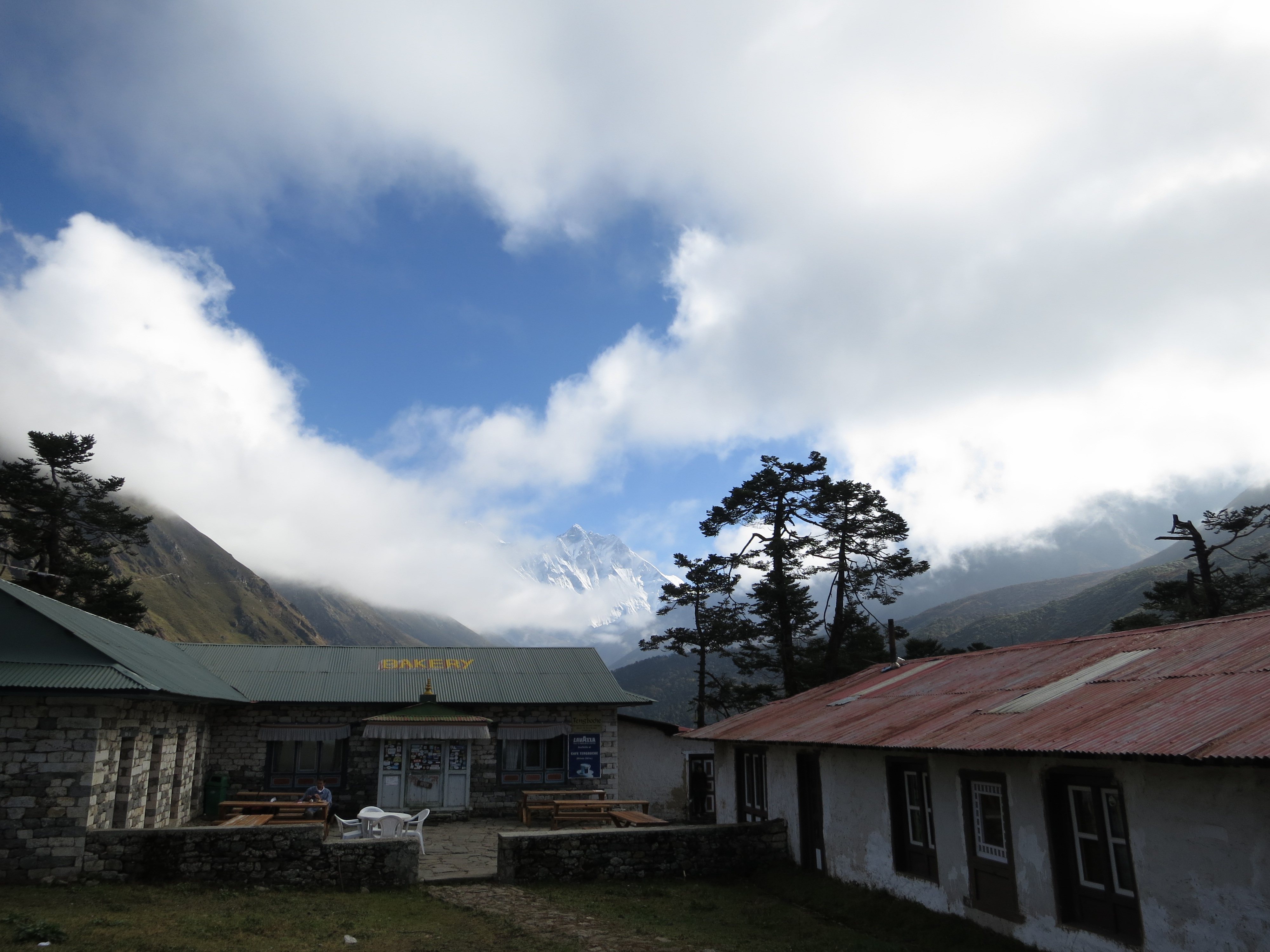
Perhaps the most scenically-located bakery I’ve ever seen.  And a good one too…

Perhaps the most scenically-located bakery I’ve ever seen. And a good one too…

… and the view from said bakery.

… and the view from said bakery.

So after our tasty interlude overnighting in Tengboche, it was back down towards Namche Bazaar.  Still appreciating walking through trees again.  We weren’t just walking through trees, though:  also through the fog and cloud.

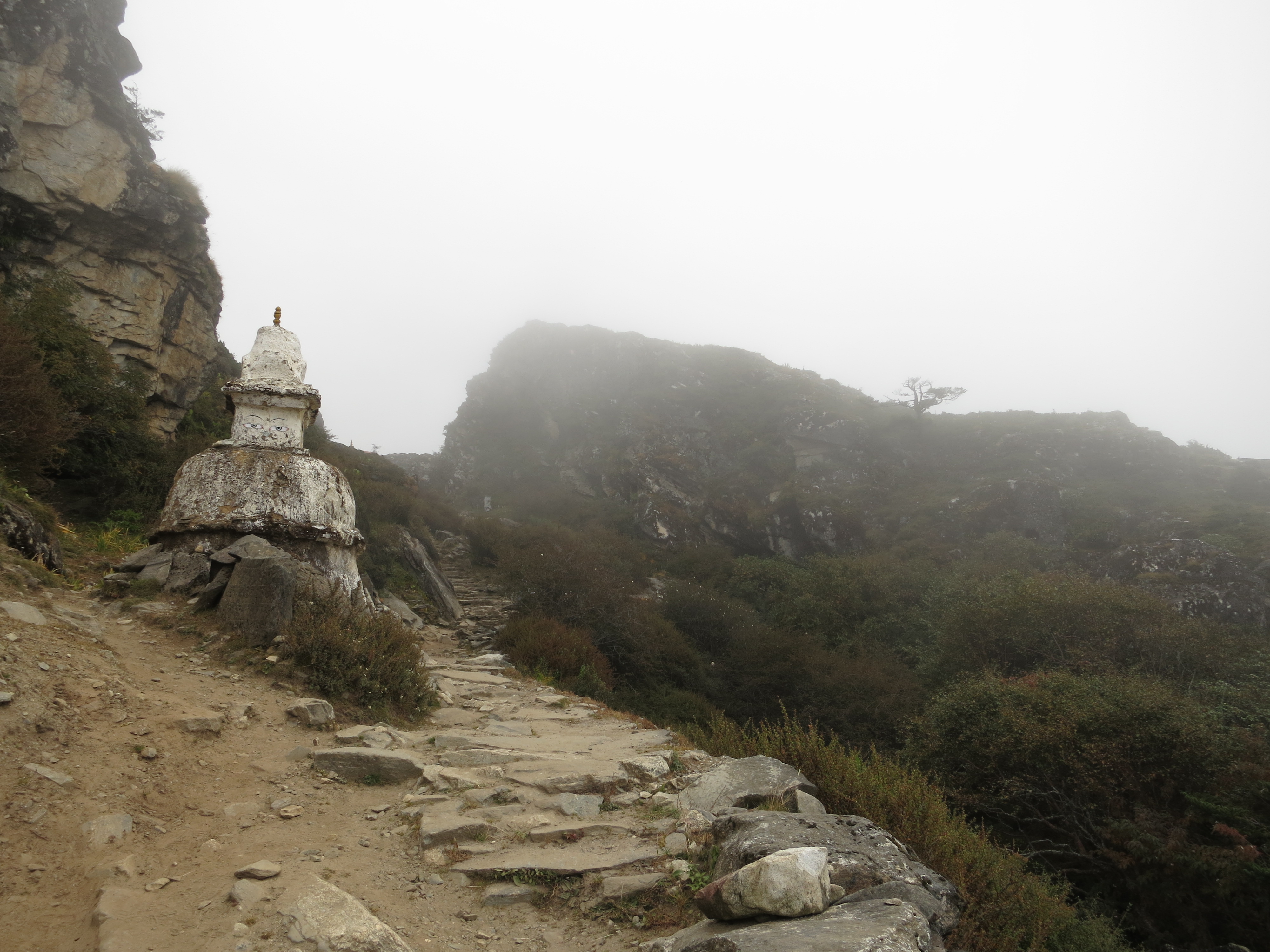
Fog and cloud on the path back towards Namche Bazaar

Fog and cloud on the path back towards Namche Bazaar

Oh…

Fog and cloud…

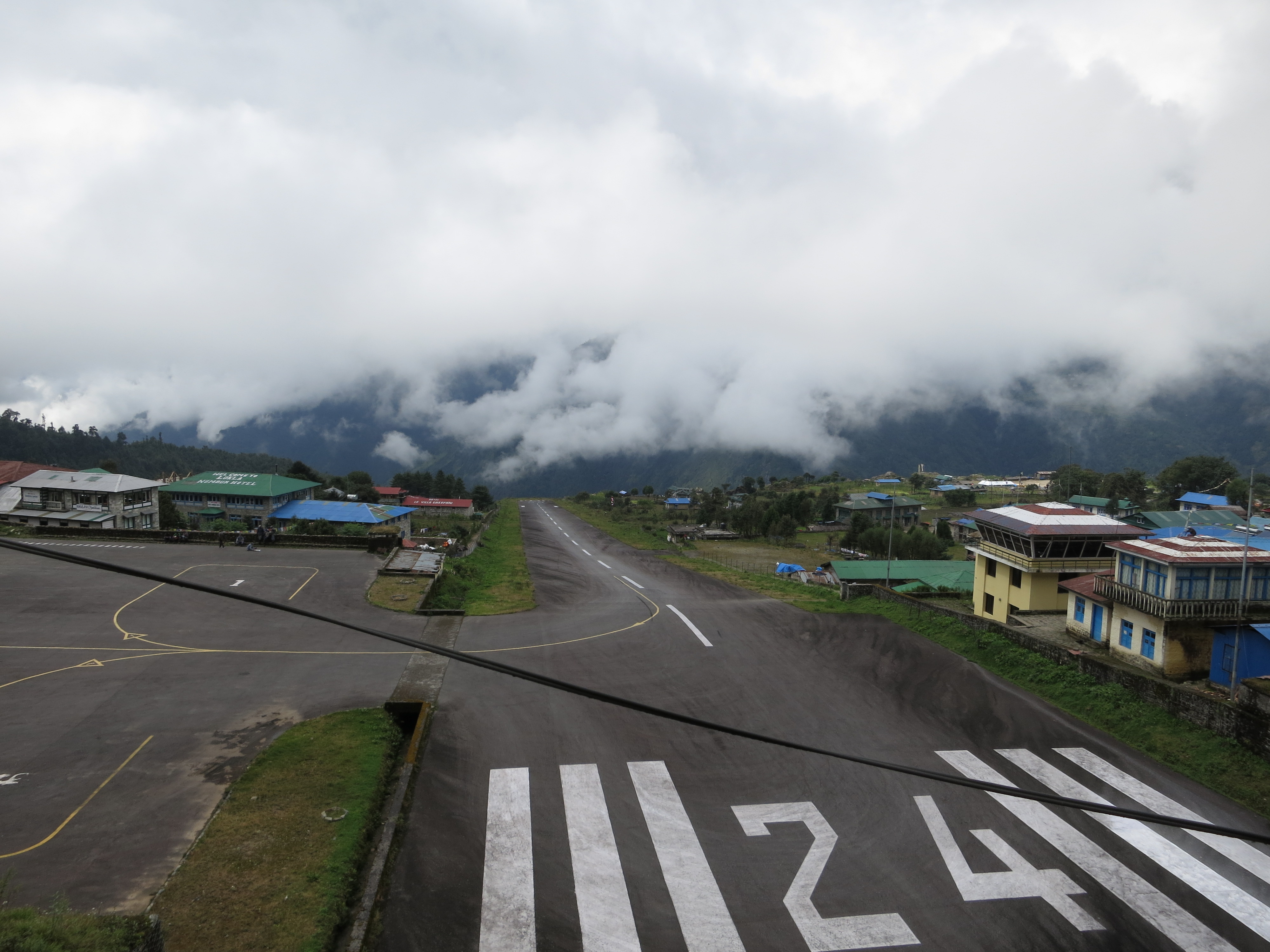
… That’s what they close Lukla airport for, generally, isn’t it?

En route back to Namche Bazaar, we all enjoyed a great laugh as we admired the “view” from the Everest View Hotel.  If there had been any guests, they might have been a little disillusioned and unhappy with the (for that day) somewhat misnamed hotel:  it was shrouded in cloud, and visibility was about 28.996 km short of the 29km or so you need to be able to see Everest from there.  But that wasn’t a problem for anyone, as it happened.  The hotel was completely empty.  There were no guests because there hadn’t been any flights into Lukla for days now.

The ‘view’ from the Everest View Hotel

The ‘view’ from the Everest View Hotel

An alternative view from the Everest View Hotel:  one with a clearer indication of Everest.

An alternative view from the Everest View Hotel: one with a clearer indication of Everest.

Point being, the cloud had really set in.  Which was going to be a pain if it meant we couldn’t fly out to connect to our flight out of Kathmandu…

This was around the point in time that our guide, Jay Ram – who himself needed to fly out on time to start his next trek in a couple of days – had to start trying his best to dissuade us from the plan that was slowly formulating in our minds:  to walk all the way out of the mountains, to Jiri, from where we could bus back to Kathmandu.

The walk down to Jiri generally takes five days, apparently, but we reckoned that pushing hard (basically walking twelve hour days) we could probably make it in three – which would mean we’d be on time, so long as we started out a day earlier than we had planned to fly…

… But just as we were settling on turning vague notion into plan B and thence into action, the cloud lifted.  And there was much rejoicing.

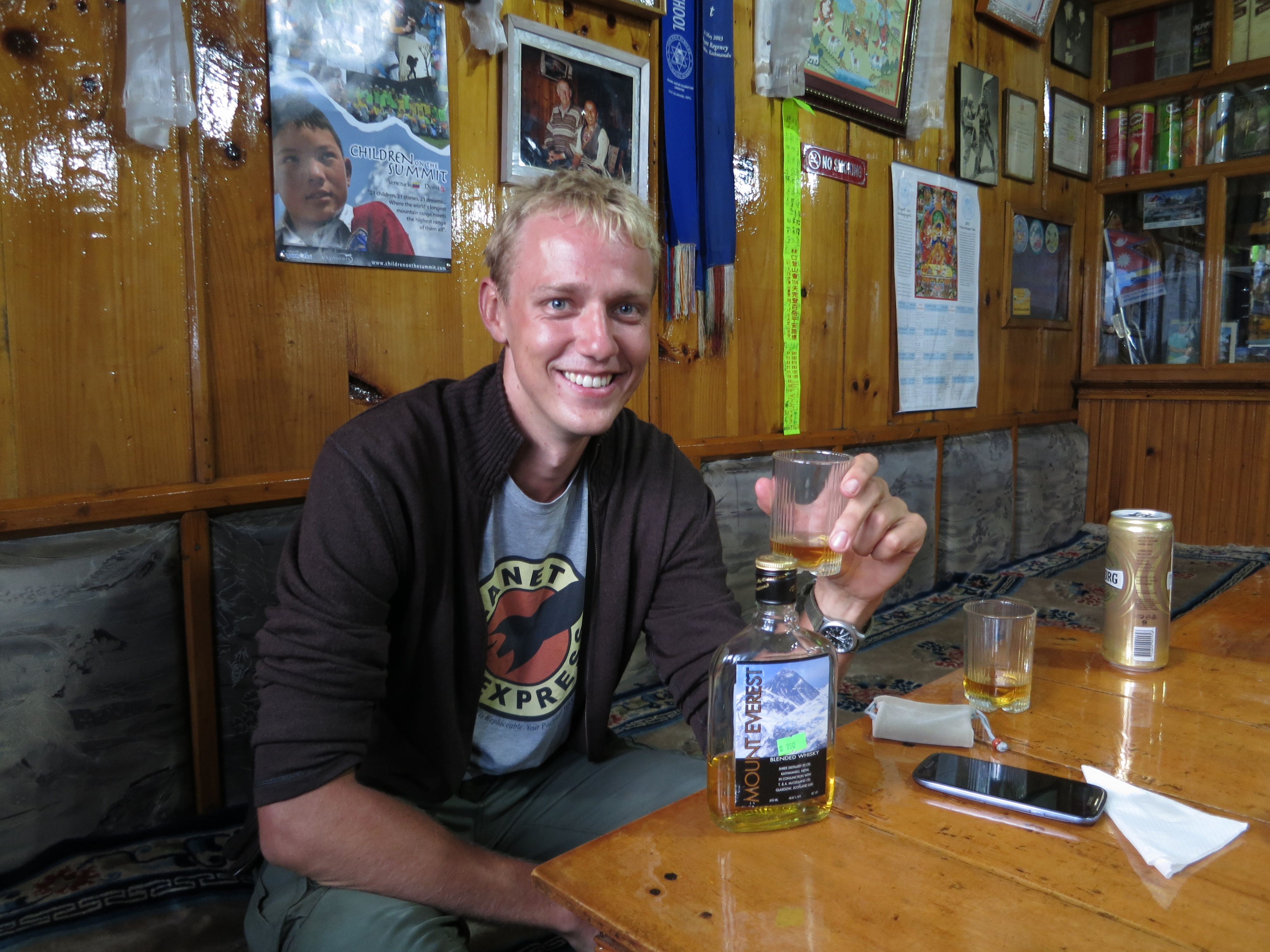
We enjoyed a final night in Lukla – taking the opportunity to try the Everest-brand scotch we’d been seeing all through our trek, enjoying both the scotch (meh, I’ve had worse scotches) and some welcome beers with our guides and with Kiwi Steve, who’d made it back to Lukla at the same time.  And taking no chances, we asked Jay Ram to organise for us to try for a flight out one day in advance of the original plan.  And thus we ended our time in the Himalayas and made it back to Kathmandu.

A well-earned Mount Everest scotch in the tea-house in our final night in Lukla

A well-earned Mount Everest scotch in the tea-house in our final night in Lukla

Job done.  Trek over.  Achievement unlocked.

Trekking the Himalayas, part 4 – Gorak Shep and Everest Base Camp

In case you’re late to the party on this series, have some friendly links to posts one, two and three.

We awoke on day ten of our trek in Gorak Shep, bright and early (at 4.15am!) for a pre-dawn excursion to see the sunrise.  Admittedly we required a little help – our guide Jay Ram had to come rouse us, knocking politely on our door after we apparently slept through the appointed time.  Whoops!  Seems that easy day the day before had really taken it out of us…

This, though, was to be the trek’s big day:  a sunrise view of Everest, and, the achievement of our nominal destination, a visit to Everest Base Camp.

Like our slow slog up Gokyo Ri a few days earlier, this too was a difficult climb – although perhaps this time we were a little better acclimatised, and found it a touch less challenging.  Or perhaps we’d just got better with the practice.  Or, perhaps, we may have found inspiration in the silhouette of Everest, backlight by the rising sun.

Everest (just right of centre, the second-highest-looking peak from this perspective) at dawn

Everest (just right of centre, the second-highest-looking peak from this perspective) at dawn

Looking down the Khumbu Valley from Kala Patthar as the sun begins to hit the snowy peaks

… and it wasn’t just Everest. The view down the valley was just a little special as well.

We were climbing Kala Patthar, a 5600m minor summit next to, and a little under 500m above, Gorak Shep.  And still, it was tough – and cold.  Somewhat surprisingly, after we reached the peak and settled in to sit out the sunrise, it actually got colder as the arriving sunlight brought the wind.

But it would be silly to complain about trivial things like the minor chill.  Unlike our previous attempts at a glimpse of the world’s most famous mountain, there was no cloud to impede our view this time.  And atop Kala Patthar, we had the best seats for a truly stunning vista, watching the sun appear directly behind Everest itself, and slowly illuminate the valley as the light marched over Everest’s neighbours, Nuptse and Lhotse, as well.

Believe it or not, that’s Everest in the centre, looking for all the world like not the world’s tallest mountain.  Perspective is weird.

Believe it or not, that’s Everest in the centre, looking for all the world like not the world’s tallest mountain. Perspective is weird.

And after viewing the sunrise from the peak, we had a thoroughly entertaining trot back down towards Gorak Shep, cameras in hand, finding the perfect spot for just one more sun-rising-over-the-mountains photo as the sun arced through the sky towards the neighbouring peak of Lhotse (the world’s fourth-highest mountain).

The sun on the tip of Lhotse

The sun on the tip of Lhotse

After such a fantastic start to the morning, we returned happily for a satisfied breakfast and a change of tea houses (the new one had an actual honest-to-god sit-down shitter, glory of glories!).  We spent our breakfast counting the helicopters – three landed at Gorak Shep that morning, each landing, loading up with one or more people needing out, and then setting off again straight away, all the way back down to Kathmandu, for a total of four evacuees within a one-hour period, we were told.  Ouch.  (From memory, I think we heard that three were altitude sickness and one was a broken limb.  But buggered if I can be sure I’m remembering that right.)

With that reminder of how glad we were to have made it up in one piece and good health, we set off again for Base Camp.  Or rather, ‘Base Camps’, since there are actually two.

After a two-hour hike alongside and then on the glacier, we found our way to the original Base Camp – the one that Hillary used way back in 1953.  There’s not a lot there these days, except a marker and a tonne of banners left by various ‘expeditions’ – tour groups – whom I can only assume have found it necessary to have the rest of the world help celebrate their being one of the hundreds of people to have made it that week.  So that wasn’t particularly interesting – although the walk out from Gorak Shep certainly was, as we heard and then saw two impressive avalanches en route.

An avalanche next to the Khumbu Glacier, en route to Base Camp

An avalanche next to the Khumbu Glacier, en route to Base Camp

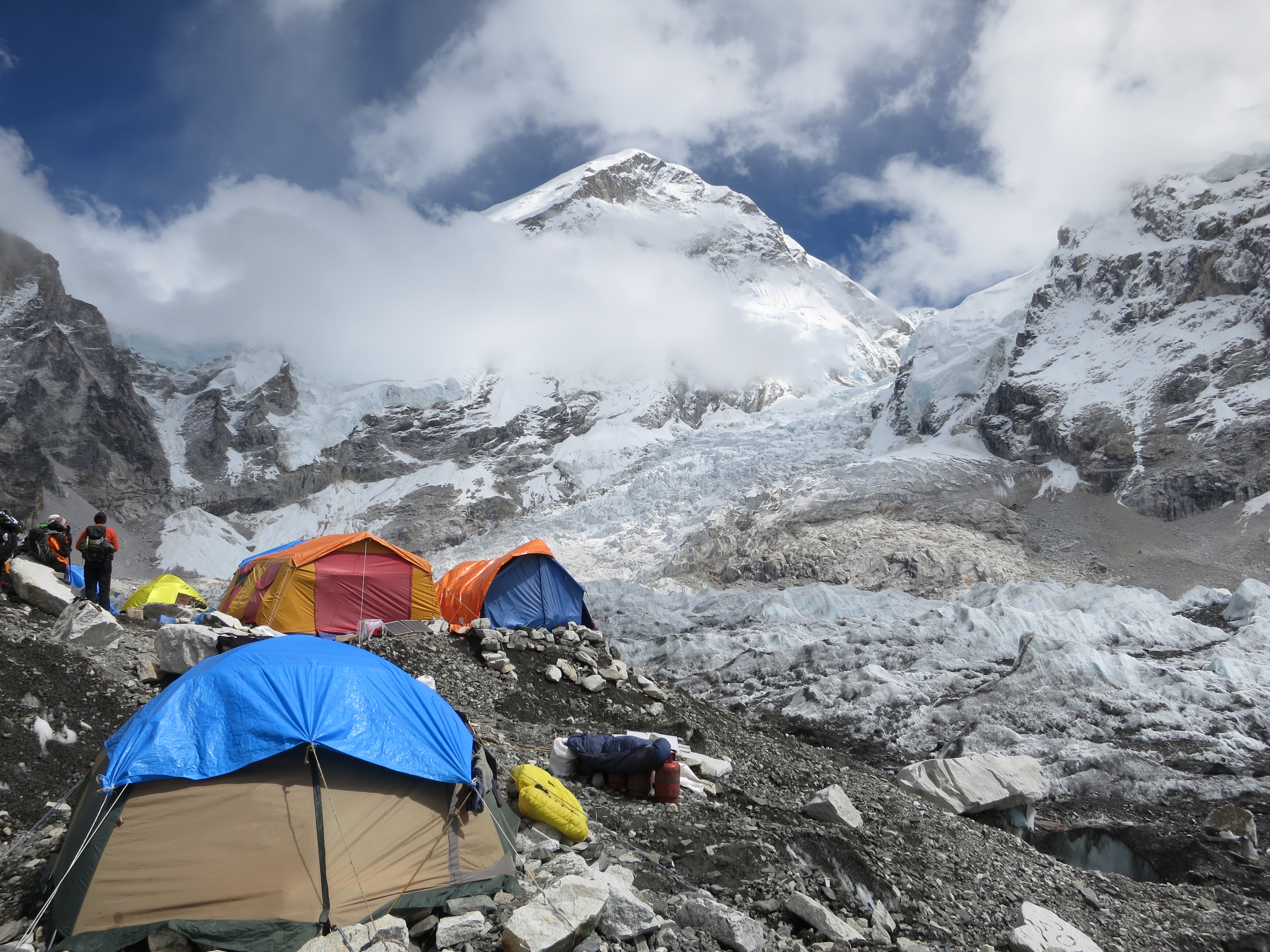
From Old Base Camp, it was another fifteen minutes up the glacier to the new one – the one used by current expeditions.  This one was much more interesting, full of tents for the solo expedition going up at this time of year.

Everest Base Camp

Everest Base Camp. Made it.

The first tent you come across is the funniest:  the shitter.  A stand-out blue thunderbox-shaped affair, you can pick it not only from its appearance, but from the large plastic drum lying behind it:  a spare, for when the one underneath it fills up.  Turns out that you can’t just do your business and leave it there, when you’re at that altitude – it’s too cold and too high, and it doesn’t break down.  So there are two locals employed fulltime to literally cart shit back down to Gorak Shep, where it won’t cause a problem.  (Next time you find yourself thinking that your job sucks…)

The thunderbox.  Everest-style.

The thunderbox. Everest-style.

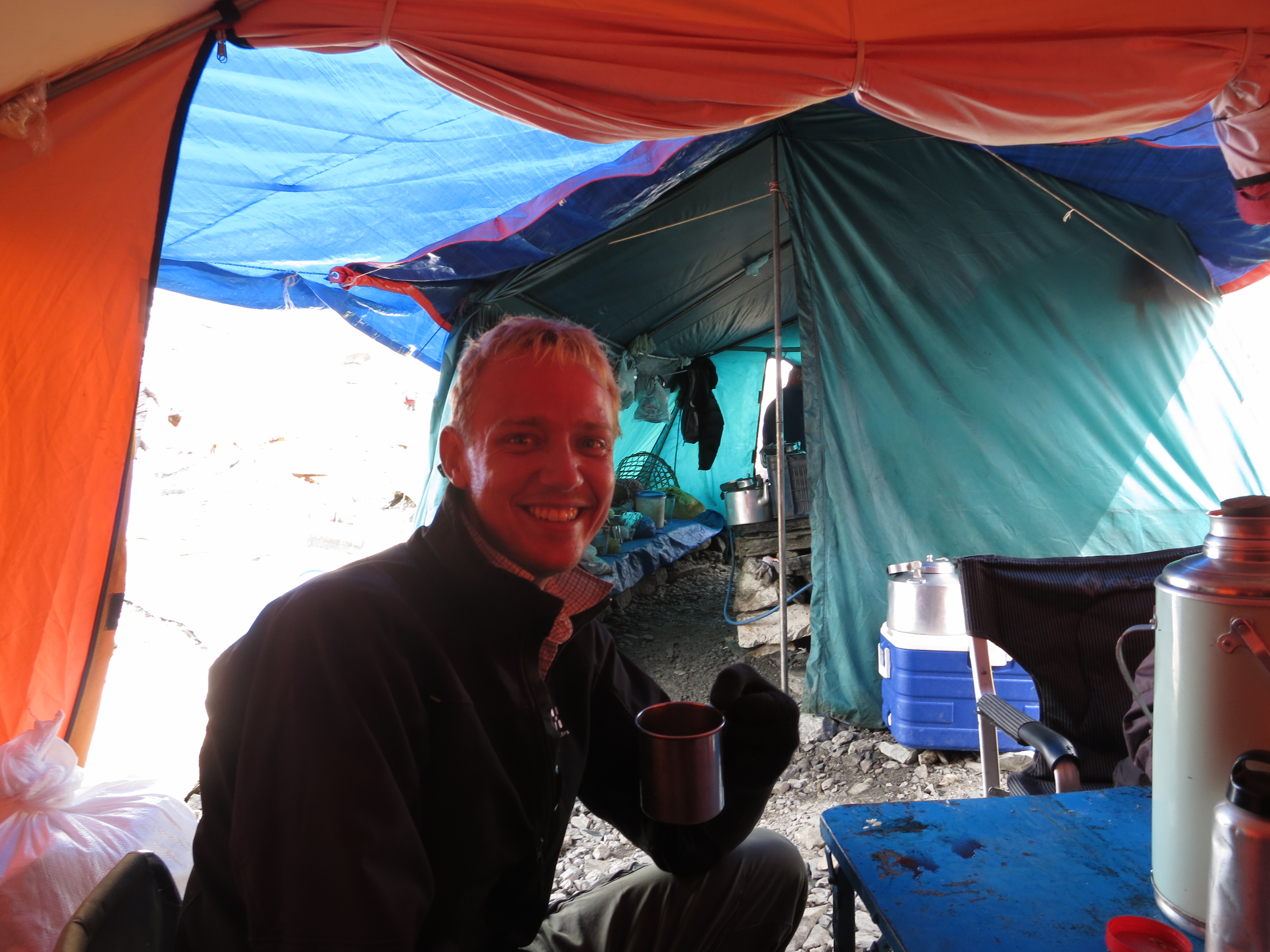
The rest of the tents don’t have nearly the same humour value, but are cool nonetheless.  Obviously, they’re mostly not really available to be poked around in:  after all, people are living in them.  But Jay Ram found a friend of his – a climbing guide – working with the current expedition, and so after we’d munched down our packed lunch, we got invited into the kitchen/dining tent for, of all things, a cup of hot Tang.  Jay Ram’s friend was having a quiet day before a planned ascent to Camp II the next day, and so happily sat and chatted away.  Most entertainingly, he showed us a video of the special remote controlled helicopter they use to scout conditions further up, before climbing.  Looks like a fun toy.  (No, they wouldn’t let us play with it!)

Enjoying a cup of hot Tang in the dining tent at Everest Base Camp

Enjoying a cup of hot Tang in the dining tent at Everest Base Camp. (Yes, the photo is blown out. It was bright outside, OK?)

And we got to observe the only expedition there at the time – a twenty-five-strong camp supporting one Japanese thirty-year-old (Kuriki Nobukazu) who would attempt the summit – sorting out their gear, and starting their preparations for the climb to Camp II.  This was October 1, by the way, and not the normal climbing season for Everest – that’s in April and May – hence no other expeditions.  He didn’t make it to the top, as it happens – although he did survive, unlike some other would-be summiteers earlier in the year.  His attempt on 17 October got him to 8000m, at which point a windstorm apparently knocked him off his feet and he decided it was a good idea to turn back.  Probably the right choice, given that even that left him with severe frostbite in all his fingers, in his toes, in his legs, and on his nose.

Tents at Everest Base Camp, in front of the glacier icefall between you and Camp II

Tents at Everest Base Camp, in front of the glacier icefall between you and Camp II

Anyway, we didn’t get any of those things, and after an appropriately satisfying final look around Base Camp, and up the intimidating face of ice that leads up away from it to glory, we wandered back to Gorak Shep for a second night.  It was a happy walk back.  We’d achieved our trek’s goal with plenty of time to spare (we were actually a day ahead of schedule at this point), and from here, it was basically downhill back down to Lukla.  Although not all the way:  since we had time to spare, Jay Ram suggested a diversion on the way home, via Chukkhung, for another sunrise climb before we headed out.

Another group of trekkers gathers for photos at the original Base Camp, as seen from the walk back from the current Base Camp

Another group of trekkers gathers for photos at the original Base Camp, as seen from the walk back from the current Base Camp

Trekking the Himalayas, part 3 – the Chola Pass and up the Khumbu Valley

If you haven’t been following along, here’s posts one and two of the series so far.

The Spaniards (see previous post) didn’t make it out of Tangnag that morning (day eight).  I’d heard them talking – loudly – through the night (tea houses in the Himalayas don’t exactly have the thickest walls, and these gents seemed to be that all-too-common type of traveller who’s incapable of adjusting the decibel level to match an environment that’s not their home country), and they hadn’t exactly sounded like they were enjoying their stay.  Nor, at 1am, did they sound much like they were enjoying each other’s company either.  They’d insisted the night before that it was just a cold, or some bad food, or something like that, but it seemed to us that they’d be in trouble if they didn’t improve and if it did turn out to be altitude sickness.  Getting out of Tangnag is like the stories your Dad tells you about walking to and from school when he was a boy:  uphill both ways, in the snow.

(Spoiler:  we saw the Spaniards again later in the trip – they made it just fine.  So I guess there isn’t really a moral to this story.  They rested up for that day and then, feeling a little better, crossed the Chola Pass the next.  A particularly stupid thing to have done, if you ask me, given the difficulty of the pass and the situation you’d find yourself in if something went wrong.  But they didn’t ask me, and that’s probably for the best, so I suppose we’ll just leave it at that…)

First light leaving Tangnag for the Chola Pass

First light leaving Tangnag for the Chola Pass

Anyway, the Spaniards missed the early morning, but we didn’t.  We were breakfasted and on the trail by 5.45am.  We knew to expect the Chola Pass to be the most difficult part of the trek, so we were anticipating a tough day.  And, y’know, being out and about already before six is nothing if not the start to an inevitably tough day.  Albeit that there is definitely something to be said for watching the sun spread across the mountains in the morning…

Approaching the Chola Pass from Tangnag in the early morning

The shadows of the mountains slowly recede in the early morning sun

The first task of the day was a short-ish but persistent uphill stretch up to a viewpoint across the glacier we were to cross to get to the pass.  The bleary-eyed pre-sunrise beginning to the day slowly but surely transformed into a clear bright sky with the sunlight slowly making its way across the dew-covered valleys.

We rewarded ourselves with a short break spent looking out across the glacier we were to cross, trying (unsuccessfully, for us followers, anyway) to discern our path over it.  We then spent the next hour or so picking our way carefully across the ice, along a trail that I had difficulty spotting even when it was pointed out to me, and which apparently changes almost weekly as the glacier moves and melts and refreezes.

The Chola Pass, looking a much easier and less daunting climb than it actually is

The Chola Pass, looking a much easier and less daunting climb than it actually is

Despite our healthily cautious progress across the glacier, the pass itself arrived quickly enough, and presented itself as an appropriately foreboding obstacle.  It’s a steep rocky slope covered in loose gravel and other debris, and I’ll happily admit that it was a reasonably tricky scramble up at times.  (Not helped, I’m afraid, by a digestive system that was uncomfortably growling its complaints at the distinct lack of fresh fruit and vegetables up in the hills.  Further details probably not required, except to say that I made an even greater effort to pick the more vegetable-heavy, and less stodgy, meal options from here onwards!)

Looking back the way we came, from the Chola Pass, as the sun makes its way across the valley

Looking back the way we came, from the Chola Pass, as the sun makes its way across the valley

Triumphantly, though, we made it to the top, two hours after our pre-dawn setting out.  And in addition to the ubiquitous prayer flags, we were also greeted by a fantastically picturesque view of the snow-covered glacier on the other side.  A view we were quite happy to contemplate for a good half hour or so, as we took another well-deserved rest.

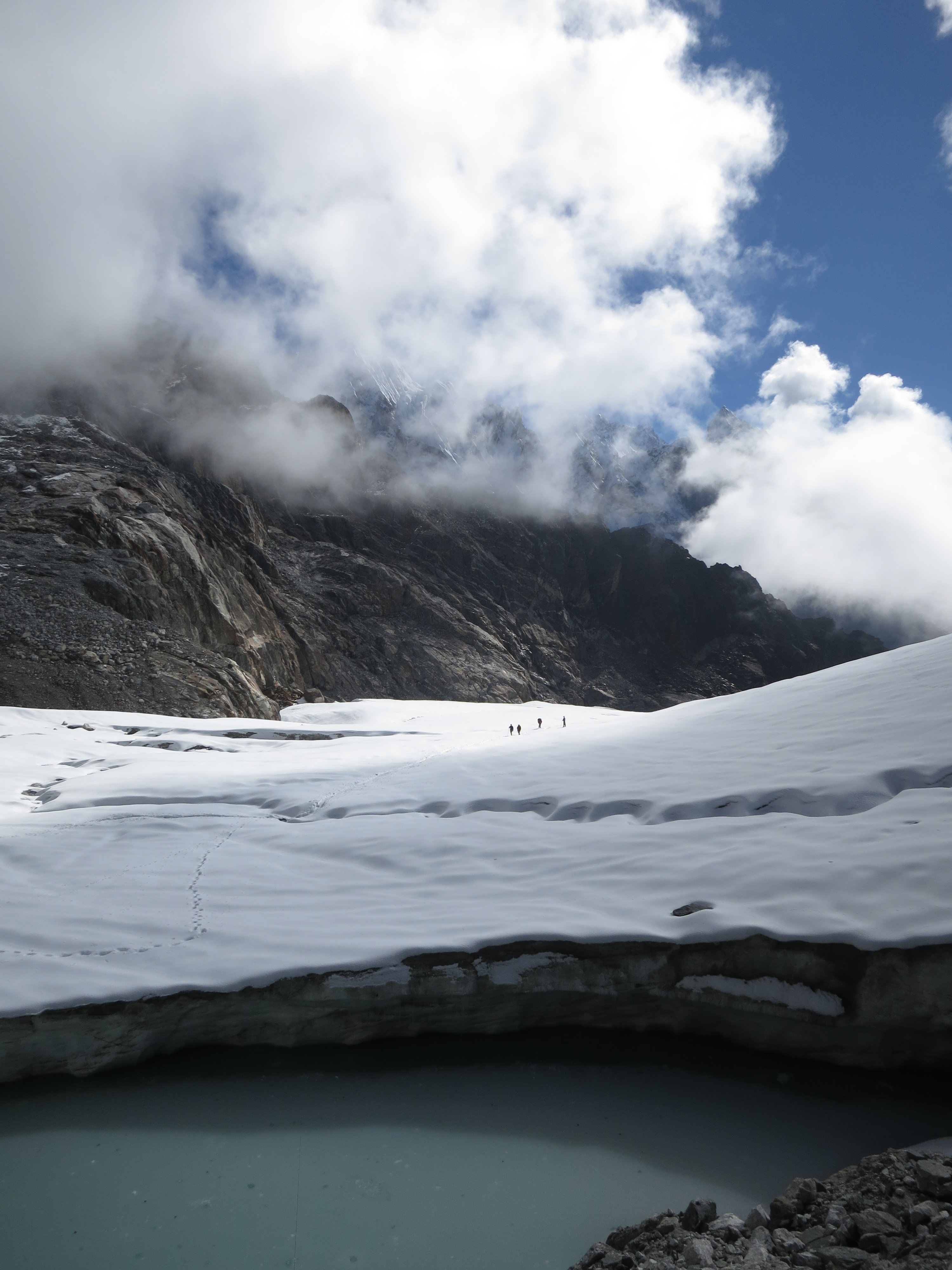
The snow-covered glacier on the other side of the Chola Pass

The snow-covered glacier on the other side of the Chola Pass

At this point, we could happily continue content in the knowledge that the rest of the day’s walking would be (a) gloriously scenic, and (b) wonderfully downhill.  Both of which made for a fantastic remainder of the morning, as we made our way at a relatively gentle pace towards our destination for the night, Dzonghla.  Crossing the snow (the only snow we’d actually directly come across over the whole trek) made for some amazing views, and we counted ourselves lucky that we had such fantastic weather for it – especially as the cloud started to set in later in the morning.  We didn’t envy the couple we encountered going the other way at 11am (five hours into our day’s walk, two hours into theirs), who would no doubt be scrambling around over the pass once the cloud had really set in in the early afternoon, probably not enjoying the limited visibility and the cold for their descent and subsequent trip across the glacier back to our starting point of Tangnag.

Crossing the snow-covered glacier after the Chola Pass

Crossing the snow-covered glacier after the Chola Pass

Finally, we arrived at Dzonghla bang on six hours after we’d set out in the morning, getting in shortly before noon.  Ready for lunch (vegetables!) and a nap.

Speaking of vegetables, I suppose I haven’t really commented on the food we were using to fuel our journey.  Food was definitely one of the aspects of the trek where I hadn’t really known what to expect.  Obviously, there are limits on the variety you can expect at altitude:  the remoteness means that you’re unlikely to enjoy a breakfast of mango and fresh yoghurt each day, and the height obviously has some pretty relevant effects on the actual cooking process too.  (What with water boiling at lower temperatures, etc.)  So we got pretty used to the regular consumption of a few recurrent themes.  Plenty of rice, for example.  (Vegetable fried rice was a popular option throughout our three weeks on high.)  And lots of potato.  (It’s one of the easiest staples for them to grow up in the mountains.)  A decent few brothy soups, on occasion.  A not-very-inventive range of ways of cooking what little non-potato vegetable matter was available.

Much to my distress, there was not much meat.  And, worse, you didn’t necessarily trust what there was, since, as we saw – and smelled;  oh god, the smell – on more than one occasion, it had almost invariably came up on someone’s back in the sun.  So I generally tried to make up for meatlessness by picking whatever on the menu looked likely to contain the most eggs.  Which was not especially difficult, it has to be said:  I clearly wasn’t the only person who’d cottoned on to the idea that maintaining a decent protein intake was probably a good idea.

But in fairness, I was actually quite impressed with the food.  And damn, did I gain a new appreciation for the wonders of a simple hot chocolate at the end of a good day’s walk.  Or a good ginger or cinnamon (aka masala) tea.

And if nothing else, it was hard not to be impressed by the price of the food.  Ours was all included in the package deal we’d bought – but even if it hadn’t been, we’re talking three to five dollars for a pretty filling meal.  And not only that, at most of the tea houses we stayed at overnight, the accommodation gets thrown in at a pretty heavy discount – sometimes free – so long as you’ve eaten dinner there.  So it’s hard not to call that a bargain.

The view of the valley that awaited us on the climb down after the Chola Pass

The view of the valley that awaited us on the climb down after the Chola Pass

Anyway, after appreciating yet another pretty decent meal, we spent the afternoon in the tea house at Dzonghla quietly, chatting to a motley assortment of other travellers.  We met a friendly Israeli woman who was doing her trek completely solo:  an impressive effort (although some points deducted given that a couple of hours after we’d crossed the Chola Pass, our guide Jay Ram had called out to her to point out that she was going the wrong way, following the glacier down into a relatively treacherous section, having not seen the path branch off above).  She seemed to be having a fantastic time in the mountains, just like us, and we were definitely taken by the idea of simply wandering up from Lukla by yourself with a tonne of time on your hands and with very little in the way of definite plans for your trek.  Apparently she was doing very well on her own, although she said she’d been a little humbled by the experience of getting to the Chola Pass in the morning:  she’d sensibly hired a porter from Tangnag just to show her the way across the glacier to the pass, and been a little surprised to discover come morning that her guide was a sixteen-year-old girl who not only showed her the way in a fairly spritely fashion, but carried her (comparatively heavy) pack as well.  We murmured that we’d seen that, too, and had been somewhat embarrassed by our own struggles across the terrain as she and her guide had bounced on ahead of us after an even earlier start!

After our new Israeli friend took her leave to get back to maintaining her incredibly detailed journal (which definitely put me to shame!), we met the table to our right:  a group which included one complete dipshit of an Australian who was happily boasting that he was sure he’d had a cerebral oedema (one of the more severe possible consequences of altitude sickness – an excess of fluid in the brain, which can be quite dangerous) a few days earlier in Gokyo, but had slept it off without taking any medical advice and continued on over the Chola Pass a day ahead of us.  Apparently, he was happy to explain to us at length, he was fine now and planning to proceed as though nothing had happened.  I presume he thought this made him sound cool, rather than, say, mentally deficient.  (He had a number of other … interesting … contributions to the conversation.  None of which seemed to stand up to more than two or three questions’ worth of scrutiny, in what can only be described as a complete shock to us all.)  We didn’t really talk much with the rest of his group:  partly because they mostly couldn’t get a word in edgewise, and partly because they seemed to be listening a little too intently to far too much of the crap coming out of his pie hole.

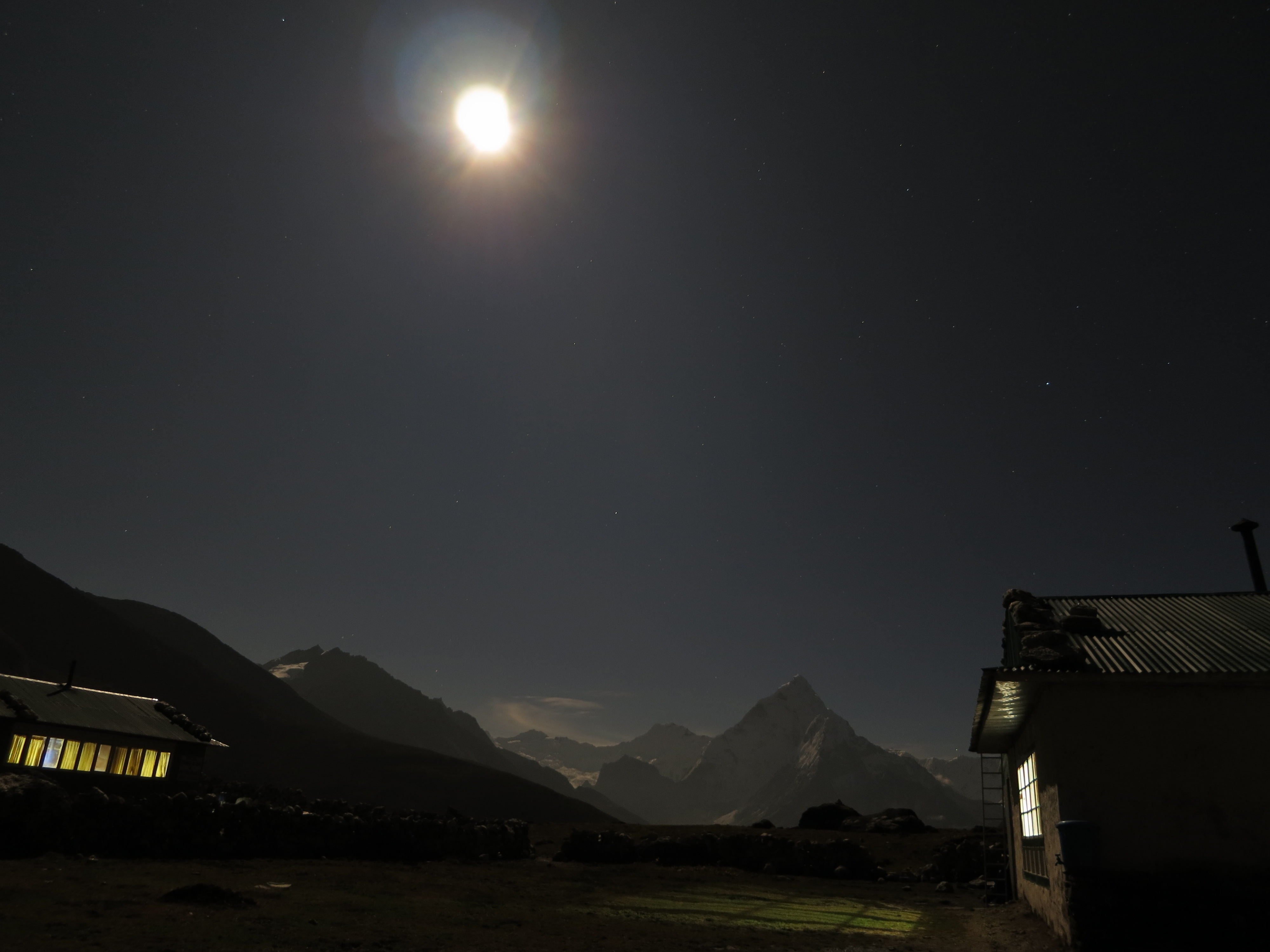
There was also another group whom we met that afternoon/evening, although only insofar as they wandered up to our table asking if we had any “medicine”.  When we suggested that we were travelling prepared with a few precautionary supplies, but that “medicine” was a fairly vague request and could they be more specific about what they were after?, they said that one of the guys in their group had a fever, but that they didn’t think it was because of the altitude, since a few of them had been (non-specifically) “sick” recently.  So, did we have any “medicine”?  Dipshit Australian – probably not the first person I’d have turned to for medical advice in any case, given his cerebral oedema grandstanding – made a big show of offering paracetamol, apparently under the impression that he was generously proposing something he really technically shouldn’t be, allowing the infinite goodness of his heart to overcome his otherwise full respect for the careful control of pharmaceutical substances in Nepal.  (Actually, you can buy pretty much anything over the counter at a pharmacy in Nepal, no questions asked.  I’d hardly be surprised if there were people up in the mountains with ‘just-in-case’ supplies of morphine.)  The questioner then offered that he didn’t know what paracetamol was, at which point Captain “My most recent medical decision was to keep doing more of the thing that gave me what I think was a particularly acute and dangerous condition, and hope it all went away” said that he wasn’t really supposed tell him in detail because he wasn’t a doctor, but, hint hint, it was there if it was wanted, and, hint hint, it might well help.  (It turned out our questioner didn’t know what Diamox was either – it’s the standard AMS medication which you should probably know a little about before heading to altitude – nor was he particularly sure what the symptoms of AMS were, although he was relatively confident his friend didn’t have it.)  We contributed that probably it wasn’t a great idea to take “medicine” that you’ve never heard of, and that paracetamol was not likely to help a “fever” anyway.  And maybe trying to find some actual medical advice from someone who actually knows what they’re talking about, perhaps in one of the clinics in several of the towns in the area, might be a good idea?  And then we went off to find someone else to talk to – unsuccessfully, as it happens, so we amused ourselves for the rest of the evening, taking long exposure night photos and generally bumming around…

The night sky in Dzonghla, with a beautiful misty mountain backdrop dimly illuminated by the moonlight

The night sky in Dzonghla, with a beautiful misty mountain backdrop dimly illuminated by the moonlight

We concluded that between the Spaniards, dipshit Australian, and the random “medicine” seekers, this, apparently, was the day for us to be reminded that while I’ll happily insist that travelling is actually really quite easy – remarkably moreso than a lot of people might expect – and requires much less planning than you might think, some basic preparatory knowledge and forethought generally doesn’t go astray.  Also to be reminded that there are a lot of idiots around, wherever you are in the world.

After an otherwise uneventful night, the next day – day nine – was finally time to head up to Gorak Shep, the town in the Khumbu Valley right before Everest Base Camp.  Compared to the previous day, this was a walk in the park.  Breakfast wasn’t until 7am, and we left at a leisurely 8.15, before stopping at 10.30 in Lobuche for lunch for a gentle hour and a half – the last half hour of it spent in pleasant conversation with the Israeli woman we’d met the previous afternoon.  After which we strolled the last two and a half hours up the valley to Gorak Shep, not particularly fazed any more by the steep up and down (more up than down!) towards as we approached our destination.

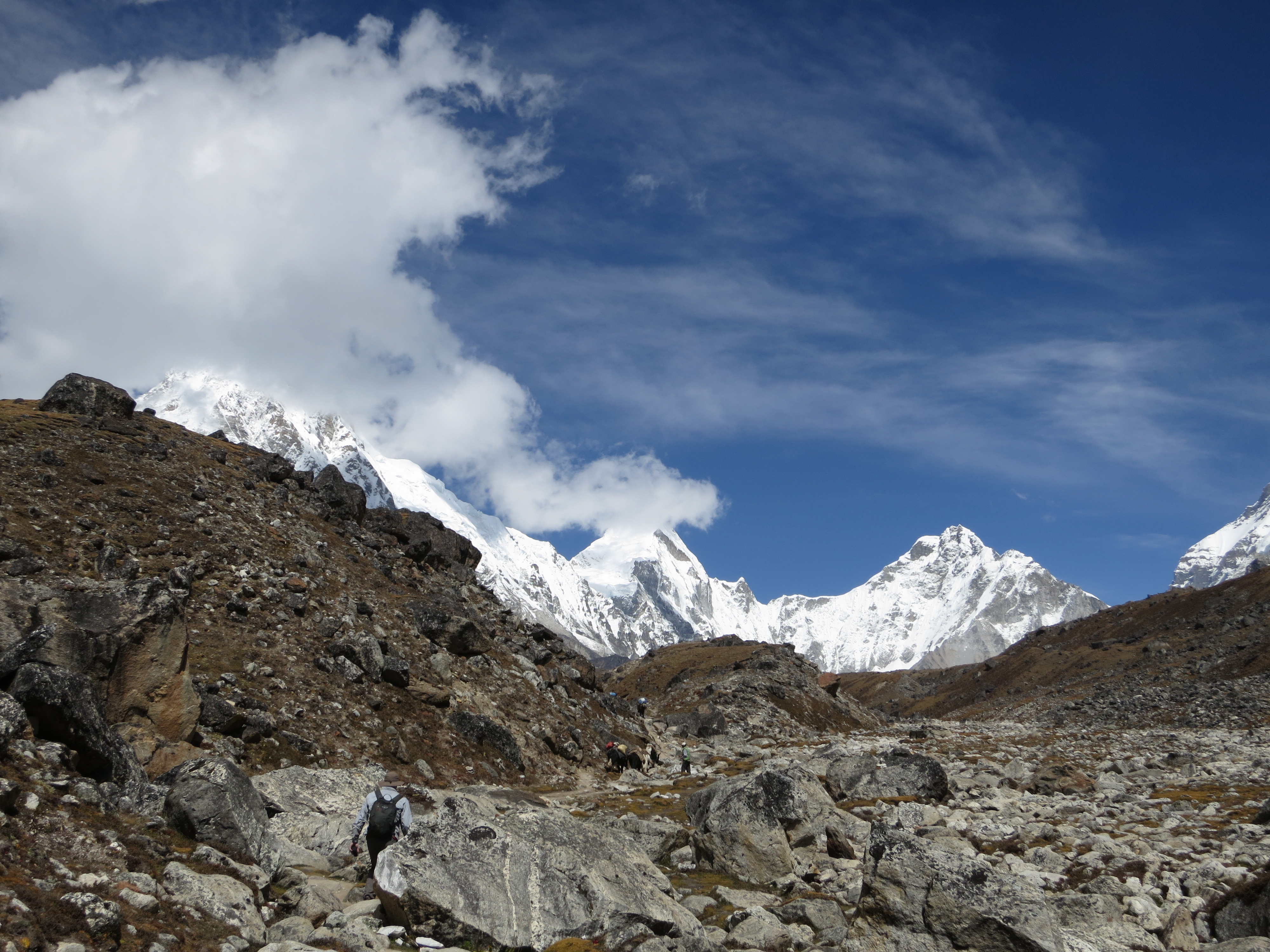
On the way to Gorak Shep

On the way to Gorak Shep

We had a lazy afternoon and evening – Chris having a nap, me reading, for fear of not being able to sleep at night if I closed my eyes this early.  And we popped out for an afternoon stroll to get a look at the Khumbu Glacier, which we’d be following up towards Base Camp shortly.

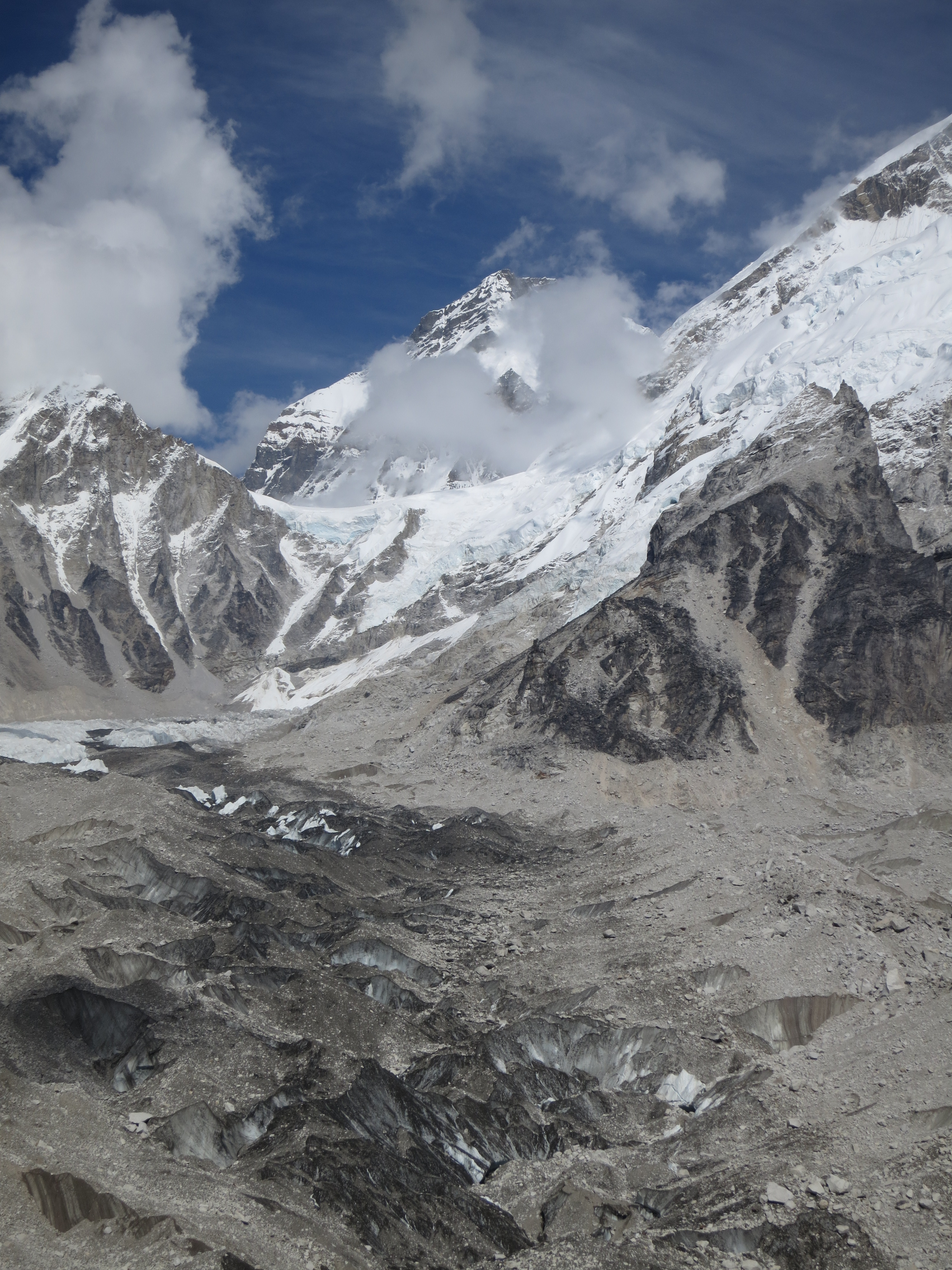
The Khumbu Glacier, leading to Everest Base Camp

The Khumbu Glacier, leading to Everest Base Camp

We relished our huge dinner, and then had a good laugh at my dessert:  it was a little more substantial than I expected, and it took me a while to make my way through an entire apple pie, having anticipated only a slice.  And then, bed.  Tomorrow was the big day…

Trekking the Himalayas, part 2 – the Gokyo Valley

If you haven’t seen it before, feel free to have a look at the first post in this series first.

There are a few different ways you can do a trek in the Himalayas.  The most common, I suppose, is a fully-organised group tour of ten to fifteen trekkers, a guide or so, and a liberal sprinkling of porters (often with yaks for some of the gear too), basically making a beeline from Lukla straight up the Khumbu Valley to Base Camp itself (Base Camp sits at the head of the valley, where the glacier comes down the mountain and flattens out somewhat into the valley).  Then you turn back around and head for home.  Typically, the round trip takes around thirteen or fourteen days.

We didn’t want to be part of a tour group:  we wanted to do it ourselves (with our own guide and porter).  Especially since this didn’t actually cost us any more than the big groups would have – in fact, it cost us substantially less than some of them.  We also didn’t want to budget only thirteen to fourteen days.  The quickest you can really safely get from Lukla to Base Camp and back without massively overexposing yourselves to the likelihood of altitude sickness is probably eleven or twelve days, if everything goes right.  With Lukla airport often closed for days (especially at the very beginning of the season in mid- to late September, when we were there), a delay of a few days could easily have meant missing Base Camp, and that hadn’t been high on our list of desirable outcomes.  So we’d allowed seventeen days up in the mountains.

All of which is by way of explaining that after our acclimatisation day in Namche Bazaar, rather than heading straight towards the ball of cloud which everyone insisted Everest was behind, we turned left instead.  Rather than heading straight for Base Camp, our plan for the extra ‘buffer’ days we’d luckily not spent waiting in Kathmandu airport was to take a bit of a detour on the way up:  heading up the Gokyo Valley, instead of going straight up the Khumbu Valley.
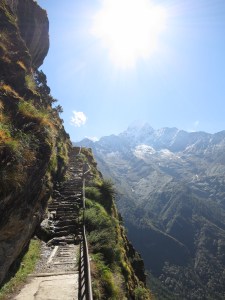
A beautiful morning's walk out of Namche Bazaar

A part of the trail shortly after Namche Bazaar, just before the path to the Gokyo Valley splits off from the main path up towards the Khumbu Valley.

The Gokyo Valley runs parallel to the Khumbu Valley, up to a town inventively named Gokyo.  Just next to Gokyo is a comparatively low peak (climbable without gear) inventively named Gokyo Ri, which you can wander up to get a view of Everest.  We were headed for that, although (as planned) it wouldn’t be til the third day out of Namche Bazaar (day six of the trek) that we got there.

In the meantime, day four’s target was Dole (pronounced ‘doll-eh’ – imagine a Canadian discovering a Barbie, and that’s probably about right).  At 4100m, Dole meant we’d be ascending over 600m for the day – more than the 400m you’d normally aim for, but after an acclimatisation day, probably not too much to worry about.  The 400m guideline is supposed to be an average, after all.  We headed out bright and early, chatting to, and overtaking, a number of other trekkers along the way.  Most others, as expected, were heading straight up the Khumbu Valley towards Base Camp – of those we spoke to in the first part of the day, we were the only ones heading off to the west first.  This was a source of great satisfaction when we got to the turnoff, which arrived after a sustained uphill climb of two to three hundred metres of altitude gain:  we continued on upwards, to the left, while the others we’d been chatting to were looking at a hefty descent all the way back down to cross the river, undoing all the good work they’d just done.  Gratifying.  Until we paused on the ridge at lunchtime, and spent our lunch break looking out over our next segment, which would have made a nice pleasant downhill ski run if only it had been covered in snow.  (And don’t forget, we were going to end the day up 600m on our previous night’s altitude, so after that downhill run, we’d have to be heading back up all over again to get to Dole.)

Still, overall, the day’s five and a half hour walk – past numerous pretty waterfalls and some beautiful valley views – wasn’t too tough, especially with our two hour lunch break in the middle.  I’m not sure whether the Snickers Pie I had for dessert made it easier (with the massive influx of sugar into the bloodstream) or harder (with the bloated heavy feeling that only deep-fried confectionary can contribute to an afternoon stroll).  Ditto Chris’s Mars Bar Roll.  But we enjoyed being on the trail, either way.

One of many path-side waterfalls on the way to Dole

One of many path-side waterfalls on the way to Dole

By this stage, we were confident that we were handling the altitude well – short of breath often on the uphill stretches, of course, but happily striding off ahead of the overburdened Jay Ram and Lal and feeling relatively spritely the majority of the day.  Good news.  We did start to notice the altitude in another way, though:  it was beginning to get noticeably colder, despite the brilliant sunshine we were enjoying.

The cold, of course, can be a bit of an issue up in the Himalayas.  Hardly a surprise to anyone, I’m sure.  But bear in mind there’s not an awful lot of fuel up there to run, say, a fancy central heating system.  Burning wood is frowned upon, too:  there’s not a lot to go around, and in any case, it’s not long until you pass above the tree line.  Petrol or gas is for the most part not feasible:  recall that it would have to be carried up by hand.  But thankfully, nature provides – specifically in yak form.  Well, in excrement form.  This evening’s warmth in the dining room, keeping us all nice and toasty, brought to you by yak shit.  Yes, that’s that heavy, musty aroma you can’t quite place of an evening.

Dole was the first time we saw it, I think:  locals spending their days out in the fields carefully laying out yak shit pies to dry in the sun, and re-harvesting them, once dried, for fuel.  Or, even more entertainingly, sticking their combustible brown pancakes to the stone walls instead of laying them in the fields.  It definitely makes for an interesting sight, and one we were to see pretty much every day thenceforth, until we returned to Namche near the trek’s end.  Thankfully Chris and I are mature individuals and didn’t immediately proceed to spend the rest of the afternoon making poo jokes.
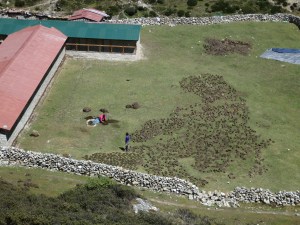
Poo-farming at altitude

“How’s the poo harvest comin’ along there, Ethel?” “Pretty good, Billy, pretty good. At this rate, we should be all full of shit come winter.”

… on which front, Dole was another first:  the first tea house (all our accommodation through the entire trek was in places they liked to call ‘tea houses’) with a squat toilet.  And not your fancy-pants sort that flushed, neither.

From Dole, we spent only two and a half hours on day five walking to Machermo.  Only a 250m altitude gain, given the magnitude of the previous day’s gain, and we were there by 11am.  This was the first day we got any inkling of being affected by altitude, though:  both of us had (very mild) intermittent headaches during the day.  Once we’d downed lunch at our destination, however, an afternoon nap helped, and after that we went to a reassuring information session on acute mountain sickness (AMS, aka altitude sickness) at Machermo Porter Rescue Post.  This was not because of our headaches – they were so mild as to be not worth worrying about at all – but the clinic is a regular stop for everyone passing through, to make sure that everyone knows what to look out for.  And an afternoon well spent, too.  The volunteers (all Brits – two doctors, a third-year med intern, and the husband of one of the doctors) gave us all the information we could want, and we chatted away with them for quite a while afterwards, asking questions, swapping stories, and telling jokes.  (The most amusing contribution, from the doctors:  if you want to make a local laugh, ask if you can have some ‘yak cheese’.  In Nepalese, as in Tibetan – from which the word originates – ‘yak’ refers only to the male animal.  The female is a ‘nak’.)

Apparently more people suffer from AMS than I would have guessed:  the clinic had already had a couple of people helicoptered out in the previous week – and bear in mind that this is at the very start of the season, and on the less popular route to Base Camp.  Also bear in mind that being medivac’d by chopper entails a bill of roughly $10,000 (one which not all insurance policies will cover!).

The Machermo area does see a bit more AMS than elsewhere, though, once you adjust the comparison for the lower number of trekkers coming through.  Apparently the doctors nickname it ‘Death Valley’, since once you get to Machermo, you’re in a bit of a dip, meaning that to walk out, you have to go up first, no matter what direction you head.  AMS is an interesting sickness:  it’s quite debilitating, but so long as you can drop down one or two hundred metres of altitude, you’ll generally improve quite rapidly.  From Machermo, though, that’s not an option, without going up on your way out, which is liable to make you much, much worse.

After we eventually left the clinic, there wasn’t much else to the day.  After Dole’s dual firsts, Machermo was the first tea house with such limited electricity (all solar powered) that they flicked off all the lights shortly after dinner.  (It was alright – we’d expected it and planned ahead, charging up every single battery we had with us to full charge in Namche.  Recharging batteries is possible farther into the Himalayas, but it’s very slow, substantially more expensive – although let’s face it, this is Nepal, so we’re not talking about burning a hole in your pocket – and substantially less reliable.)  But the early darkness was OK:  with uninterrupted quality sleep that much more difficult at altitude, we were happy to give ourselves plenty of time to rest up again overnight.
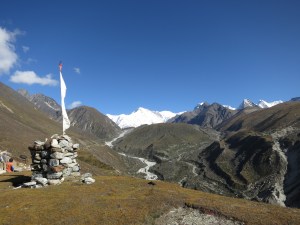
On the way to Gokyo, just out of Machermo

An early highlight from a beautiful day of trekking up the Gokyo Valley

The next day, day six, looked pretty easy.  All we had to do was a short hike up to Gokyo, a little farther up valley.  As you proceed up towards the glacier, you pass a series of beautiful lakes.  First Lake, Second Lake, Third Lake, and beside that is Gokyo.  And we were there before 11am, complete with a couple of other trekkers in tow:  two Spaniards we’d run into once or twice before, and who had been quite happy to discover that our guide, Jay Ram, speaks Spanish.  (In what can only be described as a brilliant piece of planning, they’d managed to get themselves a guide who spoke no Spanish, and they spoke effectively no English.  Also, I’m calling them ‘Spaniards’ even though they identified themselves as ‘Basques’.  That’s because they were annoying, and I am a petty individual.)
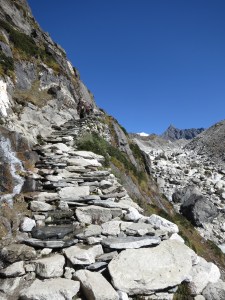
… also on the way to Gokyo …

… also on the way to Gokyo …

Anyway, there by 11am.  Lunch well earned, and another day under the belt having reached our destination with the whole afternoon to spare.
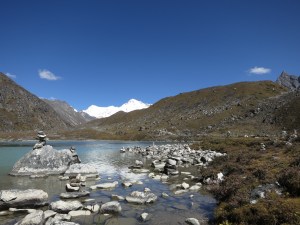
First Lake, in the Gokyo Valley, en route to Gokyo

… still on the way to Gokyo (it was a pretty picturesque day!): First Lake.
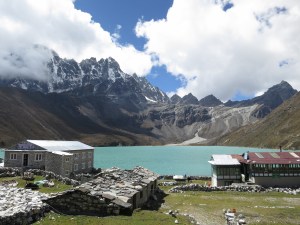
Gokyo, next to Third Lake

… and there. Gokyo.

That afternoon was not to be wasted on anything so obvious as rest, though.  Shortly after lunch, we left our packs behind and hiked another two hours up the valley – past Fourth Lake, and out towards Fifth Lake, adding a good chunk of extra kilometres to the day’s tally.  The hike was demanding but rewarding, but what we were really hoping for was a view of Everest from by the shores of Fifth Lake.  Apparently the vista can be quite stunning.  Alas, it was not to be:  Everest was again shrouded in cloud, and so all our neck-craning along the path was in vain.  Quite an effort it was, too:  by Fifth Lake, we were up to an altitude of about 5000m, and for the first time the physical demands of climbing the uphill sections in low oxygen were really starting to wear on us, and the cold was starting to get to us a little on the return route.  But we returned with a sense of satisfaction – we might not have seen the view we’d hoped for, but we’d still achieved something in the walk itself.
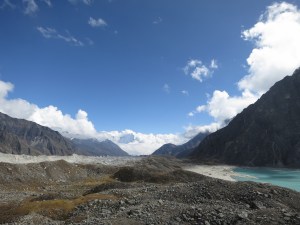
Hiking out past Fourth Lake, as we watched the cloud begin to roll up the valley

Hiking out past Fourth Lake, as we watched the cloud begin to roll up the valley

We also returned with a sense of tiredness.  Once back in the comfort and warmth of the dining room, with a much-appreciated cup of hot chocolate in hand, I remember struggling somewhat to stay awake through some of the conversations we had with other trekkers.  Which I mean in no way as a reflection on the conversational abilities of, say, Kiwi Steve (as I quickly began to insist on calling him), whom we met for the first time here.  We did manage to get through enough largely mutually intelligible conversation to establish that our newfound friend from across the ditch was (a) quite entertaining, and (b) going to be travelling through south-east Asia at roughly the same time as us, so we made sure to get an email address and a URL for his blog, so that (once we returned to the world of internet access) we could pore over his posts about the first couple of days of the trek, and then watch avidly as he failed utterly to produce more than two posts over the next several months.  (No, I’m not actually making fun of him for this.  How could I, given that his first posts about the Himalayas beat mine up to the internets by a good four months?  Besides, Steve’s a Kiwi – there are already plenty of things to make fun of him for without resorting to blog-bashing!)

But beyond that, our day’s activity had us tired enough to hit the hay by 7.30pm, in anticipation of a 4.30am start in the morning to climb Gokyo Ri for the view at sunrise.  Hopefully Everest wouldn’t be covered in cloud this time!

We did manage to make it up at 4.15am, I’m proud to say.  But it was a shortlived achievement:  Jay Ram knocked on the door five minutes later to tell us that who knew whether Everest was covered in cloud, but Gokyo Ri definitely was, so it wasn’t worth getting out of bed for yet.  So instead, we started off at 8.20am, finding ourselves at the top – at our highest altitude yet, at 5360m – at 10am.  After a fairly brutal, very steep, and very slow walk.  Which in fact meant that had we set out at 4.30, we wouldn’t have made it to the peak by sunrise anyway.  Still, once we’d reached the Nepalese prayer flags marking the top, we had a fantastic view of the puffy white cloud surrounding Mt Everest.  Again.  Oh well.  Nevertheless, the rest of the view was stunning, and easily worth the considerable effort.
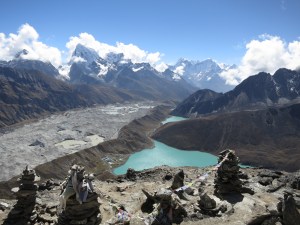
Looking down the Gokyo Valley, over Gokyo and Third Lake and the Gokyo Glacier and beyond, from the summit of Gokyo Ri

Looking down the Gokyo Valley, over Gokyo and Third Lake and the Gokyo Glacier and beyond, from the summit of Gokyo Ri

By the time we got back down, it was lunchtime.  As we fed ourselves, some news filtered through via the locals and guides:  there’d been a plane crash that morning;  one of the planes ferrying Sherpas and tourists from Kathmandu to Lukla hadn’t made it more than a few minutes out of Kathmandu airport.  Everyone died.

Lunch was a little quiet, and full of sober reflection.

After that, though, we were on the move again.  This time, across the Gokyo Glacier to Tangnag, where we had a relaxed afternoon shooting the breeze with Kiwi Steve, before an early bed.  We’d need our rest, so that on day eight we could attack probably the hardest part of the trip:  the Chola Pass to cross from the Gokyo Valley into the Khumbu Valley.  Then we’d turn towards Base Camp.

Thankfully we got our rest without too much trouble.  By this stage the Spaniards – who’d hurried up to Gokyo after being delayed getting into Lukla – were looking somewhat the worse for wear, with headaches and a fever and a fairly generous dollop of general malaise.  They’d need their rest too, but they didn’t get it.

Trekking the Himalayas, part 1 – Lukla to Namche Bazaar

We were lucky.  Tenzing-Hillary Airport, Lukla, is notorious not only as one of the most dangerous airports in the world, but also one of the most fickle.  No-instruments landings at a difficult airport in prop planes (or, as I prefer to call them, rubber band planes) means that the slightest hint of cloud on the approach is enough to make the airport too dangerous, and it will close.  It had been closed for the two days before we were due to fly up, so when we got to Kathmandu airport, there were a lot of grumpy-looking faces preparing to spend their third day waiting for a ride up.  (Those grumpy faces included the clients of one of our guide’s friends.)  But our 6am start, thankfully, was not in vain.  We made it up on the third flight.  (Which, it turned out, was the last flight for the day.  Afternoon clouds roll in pretty regularly to fill the valleys up in the Himalayas, and they closed the airport as soon as our plane had completely its incredibly hurried turn-around and raced off again.  Many of those who’d been waiting for two days had to wait another before they finally made it up on what should have been day four of their treks.)

Tenzing-Hillary Airport, Lukla, closed

The cloud set in just after we arrived, closing the airport as soon as the plane that had delivered us had hurriedly picked up its next load and buggered off

We didn’t crash on the way up, either.  And that statement’s not as flippant as it might sound:  seven days later, one of those flights did crash, killing all nineteen on board – although as it happens that was nothing to do with Lukla;  the plane hit a bird minutes after take-off from Kathmandu and crashed trying to make it back to base.  On average, though, about one KTM-LUA or LUA-KTM flight has had some sort of crash per year since 2004, with about half of those involving fatalities.

So our trek was starting well:  we were up in the mountains safe and sound, and we hadn’t even needed to use any of the buffer time we’d built in to our planned schedule in case of bad weather.  Having made it to 2860m the easy way, now the walking could begin.  Only about 2500m of vertical elevation to go to Base Camp…  But of course, once we started walking, we weren’t heading up at all – for a trek up into the highest mountain range on Earth, there seemed to be an awful lot of downhill.

The view from our lunch stop

The view from our lunch stop. (The valley in the centre is where the planes to Lukla fly up.)

Still, we were beginning our first leg of the trek:  the easy leg.  From Lukla, we were to spend days one and two making our way to Namche Bazaar – the biggest town up in the mountains, and focal point of a weekly Saturday market, from which (this being Sunday) we saw many people and beasts of burden returning.  And that would be it for this leg – after those two days getting to Namche, we’d then have a rest day to acclimatise to the altitude before setting off for the Gokyo Valley.

That’s exactly how it worked out, and, best of all, it was as easy as that sounded.  The thing about hiking the Himalayas on the way up is that so long as you have a pretty basic level of fitness (so long as you haven’t developed a well-founded fear of stairs, for example) you’re not at all limited by the distance you can walk over the course of one day, or by tiredness, or anything like that.  You’re limited by the fact that on average, you don’t want to exceed 400m of elevation gain per day, to reduce the likelihood of altitude sickness.  So actually these first few days set a pretty cruisy pace.

Day one – from Lukla to Phakding – only involved about two to two and a half hours of walking.  Our guide Jay Ram set a fast pace, which we appreciated.  I presume he was testing us out to see how we’d deal with the altitude, and whether we could actually follow through on our confident bravado, or whether we were full of crap and would tire at the first little slope.  Thankfully, I think we passed.  (Although in fairness, I should admit that my efforts, at least, were somewhat wind-assisted.  The beans in the previous night’s vegetable moussaka, combined with the low atmospheric pressure at altitude, meant that I was not doing a lot of good things to the sweet mountain air!)

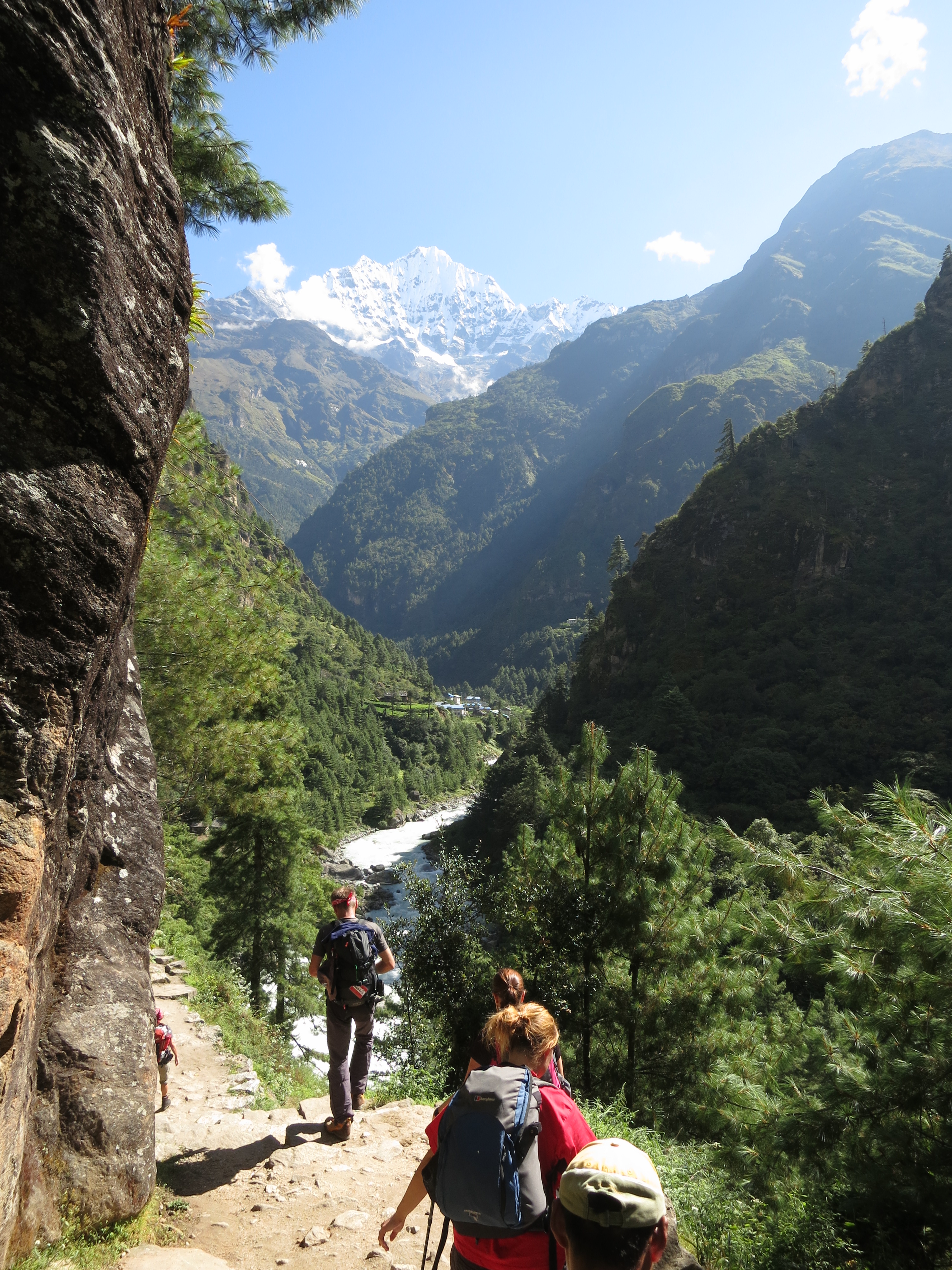
Anyway, day one was a rousing success.  Our introduction to the trek was pleasant – much like a pretty afternoon hike pretty much anywhere in the world.  The Buddhist prayer flags decorating the wire footbridges over some of the valleys hinted that we were not walking just anywhere.  And we knew that the water rushing beneath those bridges had made its way only a very short distance from its source – and our destination – in the glaciers of the Khumbu and Gokyo Valleys.  So obviously it wasn’t just a pretty afternoon hike just anywhere.  But as much as it was exciting to know that we were starting – and as much as it’s hard to express in words just how stunning the mountainous backdrop was – it was a relief to finally experience the beginning of the walk and discover that it, so long as this kept up, it wasn’t going to be beyond us.

All that said, though the day’s walk had been short, after little sleep the night before, we were pretty happy with the opportunity for an afternoon nap once we’d settled into our room at around 2.30pm.  After which we were forced to face the inevitable dilemma head on:  what are two computer geeks to do with the rest of the day if the walks are short, and there’s no laptop and no internet?  (Thank god for my Kindle!  I’d bought the Game of Thrones series shortly before heading up to altitude.  That’d keep me plenty busy.)

On the trail on day two

On the trail on day two

Day two – from Phakding to Namche Bazaar – was closer to what would turn out to be our average:  a couple of hours walking in the morning, followed by an early lunch (10.30am!  who eats lunch at 10.30am?  most of the time I haven’t even got as far as breakfast by then!), with another two to three hours walking in the afternoon.  Still nothing too strenuous in terms of time or distance, although there were a few steep uphills and downhills – especially just after our mid-morning feed.  By this stage, we were pretty confident that we were doing OK, and we discovered, much to our delight, that Jay Ram didn’t seem to mind if we forged on ahead, so long as we paused and waited at any fork in the path, or any small village we might be supposed to stop at.  This was then the point at which Jay Ram started pointing out his shorter legs as an excuse.  This is now the point at which I should point out that he was carrying a chunk of our stuff, and we were carrying just day packs.

Speaking of which, I decided at lunch time that I wanted to try carrying the porter’s load.  Lal was carrying my main backpack, plus his own and Jay Ram’s packs (all quite ingeniously tied together into one big load, with a knotty concoction that would have made a sailor justifiably proud), while Jay Ram was carrying Chris’s main backpack.  Lal’s load looked heavy, and we’d been particularly impressed when he’d practically sprinted off ahead of us on the first day before lunch.  So from our lunch spot, at the beginning of some town we were passing through, I loaded up and we walked onwards with me carrying Lal’s load, and Lal practically skipping along grinning holding just my daypack.

We got some very strange looks from the locals as we wandered through town.  General agreement was that it was all quite hilarious, and Lal in particular seemed to be enjoying some especially amused and amusing conversations with friends he passed on the way.  But much to my dismay, Jay Ram made me swap back after only about five to ten minutes.  I presume he wanted to avoid the possibility that the next day I ended up exhausted and starting to come down with altitude sickness, which is entirely fair, if also somewhat fun-killing.  Or maybe he was worried I might not be quite as sure-footed with the extra load, and might slip on the unfamiliar paths and injure myself.  Or maybe he just thought it made him and Lal look bad.  Whatever the reason, unfortunately I didn’t get to find out whether I could make the whole afternoon carrying a porter’s cargo.

Me temporarily carrying Lal’s burden on day two

Sam Roberton, porter: me temporarily carrying Lal’s burden on day two

I was pleased, though, to discover that not only could I lift it in the first place, I didn’t actually find it that heavy.  Inconvenient and unwieldy, yes – mostly because it has a high centre of gravity, especially when perched atop my gangly legs.  But I was relieved to conclude that actually I didn’t need to feel absolutely terrible about the amount of stuff I’d brought:  Lal wasn’t going to die under the load after all.  (That said, for all my gushing bluster in my epic pack-carrying abilities, I am actually glad I didn’t have to carry it the whole way myself.  We met a guy from Oregon en route, and he was on his eighth day of trekking, having walked up from Jiri, rather than flying up to Lukla.  He was doing it solo – no guide, no porter – and carrying all the stuff he had for a six-month backpacking trip in Nepal and India.  Bravo to him – it was impressive work.  But Jesus.  He looked absolutely rooted!)

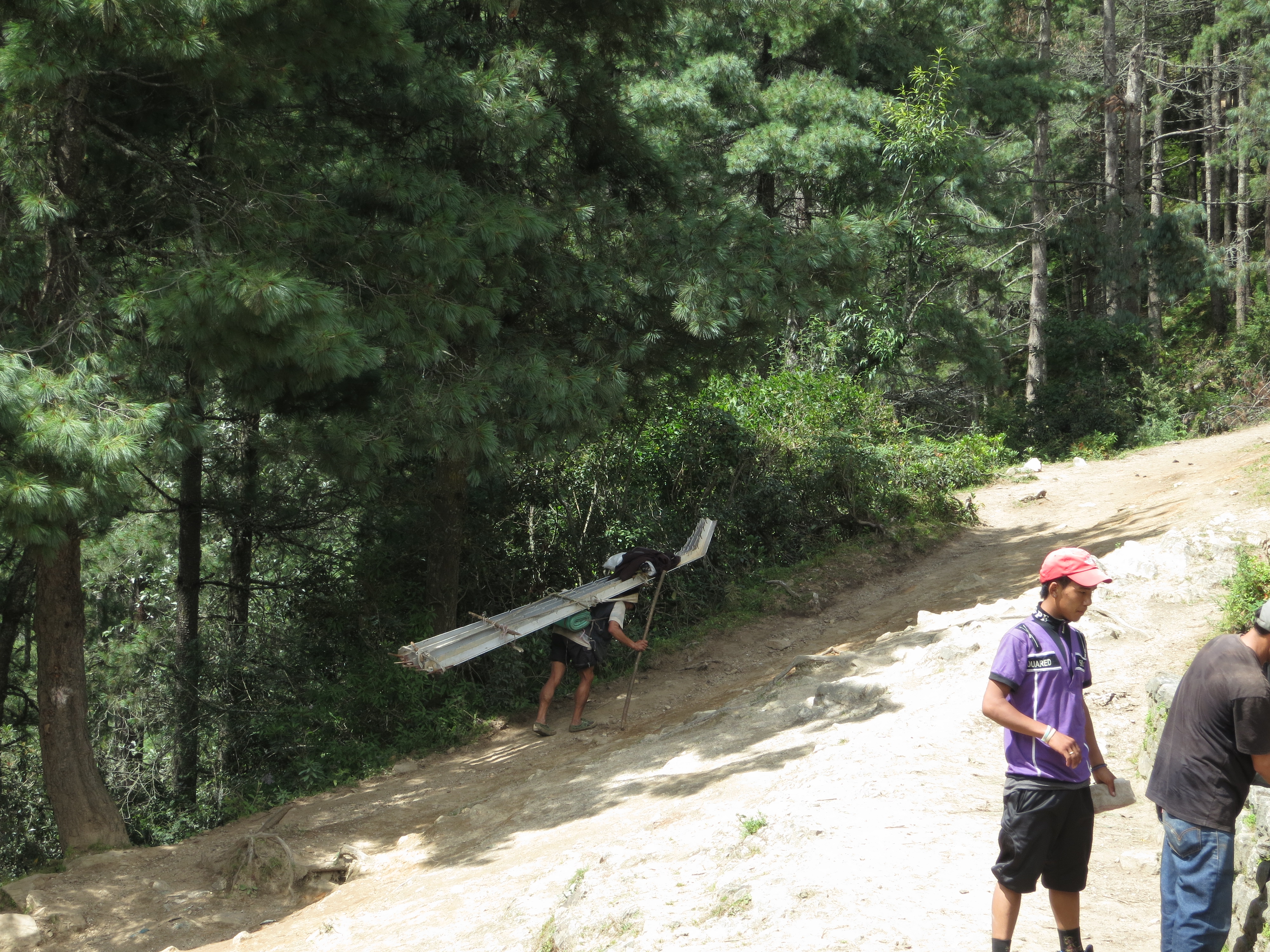
This, meanwhile, in stark contrast to the loads some other porters were carrying.  With no local airport higher than Lukla, pretty much everything from there onwards has to be carried up by a person, a buffalo, or a yak.  (Although interestingly, the yaks are no good until you get to higher altitudes.  We joked about that being a reverse altitude sickness, but my guess is that their thick fur coats are just too oppressively hot in the thicker air.)  And actually, it’s mostly by people.  After a day or so of seeing some frankly awe-inspiring loads being hauled up by some remarkably wiry Sherpas, we quickly learned to appreciate that every time we spotted a fridge or washing machine or concrete mixer up in the mountains, odds are on it came up on someone’s back.  Talking to Jay Ram and Lal, we found out that while porters on expeditions such as ours are paid a flat rate, and only supposed to carry up to 30kg, porters ferrying goods have no such limit and are paid by weight.  Apparently it’s not uncommon for the little human nuggets to be trundling up the hill with 120kg of stuff.  Ludicrous as that sounds (especially bearing in mind that that’ll be at least twice their bodyweight – these are not big guys), I can believe it:  there were a lot of Sherpas we overtook – and, ridiculously, a lot who overtook us – carrying five or six cartons of beer, or similar amounts of bottled water, and that was typically not all of their cargo.

A Sherpa porter carriers building supplies up in to the mountains

This guy (centre) is carrying up building supplies. Seriously, that does not look like a pleasant task. I hope at the end he gets to relax with a beer from some of the many cartons the guy not too far ahead of him (but not pictured) is carrying!

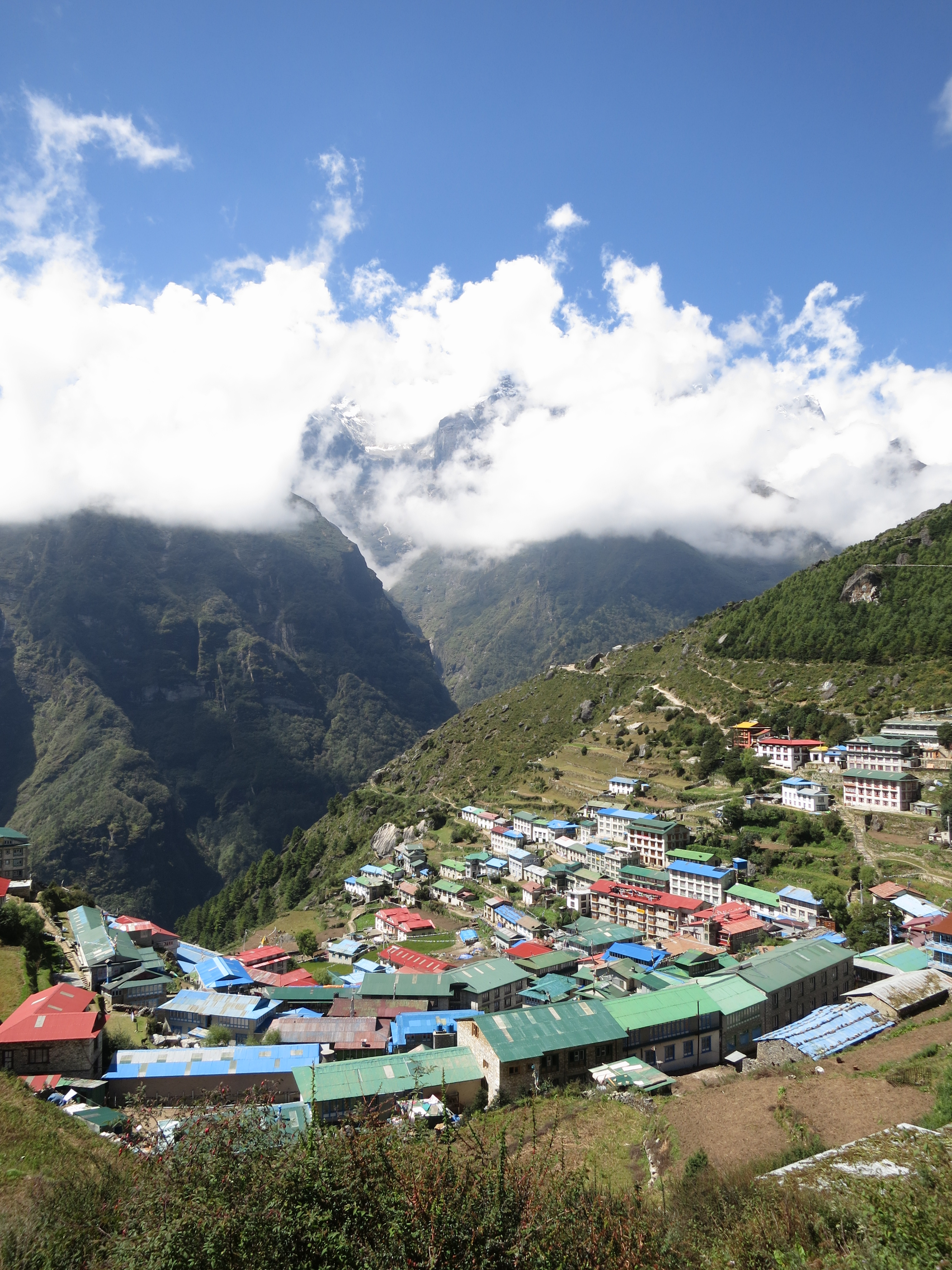
So anyway, as planned, we arrived at the destination most of those porters had been heading for on day two:  Namche Bazaar.

Namche Bazaar

Namche Bazaar

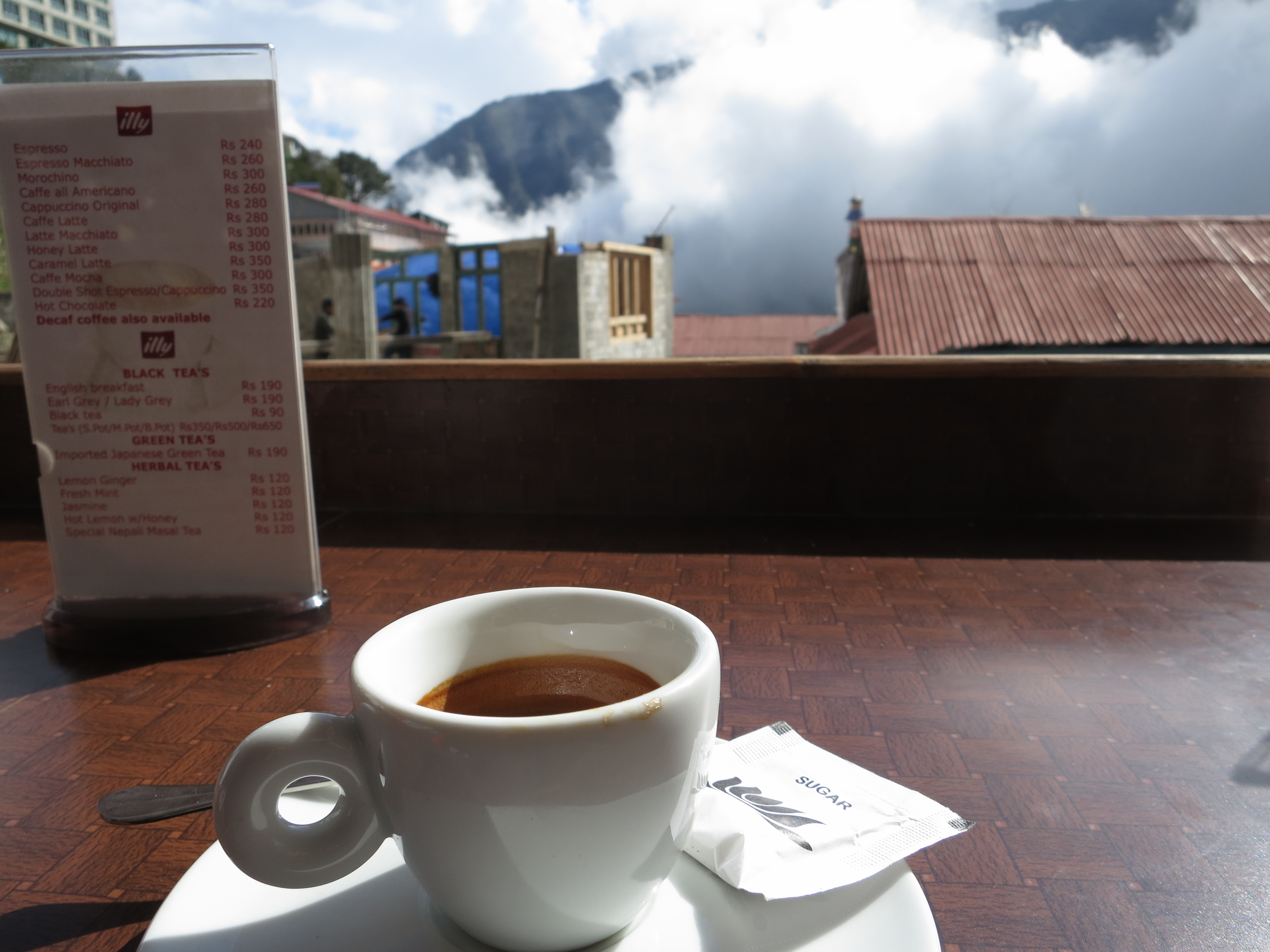
By now we were at 3443m above sea level.  And across the street from our accommodation was an Illy-branded coffee shop.  Nice.  We happily sat and watched the afternoon’s cloud roll in.  One espresso:  240 Rs (Nepalese Rupees), or about $AU2.60.  A beer, for that matter:  550 Rs for a 500mL San Miguel.  Which by my calculations, at about $AU6.10, makes half a litre of beer cheaper in a coffee shop in a remote Himalayan village, to which it’s been carried on some poor bastard’s back, than in a number of bars in my hometown of Adelaide.  They also had the internet, which was obviously a god-send for us poor deprived computer nerds.  (Actually, in all seriousness, it was quite useful:  when we got to Namche, Jay Ram told us that he’d just heard from other guides that there’d been an avalanche in another area of Nepal, killing seven and with eleven missing and another seven airlifted out.  The café’s internet access was a welcome way to let those back home that it hadn’t been near us, and that we were fine.)

Probably the most remote Illy coffee I’ve ever enjoyed.  It was actually pretty good, too.

Probably the most remote Illy coffee I’ve ever enjoyed. It was actually pretty good, too.

Our acclimatisation day in Namche was marked as a ‘rest’ day in our itinerary, but was actually relatively busy.  First up, we headed up the hill for our very first view of Mt Everest.  Or at least, our very first view of the cloud that covered Mt Everest.

See the vaguely mountain-shaped cloud on the left?  Yeah, Mt Everest is in there.

See the vaguely mountain-shaped cloud on the left? Yeah, Mt Everest is in there.

But at least the climb up to the viewpoint felt Everest-y:  for the first time, we started to really feel the altitude.  Not when wandering around, or during the day in general – that was all fine.  But walking up a fairly straightforward hill suddenly takes a lot more huffing and puffing than it seems like it should, and leaves your legs slightly wobblier than they should be.  It’s kinda like having woken up in the morning suddenly twenty kilos fatter, I imagine:  your heart racing, and your lungs working overtime even despite a pretty relaxed pace.

After our not-view of Everest, we strolled through the Sherpa museum and a few other attractions and photo galleries up near the viewpoint.  We read newspaper clippings about the guy who climbed Everest and then paraglided off the top and then another who skied back down;  about a Sherpa who set the speed record for climbing from Base Camp to the summit – 10h56m (that was the record in 2003, anyway:  it’s since been broken several times);  about the youngest summiteer (a Sherpa girl 15 years 9 months old);  about Hillary’s ascent;  etc.  All inspiring stuff.  (Well, most of it inspiring.  Some of it is just nuts.  Seriously, who thinks that skiing down Mt Everest is a good idea?!  How the hell do you even make it up to the top if you have leg muscles big – and therefore heavy – enough to cope with skiing for three hours at that altitude on the way back down?  And how do you stop your giant brass balls from getting caught up between your skis on the descent?)

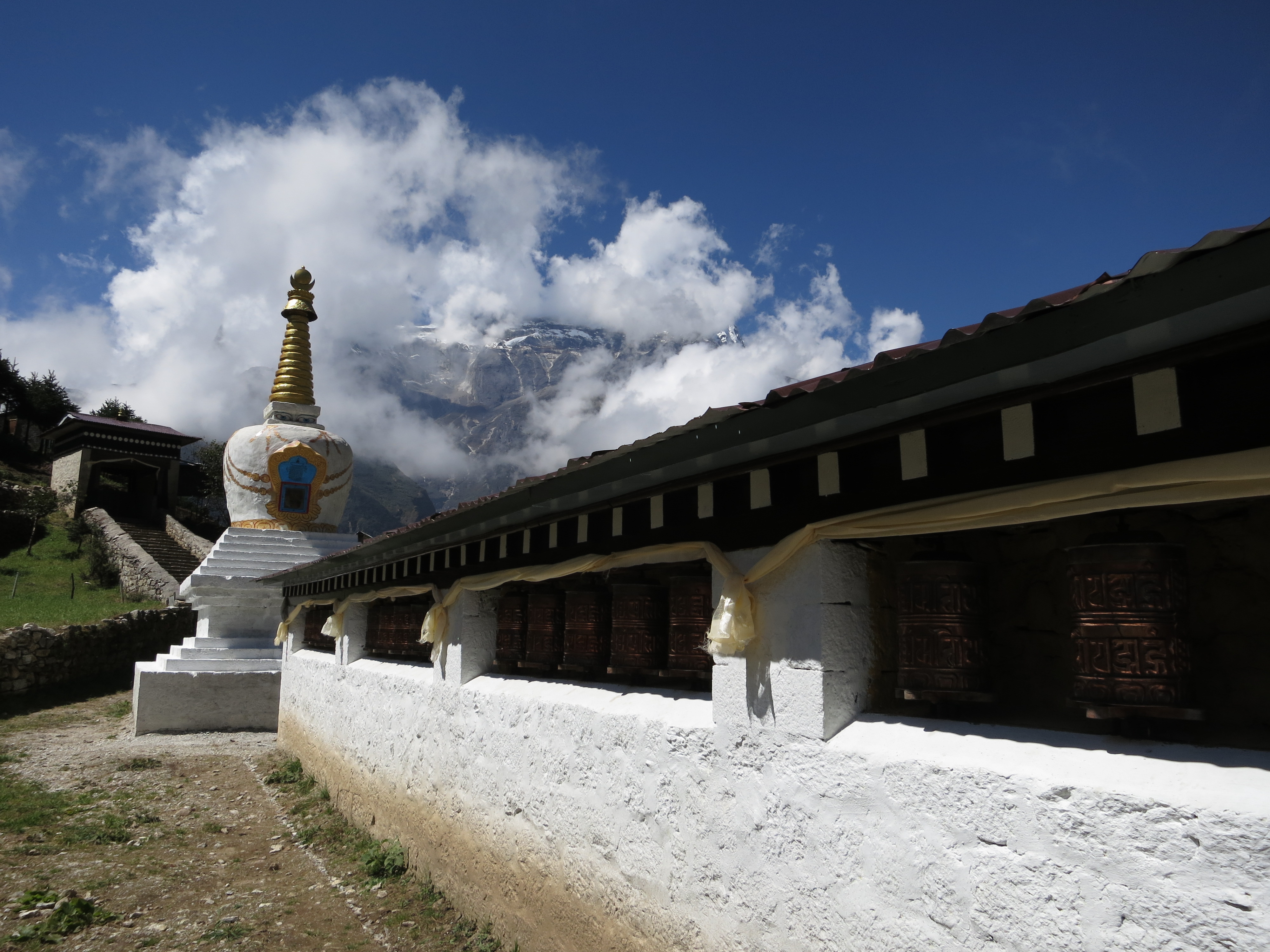
Prayer wheels by the Sherpa Museum at Namche Bazaar

Prayer wheels by the Sherpa Museum at Namche Bazaar

And after marvelling at the museum, we visited the local monastery, to be equally fascinated at some of the stuff we read there:  like the two days per year where the monks do nothing but read aloud certain holy books, the two-week long reading of certain others every five years, and the yearly ritual involving two days of no eating, no drinking (even water), no talking, and no swallowing saliva.

With those activities done for the day, all that remained was to find the local post office (yes, there is one) and send off some postcards.  For the princely sum of 50 Rs (about $AU0.55) postage per postcard.  (And yes, they made it back to Australia.)  Then, time to rest up for tomorrow’s hike off towards the Gokyo Valley…

Kathmandu

Arriving in Kathmandu was the beginning of perhaps the most anticipated part of our round-the-world trip:  the start of a 22-day stay in Nepal to go trekking in the Himalayas, up to Everest Base Camp and back.

Before flying up to the mountains, we had two days in Kathmandu to see some of the city, to meet our tour organiser Kumar, guide Jay Ram and porter Lal, and to rent and buy whatever extra gear we’d need on our trek.  That extra gear was substantial, by the way:  buggered if I was going to carry a down jacket, down sleeping bag, full set of thermals, waterproof trousers, thick gloves, etc., around in my backpack as we chase summer around the world, just so that I’d have them in Nepal.  (I totally didn’t need the down jacket, either, just by the way.  Jay Ram made me hire one, but I would have been totally fine without it.  Why wouldn’t you believe, me, Jay Ram?  Why?!  I’m a big boy, I should be allowed to make my own decisions, dammit!  And I was totally right and Jay Ram was totally wrong.  So there.  Nyah.  Ahem, moving on…)  So a decent chunk of those first two days was shopping.  Thankfully, that shopping was easy and cheap.  It turns out, would you believe, that there are a remarkably large number of shops selling remarkably cheap gear with The North Face logos plastered haphazardly all over.  It’s almost like they’re not all entirely legit.    (The funniest ones are the shops with gear where you can pick the gear you want and then pick which of their stock of brand-name labels you want sewn onto it.  “Get yer genuine <insert brand name label> gear here!”)

But while there’s tonnes of counterfeit crap everywhere, and that’s just an accepted part of shopping in Kathmandu, there are a couple of decent places around.  Based on some prior internet research Chris had done, we headed to a place called Shona’s, and after chatting and joking a while with the owners, we grabbed all our stuff there.  They had about as much fake stuff as everywhere else, but at they’d tell you what was genuine and what wasn’t, and they gave us good advice – including what stuff we needed to be good, and what stuff we could get away with going with crappy knock-offs for.  For anyone else heading through Kathmandu and needing to grab gear, the GPS in my camera tells me that Shona’s is located at 27°42’49.8”N, 85°18’44.4”E.  The storefront looks like this:

Shona's Alpine in Thamel -- a very helpful trekking gear shop

Shop here. You’re welcome.

But our time in Kathmandu wasn’t all bargain hunting.  We did get to observe the chaos of the city, with its more-pothole-than-road mainly-dirt thoroughfares, its electricity network that looks remarkably like it was wired by either monkeys or spiders (or quite possibly by a troop of monkeys who were simultaneously fighting a complex rearguard action in defence against a swarm of spiders), and its beautiful temples and pagodas.

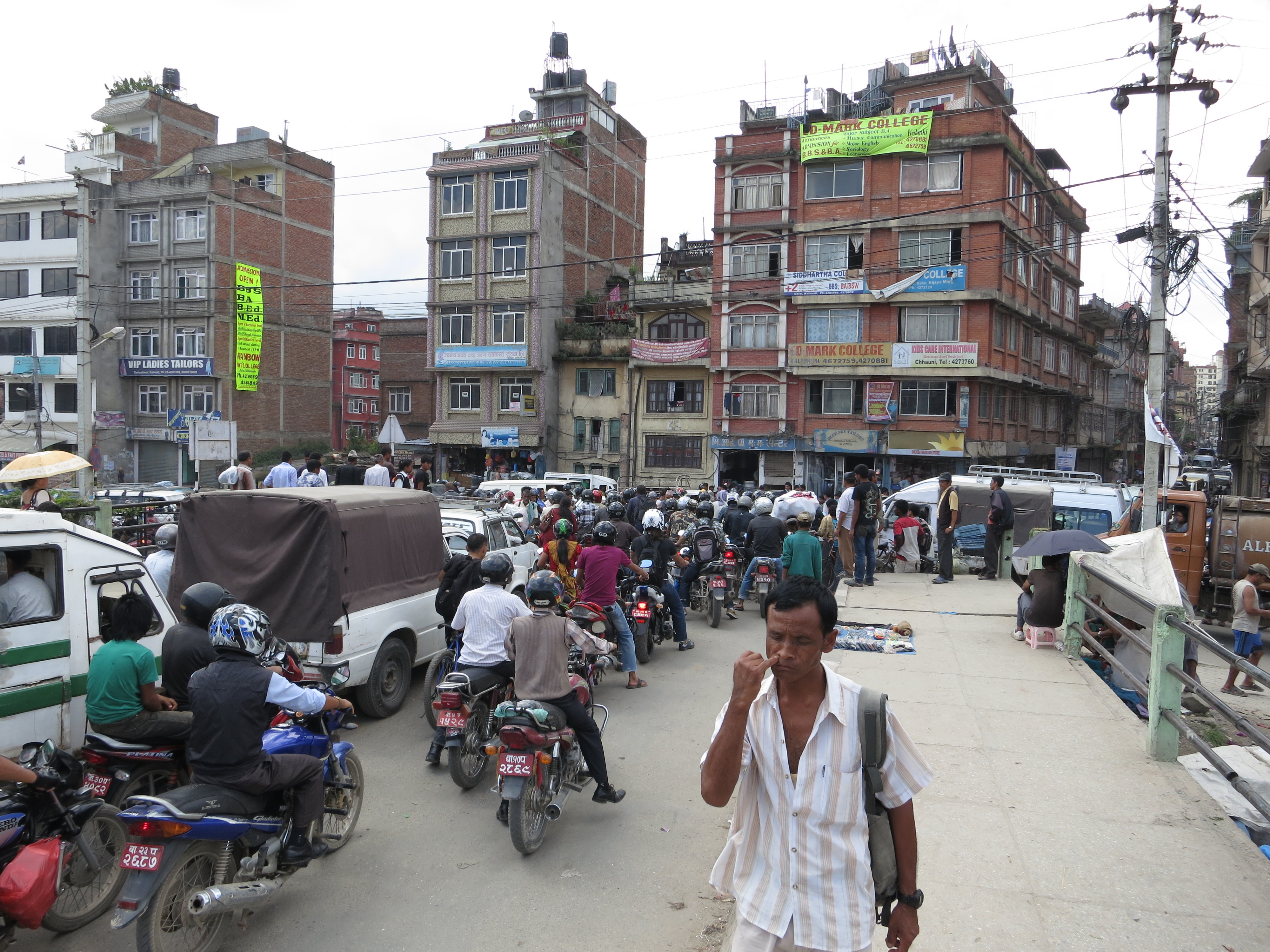
A regular traffic intersection in Kathmandu.  Complete with local dude nonchalantly picking his nose.

A regular traffic intersection in Kathmandu. The word you’re looking for is ‘clusterfuck’. Added bonus: local dude nonchalantly picking his nose in the foreground.

The streets of Thamel at night – chaotic wiring above, chaotic traffic below

The streets of Thamel at night – chaotic wiring above, chaotic traffic below

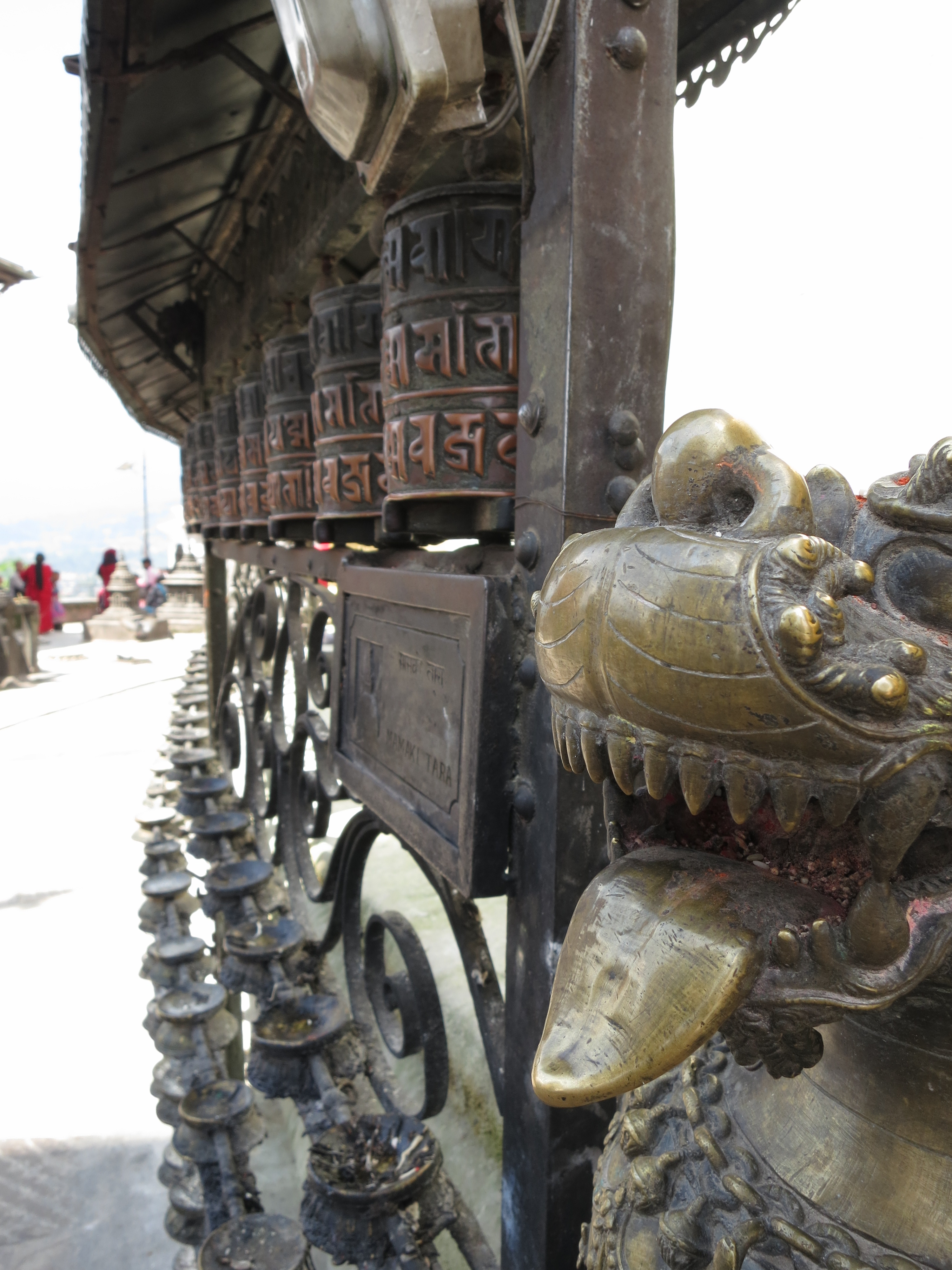
Prayer wheels (left) flanked by bronze lion-headed dragons (right) at Harati Devi Temple

Prayer wheels (left) flanked by bronze lion-headed dragons (right) at Harati Devi Temple

Mostly, though, our first two days in Kathmandu were spent holding our breath, hoping that the weather would be OK for our flight up to Tenzing-Hillary Airport, Lukla, to start our trek.  Oh, and there may have been a bit of a mad rush to pack and repack our bags to take up only what we thought we’d need in the mountains (and, y’know, to try not to overburden our porter with ridiculous amounts of unnecessary crap – only moderate amounts of unnecessary crap in these bags, thanks very much!).  We were finally done packing and made it to bed at 1am.  You’d think we’d be better at travel preparations than that by now, but apparently you’d be wrong.

Anyway, breath held, fingers crossed, prayer wheels rotating, we waited to see if the weather gods would smile on us in the morning.

An interlude in Hong Kong

One thing about travelling to a lot of places in a small-ish amount of time (and yes, much to the chagrin of many friends, I do consider the one year round-the-world trip I’m doing at the moment to be ‘a small-ish amount of time’ for travel):  it’s difficult sometimes to give every single destination the full attention it deserves.  And so it was with Hong Kong.  It got enough attention that I really enjoyed the four days we had there, but I have to admit we didn’t do much that was blog-worthy.

Hong Kong Central, seen from Victoria Peak on Hong Kong Island as the sun begins to set and the city starts to light up

Hong Kong Central, seen from Victoria Peak on Hong Kong Island as the sun begins to set and the city starts to light up

We shopped – me for a replacement daypack, and Chris for a new camera (the Sony RX100, which is a fantastic point-and-shoot, for anyone in the market for a new toy).  And we did make the effort to get in a handful of the more obvious tourist attractions:  the giant Tian Tan Buddha at Ngong Ping, on Lantau Island;  Tai O fishing village (also on Lantau Island);  the world’s longest escalator (back in town);  and Victoria Peak, for a panoramic view of the main part of Hong Kong.  But mostly we were making sure we were ready for our upcoming three weeks in Nepal, trekking in the Himalayas.

Eateries in 'Rat Alley' (properly known as 'Wing Wah Lane'), in Hong Kong Central

Eateries in ‘Rat Alley’ (properly known as ‘Wing Wah Lane’), in Hong Kong Central

Tian Tan Buddha, at Ngong Ping, on Lantau Island

Tian Tan Buddha, at Ngong Ping, on Lantau Island

So, a short post, this one.  But I will say this:  I do like Hong Kong.  The orderly chaos, the typical Asian street food with atypical (for Asia) hygiene, the sounds of an Asian language bits of which I can vaguely understand (too many years of high school Mandarin gave me too little result, but it’s better than nothing), the convenience of having literally everything you could possibly ever need for sale within a three block radius of your current location.  And once you get out to, say, Lantau Island, I love the contrast:  the vivid green scenery, the fishing villages, the stuff that seems so many miles away from the bustle of Central, but has one of the world’s bigger airports literally just across the hill.

Houses on stilts in the traditional fishing village of Tai O, on Lantau Island

Houses on stilts in the traditional fishing village of Tai O, on Lantau Island

We were distracted while we were there this time, but I look forward to being back in Hong Kong and giving it the attention it really deserves.

Dubai

If Abu Dhabi is urban planning gone boring, then as Chris wryly observed as we took the metro through the towering business district, Dubai is what happens when you give your designers-in-chief a copy of SimCity and the cheat codes.  Visiting is a series of appointments with the world’s tallest this, the world’s biggest that, and the world’s most pointless the other.  Not that it’s not all cool.  Dubai has clearly set out to buy the world’s interest, and it succeeds.  But that success comes in a way that feels a little more attention-whorey than they’d probably hoped.

The Burj Khalifa, Dubai – tallest building in the world

The Burj Khalifa, Dubai – tallest building in the world

At least Dubai doesn’t suffer quite so terribly from my primary complaint about Abu Dhabi:  you don’t have to get in a car in order to be able to do absolutely anything at all.  It’s still not a brilliantly walkable city, but the shiny, futuristic metro will at least get you around a good handful of the main attractions.

Heading back into central Dubai on the metro, with the Burj Khalifa on the right

Heading back into central Dubai on said shiny metro, with the Burj Khalifa on the right. The hazy effect is from the dust.

It will get you, for example, to the Burj Khalifa – the tallest building in the world.  And tall it is, and elegantly striking.  But when you pay your money to go up to observation deck and find yourself only about halfway up the building, you’ll be told that’s because the Burj Khalifa has pretty much nothing there from the waist up:  above the observation deck is basically just machine rooms and elevator shafts, save for a couple of how-good-am-I-I-live-at-the-top-of-the-world penthouses near the very summit.  Still, it’s a pretty building, and very shiny, and well, it is the tallest.  And from said observation deck, you can look down at Dubai Mall – the largest in the world.  And you can see just how much airconditioning is required to keep cold such a behemoth of a monument to consumerism.  (Quite a lot, it turns out.  I’m guessing that keeping that sort of floorspace nicely refrigerated has got to account for a fairly hefty line item in the budgeting for Dubai’s oil reserves for the next thirty or forty years, til it all runs out.)

Looking down over the fountain from the viewing platform of the Burj Khalifa

The view down from the Burj Khalifa’s observation deck. “Look at the cute widdle skyscrapers! Aren’t they just adorable?”

Wandering down from the Burj Khalifa into the Mall, you realise that at the end of the day, being the world’s largest shopping mall really just involves being a normal shopping mall but with more shops.  So you quickly get over that – although the place does deserve some extra credit, I suppose, for housing an indoor waterfall and an indoor aquarium.  (In what, in combination with the aforementioned airconditioning, can only be interpreted as a big ‘fuck you’ to Dubai’s natural heat and lack of water.)  Oh, and for having a Burger Fuel in the food court.  And a Waitrose in the basement.

In Waitrose, in the basement of the Dubai Mall, giggling giddily at the notion of a separate room dedicated to pork products

… and in that Waitrose, in the basement of the Dubai Mall, there is a ‘Pork Shop’, hilariously subtitled ‘For non-Muslims’. And there is me, giggling giddily at the notion of a separate room dedicated to pork products. It’s the Sam version of a candy store! Hooray!

Aside from doing some shopping (yes, I know, ‘monument to consumerism’, etc., but I needed a new phone), our other excursion out through the metal forest of Dubai was out to the Palm Jumeirah – the giant tree-shaped expanse of land and sand that Dubai has bulldozed out into the sea.  First, out to Atlantis water park, right out on the tip of the Palm.  Because, well, why not?  And because there’s actually something quite amusing about the combination of western girls in bikinis and middle-eastern girls in full-body swimming costumes, all lining up for the same rides.  And, to be honest, because it was actually quite a decent water park, and we had fun.

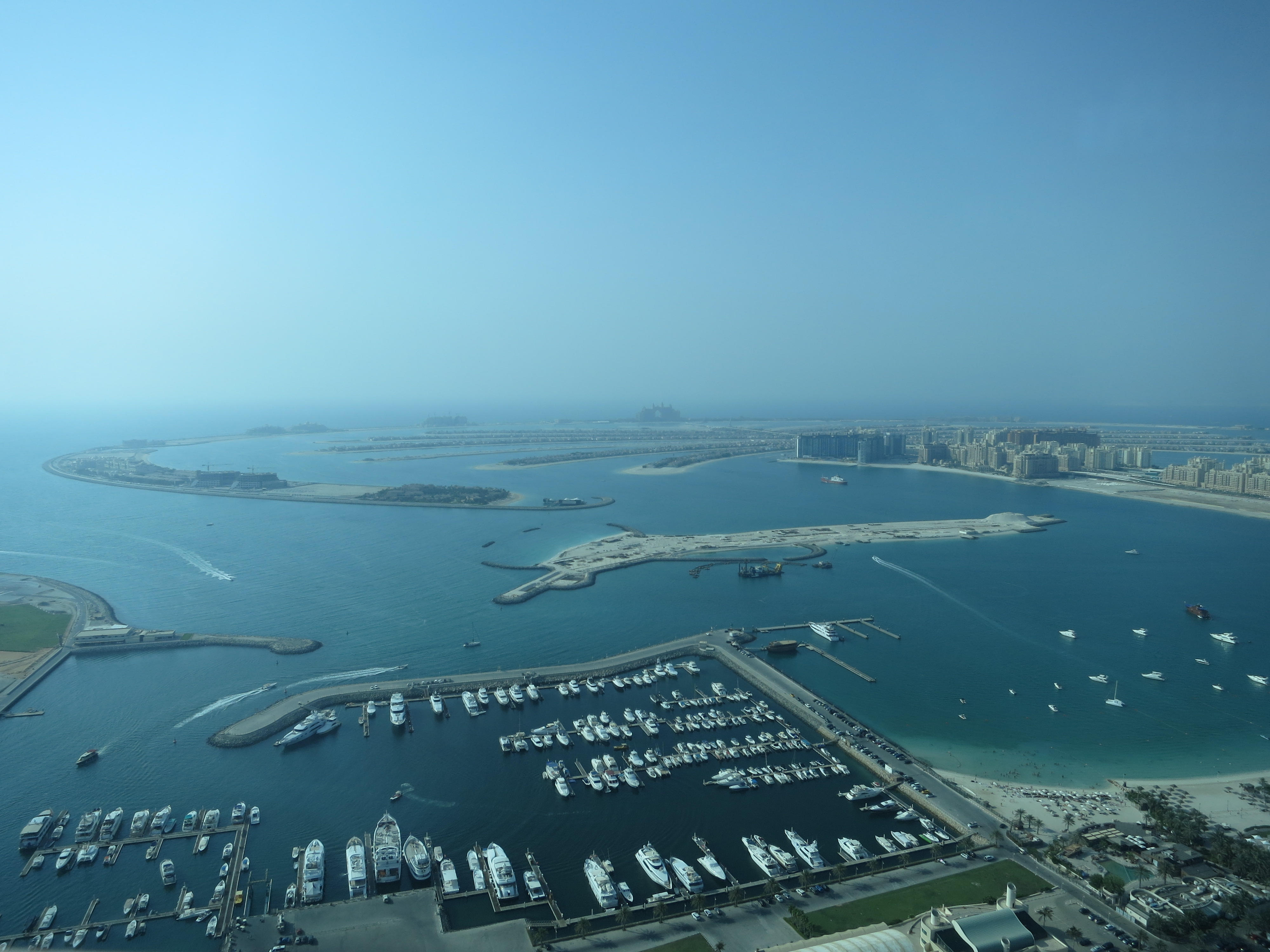
The Palm Jumeirah, as seen from the bar of the Marriott Hotel

The Palm Jumeirah, as seen from the bar of the Marriott Hotel

Then second, up to the bar of the Marriott Hotel – following the advice of a helpful American bloke I’d met in Turkey (whose other great advice had given me a tonne of excellent books to seek out and read) – which allows entry to those of us not guests at the hotel, and also has a great view out to sea, to see exactly what Dubai’s fronded expanse of sand looks like in the flesh.  It turns out it looks incredible.  I’m still not sure whether it’s incredible in a good way or bad.  But it’s definitely incredible.

We turned up to the hotel just after 2pm, and were impressed and excited to see a Guinness tap.  But we were bemused, upon ordering, to discover that the bar wouldn’t serve alcohol between 2 and 3pm – a strange limitation, we reflected, looking around at several groups of nearby customers (many clearly well progressed in their enjoyment of a loud and somewhat tipsy party) who’d clearly stocked up just before we arrived, to get themselves through that arduous hour.  So we made do with coffee and the views, and spent our time pondering the bizarreness of a place that’s cool with building giant sand decorations in the sea for people to live on, but not so much with purchasing booze between your wine-fuelled late lunch and your gin-and-tonic-focussed afternoon tea.

Unwalkable Abu Dhabi

Abu Dhabi is perhaps the least pedestrian-friendly city I could imagine.  City streets are uncrossable highways.  City blocks are enormous and filled with unexciting hotels and office blocks.  And the heat and humidity don’t exactly encourage outdoor aerobic activity of any kind.  So with me the sort of person who likes to wander around a city at leisure, Abu Dhabi and I were probably never going to be great friends.  And so it transpired.  The city seems a comic stereotype of drive-everywhere, shopping-mall-as-panacea suburban America.

A city street in Abu Dhabi, complete with Arabic numbers on the speed limit

A city street in Abu Dhabi, complete with Arabic numbers on the speed limit.  Seriously, this is one of the most interesting photos I have from Abu Dhabi.

But even allowing for that, the capital of the UAE still left me uninspired.  There’s stuff there that’s supposed to be interesting or impressive – the enormous shopping malls, the long stretch of beach (the Corniche), and probably other stuff I’ve already consigned to an area of memory marked ‘reclaim for future reuse’.  But it just wasn’t.  (Interesting or impressive, that is.)  We actually did very little.  We just couldn’t find that much to do.  And what we did find for the most part didn’t excite.

My lasting impression of Abu Dhabi will be the feeling that surely it must have been designed by someone who’s only ever visited other cities from the inside of a limousine.  I expect that if you’re an oil tycoon, your experience of, say, Paris or London or New York probably features a lot of driving from highlight to highlight in air-conditioned comfort.  Not a lot of walking around the back streets in search of a cheesy baguette, soaking up the culture and enjoying the sight, sounds and smells of ordinary life.  So I can’t help but think that the guys who were responsible for carving up the UAE’s petroleum-flavoured pie probably optimised their urban planning for the type of international city they knew.  A boring type that exists only in their heads.  Oh well.  Good for the taxi drivers, I guess.

The world’s fastest roller coaster, at Ferrari World, Abu Dhabi

The world’s fastest roller coaster, at Ferrari World, Abu Dhabi

The one memorable (if hugely overpriced) experience, I suppose, was Ferrari World.  Although like much of the rest of the UAE, that was interesting mostly as an exercise in unjustifiable extravagance.  The world’s fastest rollercoaster was kind of fun – but we did it five or six times more because we could (there were no lines when we were there – I can only imagine how much money the place must be losing) and because there was not much else to do, really.  The last two times were because it seemed an efficient and novel way to dry off after the water features in the V12 ride.  And once we were dry, that was Abu Dhabi done, really.  A good night’s sleep and then onto a bus for Dubai, hoping to find more of interest there…

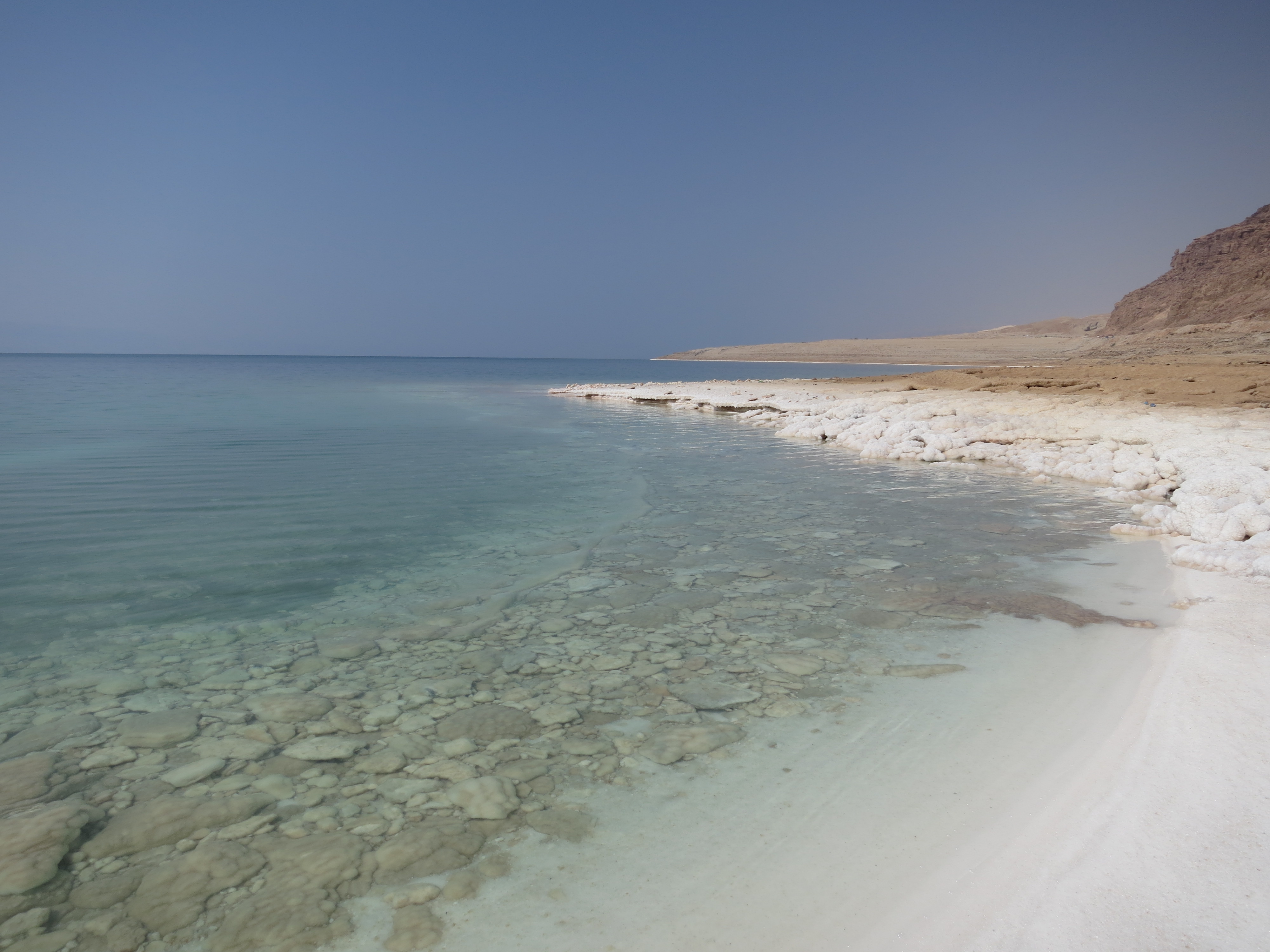
Floating in the Dead Sea

The lady at the tourist information centre in Queen Alia International Airport in Amman was horrified:  yes, Petra was definitely the premier tourist attraction, but how could we come to Jordan and not also see the many other wonders the country has to offer?  Well, fairly easily, it turned out:  I’m sure the rest of Jordan is great, but a round-the-world ticket has time constraints, and sacrifices have to be made.

Regardless, though, Petra is most of the way down the south of the country, and Amman is up towards the north, and to make the most of our time, we’d hired a car to get between them.  And so on the way back, since we were in the vicinity anyway, there was time for us to fit in one other cheesy Kodak moment:  floating in the Dead Sea.

The Dead Sea, on the coast of Jordan

Our chosen portion of the Dead Sea

Paddling in brine is apparently quite the money-extractor in Jordan:  there are really quite a number of surprisingly expensive private beaches on the eastern shores of the world’s premier saline attraction.  (And I have no reason to expect that the western shores, in Israel, would be any different.)  That didn’t really seem like our style, though, since their pitch seemed largely limited to the fact that they had fresh water showers to clean yourself off in afterwards.  A welcome benefit, most definitely, but not one worth paying through the newly salt-encrusted nose for.  So with several bottles of tap water prepared as our makeshift showers, we just drove around a bit until we figured we’d found a nice stretch of waterfront that seemed pretty and available.  In fact, it turned out that we’d picked the perfect spot:  other than intermittent highway traffic in the distance, there was no one for miles, and we spent a good hour dicking about with, so far as we could see, the whole sea and shore to ourselves.  (For anyone who’s interested, my camera’s GPS tells me that we were at 31°27’20” N, 35°33’59″E.  Feel free to steal our spot.)

The typical tourist shot of the Dead Sea is supposed to be lying on your back, reading a book or a newspaper.  So Chris ventured out into the water pretending to be able to read his Arabic broadsheet, and I demonstrated my advanced skills with technology by paddling about with my Kindle.

Reading my Kindle while floating in the Dead Sea

Reading my Kindle while floating in the Dead Sea

Once done with the mandatory Kodak moments, we made a few discoveries about swimming in the Dead Sea.  First, swimming breaststroke is remarkably difficult:  keeping your legs below the water is a constant struggle, and you’re always rolling unintentionally over onto your back as you lose your balance.  Backstroke requires quite some shoulder flexibility to get the arms down far enough, and freestyle is, well, strange.  At last, an appropriate location for doggy paddling.  Second, highly concentrated (saturated, in fact) saline is incredibly slimy, and makes for a very weird sensation on the skin – a very foreign, greasy, stinging mess that won’t go away, basically.  Third, the salt is so concentrated that getting any in the eyes is incredibly painful, and the pain lasts for a surprisingly long time.  Woe betide anyone who reacts to the pain by reflexively trying to wipe your eyes with hands wet with the salt water.  That’s a mistake you won’t make twice.  (Ok, fine, it’s a mistake I made twice.  But fool me thrice, shame on… something something.)  Fourth, the Dead Sea is an excellent way to discover (and sterilise) all those tiny little cuts and skin abrasions you didn’t know you had.  Fifth, be careful when you fart.  Yes, the bubbles coming out of your butt are just as funny in the Dead Sea as they are anywhere else in the world.  But be careful not to let any water back up the pipes when you’re done, or you’ll be in for a most unwelcome stinging sensation.  You have been warned.

Floating in the Dead Sea:  the lazy man’s Superman

Meanwhile: Superman!, do-do-do-do-do-dooh!