Dubai

If Abu Dhabi is urban planning gone boring, then as Chris wryly observed as we took the metro through the towering business district, Dubai is what happens when you give your designers-in-chief a copy of SimCity and the cheat codes.  Visiting is a series of appointments with the world’s tallest this, the world’s biggest that, and the world’s most pointless the other.  Not that it’s not all cool.  Dubai has clearly set out to buy the world’s interest, and it succeeds.  But that success comes in a way that feels a little more attention-whorey than they’d probably hoped.

The Burj Khalifa, Dubai – tallest building in the world

The Burj Khalifa, Dubai – tallest building in the world

At least Dubai doesn’t suffer quite so terribly from my primary complaint about Abu Dhabi:  you don’t have to get in a car in order to be able to do absolutely anything at all.  It’s still not a brilliantly walkable city, but the shiny, futuristic metro will at least get you around a good handful of the main attractions.

Heading back into central Dubai on the metro, with the Burj Khalifa on the right

Heading back into central Dubai on said shiny metro, with the Burj Khalifa on the right. The hazy effect is from the dust.

It will get you, for example, to the Burj Khalifa – the tallest building in the world.  And tall it is, and elegantly striking.  But when you pay your money to go up to observation deck and find yourself only about halfway up the building, you’ll be told that’s because the Burj Khalifa has pretty much nothing there from the waist up:  above the observation deck is basically just machine rooms and elevator shafts, save for a couple of how-good-am-I-I-live-at-the-top-of-the-world penthouses near the very summit.  Still, it’s a pretty building, and very shiny, and well, it is the tallest.  And from said observation deck, you can look down at Dubai Mall – the largest in the world.  And you can see just how much airconditioning is required to keep cold such a behemoth of a monument to consumerism.  (Quite a lot, it turns out.  I’m guessing that keeping that sort of floorspace nicely refrigerated has got to account for a fairly hefty line item in the budgeting for Dubai’s oil reserves for the next thirty or forty years, til it all runs out.)

Looking down over the fountain from the viewing platform of the Burj Khalifa

The view down from the Burj Khalifa’s observation deck. “Look at the cute widdle skyscrapers! Aren’t they just adorable?”

Wandering down from the Burj Khalifa into the Mall, you realise that at the end of the day, being the world’s largest shopping mall really just involves being a normal shopping mall but with more shops.  So you quickly get over that – although the place does deserve some extra credit, I suppose, for housing an indoor waterfall and an indoor aquarium.  (In what, in combination with the aforementioned airconditioning, can only be interpreted as a big ‘fuck you’ to Dubai’s natural heat and lack of water.)  Oh, and for having a Burger Fuel in the food court.  And a Waitrose in the basement.

In Waitrose, in the basement of the Dubai Mall, giggling giddily at the notion of a separate room dedicated to pork products

… and in that Waitrose, in the basement of the Dubai Mall, there is a ‘Pork Shop’, hilariously subtitled ‘For non-Muslims’. And there is me, giggling giddily at the notion of a separate room dedicated to pork products. It’s the Sam version of a candy store! Hooray!

Aside from doing some shopping (yes, I know, ‘monument to consumerism’, etc., but I needed a new phone), our other excursion out through the metal forest of Dubai was out to the Palm Jumeirah – the giant tree-shaped expanse of land and sand that Dubai has bulldozed out into the sea.  First, out to Atlantis water park, right out on the tip of the Palm.  Because, well, why not?  And because there’s actually something quite amusing about the combination of western girls in bikinis and middle-eastern girls in full-body swimming costumes, all lining up for the same rides.  And, to be honest, because it was actually quite a decent water park, and we had fun.

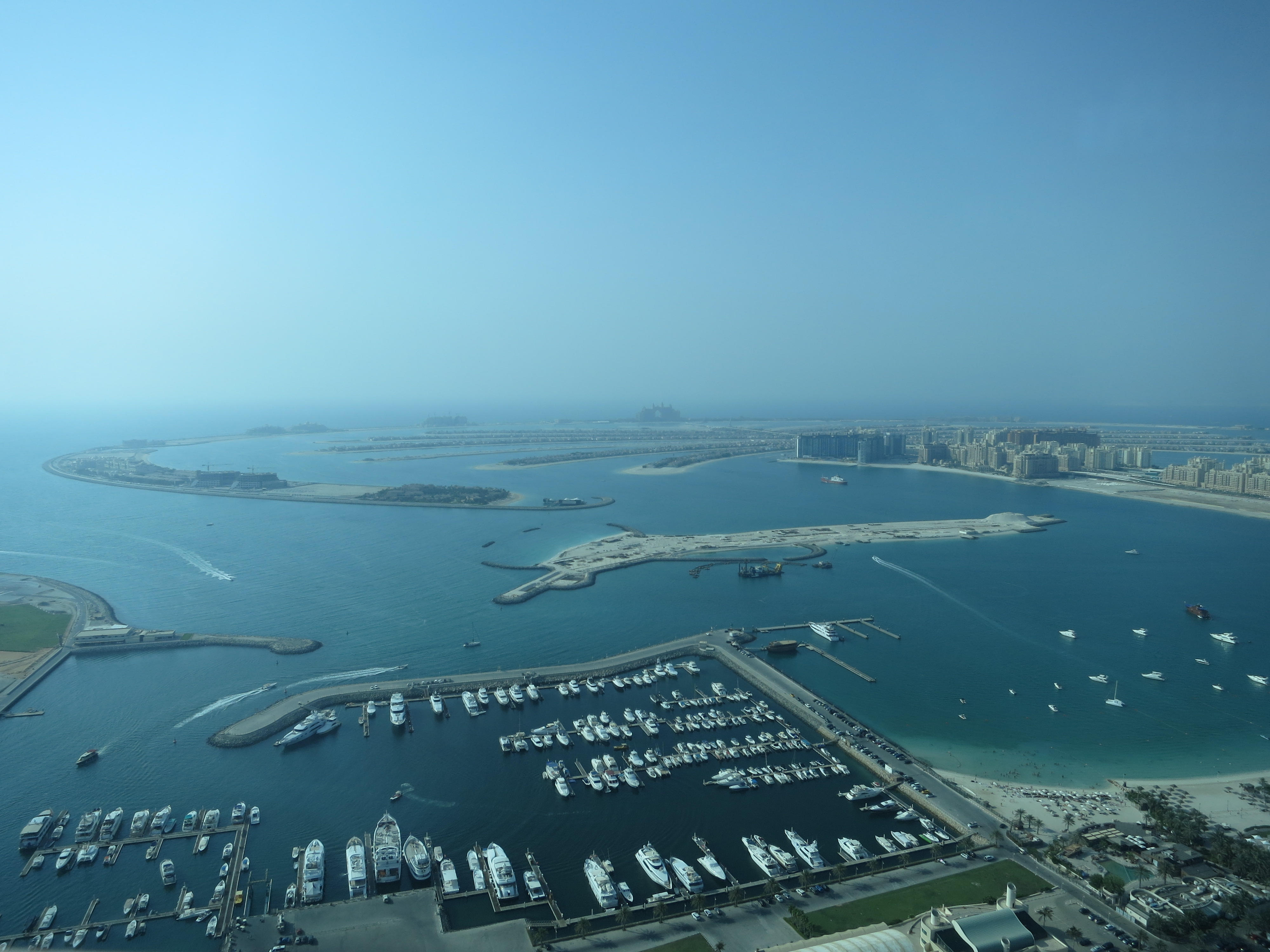
The Palm Jumeirah, as seen from the bar of the Marriott Hotel

The Palm Jumeirah, as seen from the bar of the Marriott Hotel

Then second, up to the bar of the Marriott Hotel – following the advice of a helpful American bloke I’d met in Turkey (whose other great advice had given me a tonne of excellent books to seek out and read) – which allows entry to those of us not guests at the hotel, and also has a great view out to sea, to see exactly what Dubai’s fronded expanse of sand looks like in the flesh.  It turns out it looks incredible.  I’m still not sure whether it’s incredible in a good way or bad.  But it’s definitely incredible.

We turned up to the hotel just after 2pm, and were impressed and excited to see a Guinness tap.  But we were bemused, upon ordering, to discover that the bar wouldn’t serve alcohol between 2 and 3pm – a strange limitation, we reflected, looking around at several groups of nearby customers (many clearly well progressed in their enjoyment of a loud and somewhat tipsy party) who’d clearly stocked up just before we arrived, to get themselves through that arduous hour.  So we made do with coffee and the views, and spent our time pondering the bizarreness of a place that’s cool with building giant sand decorations in the sea for people to live on, but not so much with purchasing booze between your wine-fuelled late lunch and your gin-and-tonic-focussed afternoon tea.

Unwalkable Abu Dhabi

Abu Dhabi is perhaps the least pedestrian-friendly city I could imagine.  City streets are uncrossable highways.  City blocks are enormous and filled with unexciting hotels and office blocks.  And the heat and humidity don’t exactly encourage outdoor aerobic activity of any kind.  So with me the sort of person who likes to wander around a city at leisure, Abu Dhabi and I were probably never going to be great friends.  And so it transpired.  The city seems a comic stereotype of drive-everywhere, shopping-mall-as-panacea suburban America.

A city street in Abu Dhabi, complete with Arabic numbers on the speed limit

A city street in Abu Dhabi, complete with Arabic numbers on the speed limit.  Seriously, this is one of the most interesting photos I have from Abu Dhabi.

But even allowing for that, the capital of the UAE still left me uninspired.  There’s stuff there that’s supposed to be interesting or impressive – the enormous shopping malls, the long stretch of beach (the Corniche), and probably other stuff I’ve already consigned to an area of memory marked ‘reclaim for future reuse’.  But it just wasn’t.  (Interesting or impressive, that is.)  We actually did very little.  We just couldn’t find that much to do.  And what we did find for the most part didn’t excite.

My lasting impression of Abu Dhabi will be the feeling that surely it must have been designed by someone who’s only ever visited other cities from the inside of a limousine.  I expect that if you’re an oil tycoon, your experience of, say, Paris or London or New York probably features a lot of driving from highlight to highlight in air-conditioned comfort.  Not a lot of walking around the back streets in search of a cheesy baguette, soaking up the culture and enjoying the sight, sounds and smells of ordinary life.  So I can’t help but think that the guys who were responsible for carving up the UAE’s petroleum-flavoured pie probably optimised their urban planning for the type of international city they knew.  A boring type that exists only in their heads.  Oh well.  Good for the taxi drivers, I guess.

The world’s fastest roller coaster, at Ferrari World, Abu Dhabi

The world’s fastest roller coaster, at Ferrari World, Abu Dhabi

The one memorable (if hugely overpriced) experience, I suppose, was Ferrari World.  Although like much of the rest of the UAE, that was interesting mostly as an exercise in unjustifiable extravagance.  The world’s fastest rollercoaster was kind of fun – but we did it five or six times more because we could (there were no lines when we were there – I can only imagine how much money the place must be losing) and because there was not much else to do, really.  The last two times were because it seemed an efficient and novel way to dry off after the water features in the V12 ride.  And once we were dry, that was Abu Dhabi done, really.  A good night’s sleep and then onto a bus for Dubai, hoping to find more of interest there…

Floating in the Dead Sea

The lady at the tourist information centre in Queen Alia International Airport in Amman was horrified:  yes, Petra was definitely the premier tourist attraction, but how could we come to Jordan and not also see the many other wonders the country has to offer?  Well, fairly easily, it turned out:  I’m sure the rest of Jordan is great, but a round-the-world ticket has time constraints, and sacrifices have to be made.

Regardless, though, Petra is most of the way down the south of the country, and Amman is up towards the north, and to make the most of our time, we’d hired a car to get between them.  And so on the way back, since we were in the vicinity anyway, there was time for us to fit in one other cheesy Kodak moment:  floating in the Dead Sea.

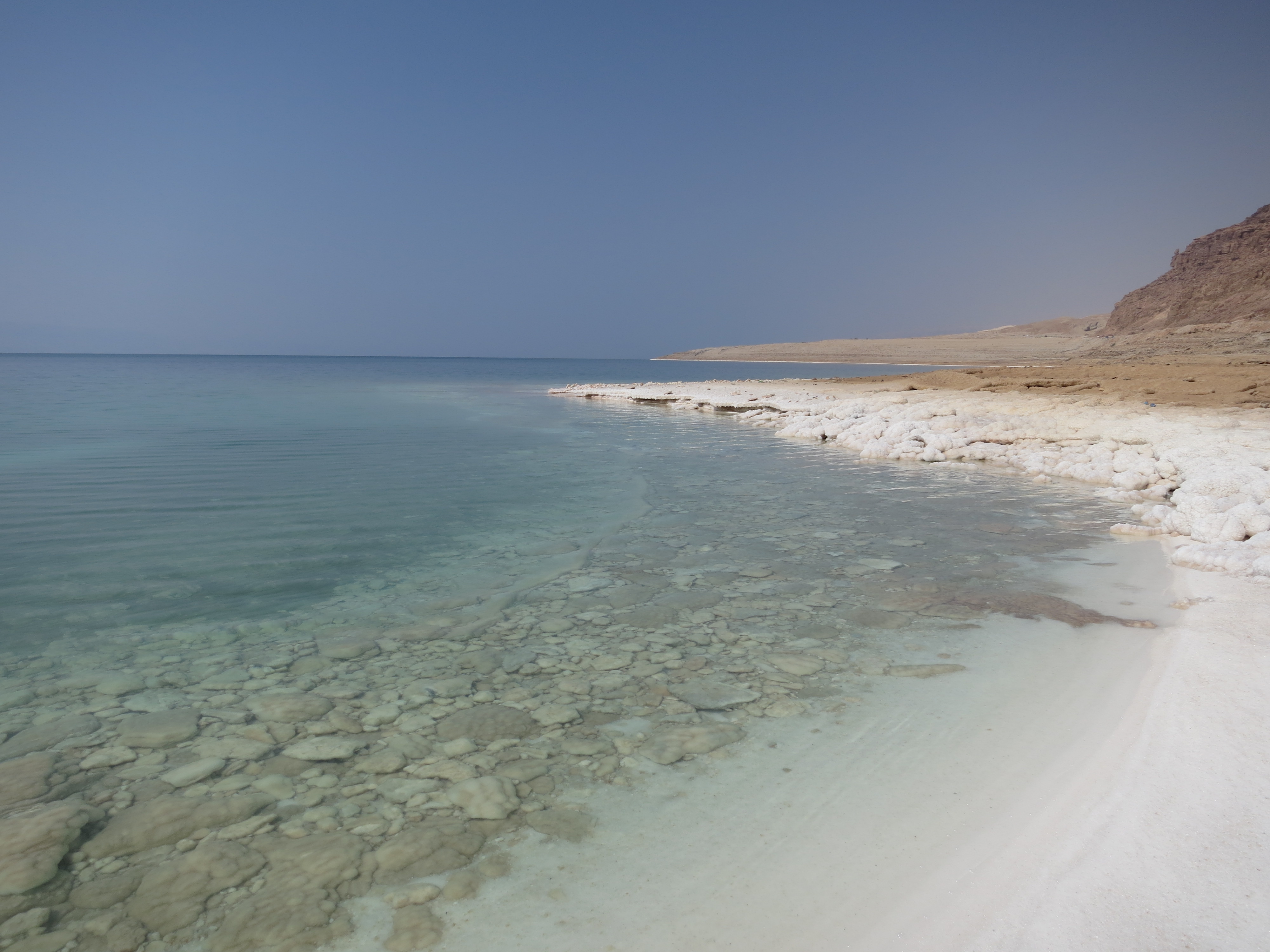
The Dead Sea, on the coast of Jordan

Our chosen portion of the Dead Sea

Paddling in brine is apparently quite the money-extractor in Jordan:  there are really quite a number of surprisingly expensive private beaches on the eastern shores of the world’s premier saline attraction.  (And I have no reason to expect that the western shores, in Israel, would be any different.)  That didn’t really seem like our style, though, since their pitch seemed largely limited to the fact that they had fresh water showers to clean yourself off in afterwards.  A welcome benefit, most definitely, but not one worth paying through the newly salt-encrusted nose for.  So with several bottles of tap water prepared as our makeshift showers, we just drove around a bit until we figured we’d found a nice stretch of waterfront that seemed pretty and available.  In fact, it turned out that we’d picked the perfect spot:  other than intermittent highway traffic in the distance, there was no one for miles, and we spent a good hour dicking about with, so far as we could see, the whole sea and shore to ourselves.  (For anyone who’s interested, my camera’s GPS tells me that we were at 31°27’20” N, 35°33’59″E.  Feel free to steal our spot.)

The typical tourist shot of the Dead Sea is supposed to be lying on your back, reading a book or a newspaper.  So Chris ventured out into the water pretending to be able to read his Arabic broadsheet, and I demonstrated my advanced skills with technology by paddling about with my Kindle.

Reading my Kindle while floating in the Dead Sea

Reading my Kindle while floating in the Dead Sea

Once done with the mandatory Kodak moments, we made a few discoveries about swimming in the Dead Sea.  First, swimming breaststroke is remarkably difficult:  keeping your legs below the water is a constant struggle, and you’re always rolling unintentionally over onto your back as you lose your balance.  Backstroke requires quite some shoulder flexibility to get the arms down far enough, and freestyle is, well, strange.  At last, an appropriate location for doggy paddling.  Second, highly concentrated (saturated, in fact) saline is incredibly slimy, and makes for a very weird sensation on the skin – a very foreign, greasy, stinging mess that won’t go away, basically.  Third, the salt is so concentrated that getting any in the eyes is incredibly painful, and the pain lasts for a surprisingly long time.  Woe betide anyone who reacts to the pain by reflexively trying to wipe your eyes with hands wet with the salt water.  That’s a mistake you won’t make twice.  (Ok, fine, it’s a mistake I made twice.  But fool me thrice, shame on… something something.)  Fourth, the Dead Sea is an excellent way to discover (and sterilise) all those tiny little cuts and skin abrasions you didn’t know you had.  Fifth, be careful when you fart.  Yes, the bubbles coming out of your butt are just as funny in the Dead Sea as they are anywhere else in the world.  But be careful not to let any water back up the pipes when you’re done, or you’ll be in for a most unwelcome stinging sensation.  You have been warned.

Floating in the Dead Sea:  the lazy man’s Superman

Meanwhile: Superman!, do-do-do-do-do-dooh!

Petra

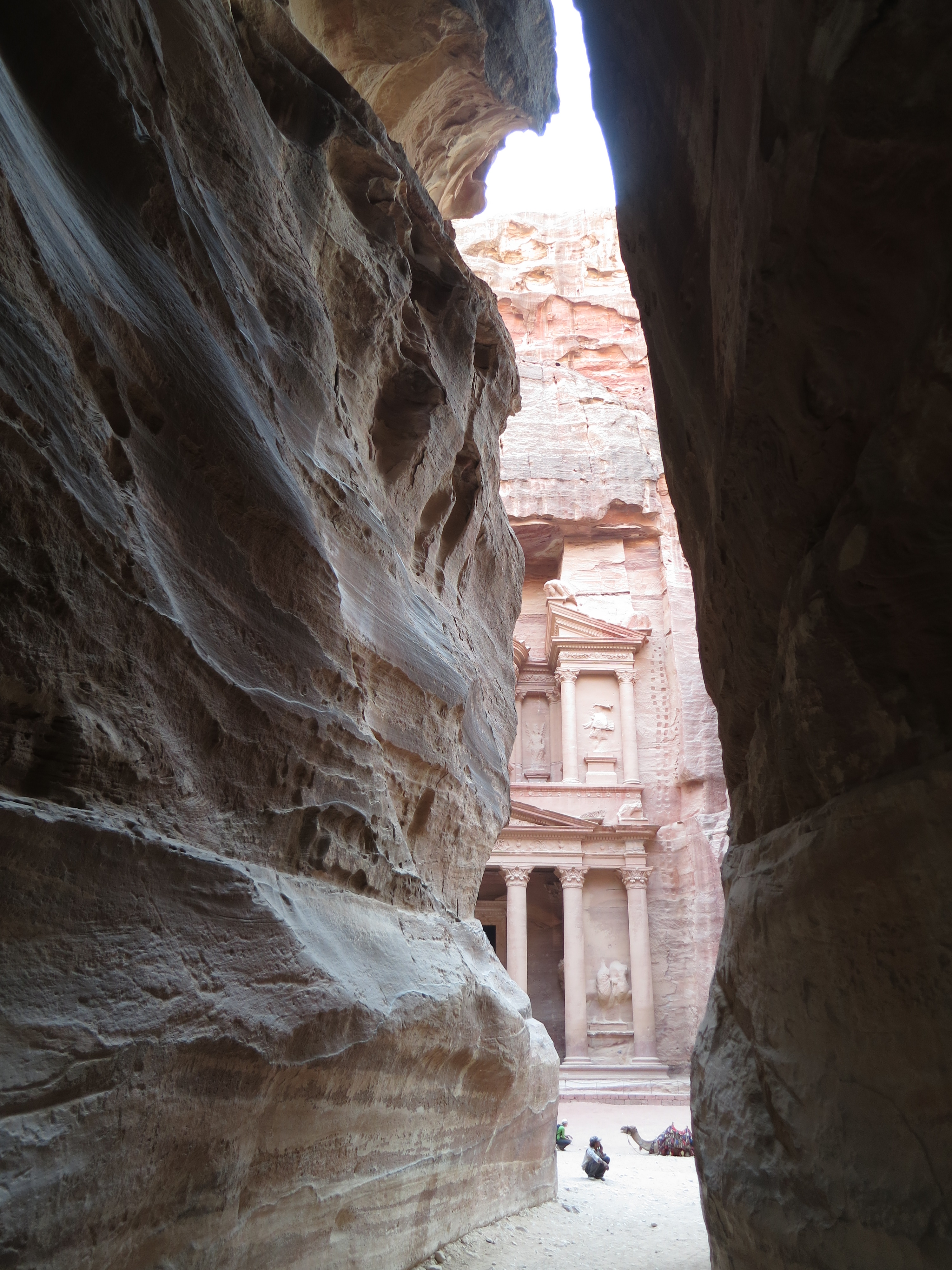
The Treasury, seen through the narrow rock walls of the Siq, not long before sunset

Indy’s first glimpse of the Temple of the Sun, aka Petra’s ‘The Treasury’

Some of you will already know what Petra is.  Give yourselves a pat on the head.  The rest of you will at least have seen its most famous edifice, ‘The Treasury’, in Indiana Jones and the Last Crusade, as the movie’s façade of the Temple of the Sun (containing the – it turns out disappointingly non-existent – caves and chiselled-out rooms and traps and bridges and stuff eventually leading to the doddery old sole remaining Knight Templar and the Holy Grail itself) that Indy gallops towards through a winding ravine in the desert (that winding ravine is called ‘the Siq’, for what it’s worth).

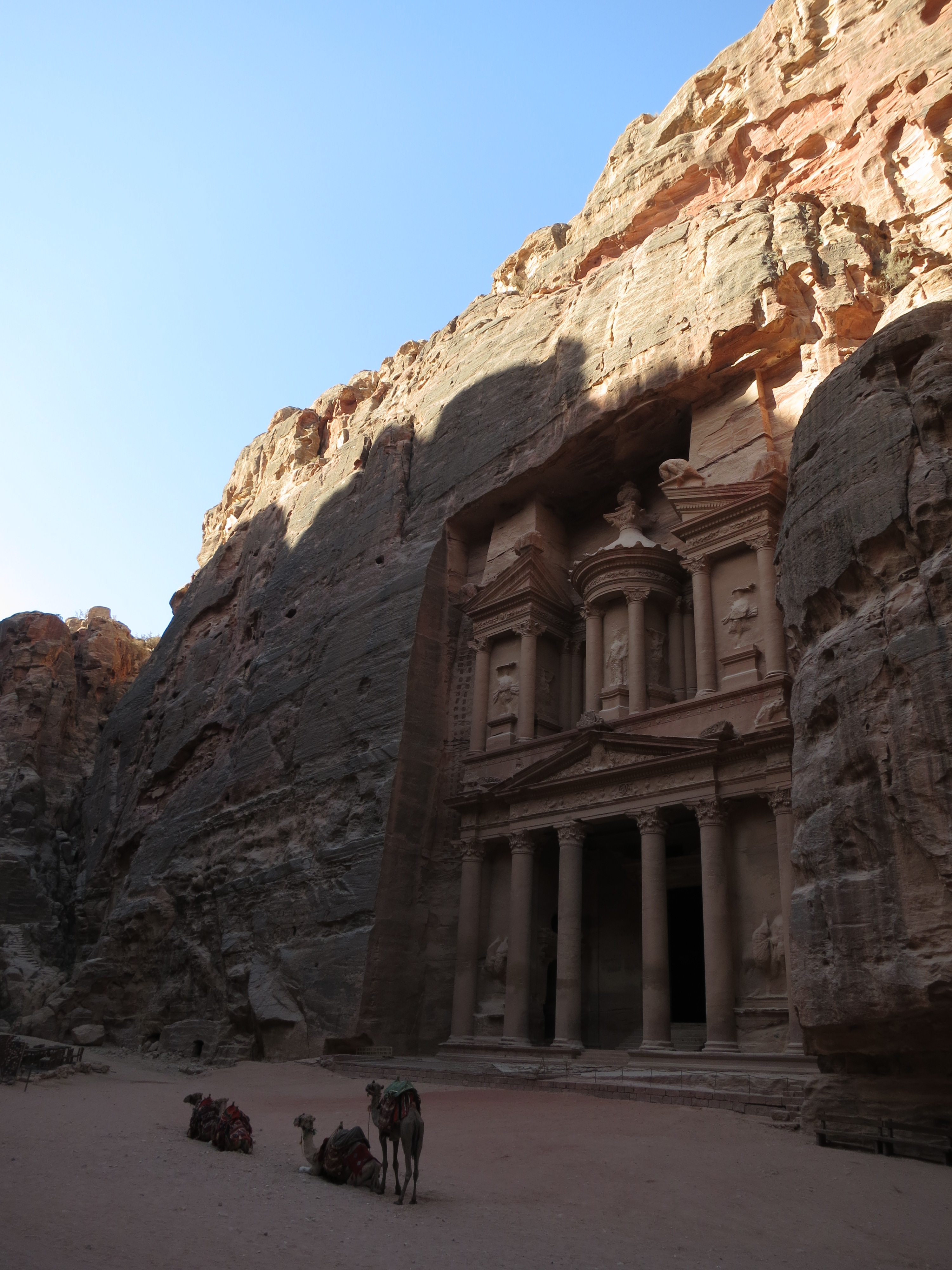
Camels in front of the Treasury

Not pictured: Sir “You Have Chosen Poorly” and Jesus’ favourite wine mug

For those whose current knowledge of Petra is on par with mine before this trip, the gist is that it’s an ancient city in present-day Jordan which, in its hey-day, lay on a major trading route, and happened to be in an area of desert well populated by cliffs featuring some very colourful sedimentary rocks.  The ruins of the town itself are partially excavated, and somewhat interesting, but the real drawcard is the tombs that were built just out of town for the local elite, both to venerate the dead and impress (and intimidate) traders on their way through.  The tombs themselves were pretty simple in general, but their façades, carved into the cliff faces, were not.  Combine the intricate carving with the vibrant sworls of colour coursing through the rock, and you have a pretty stunning mix.

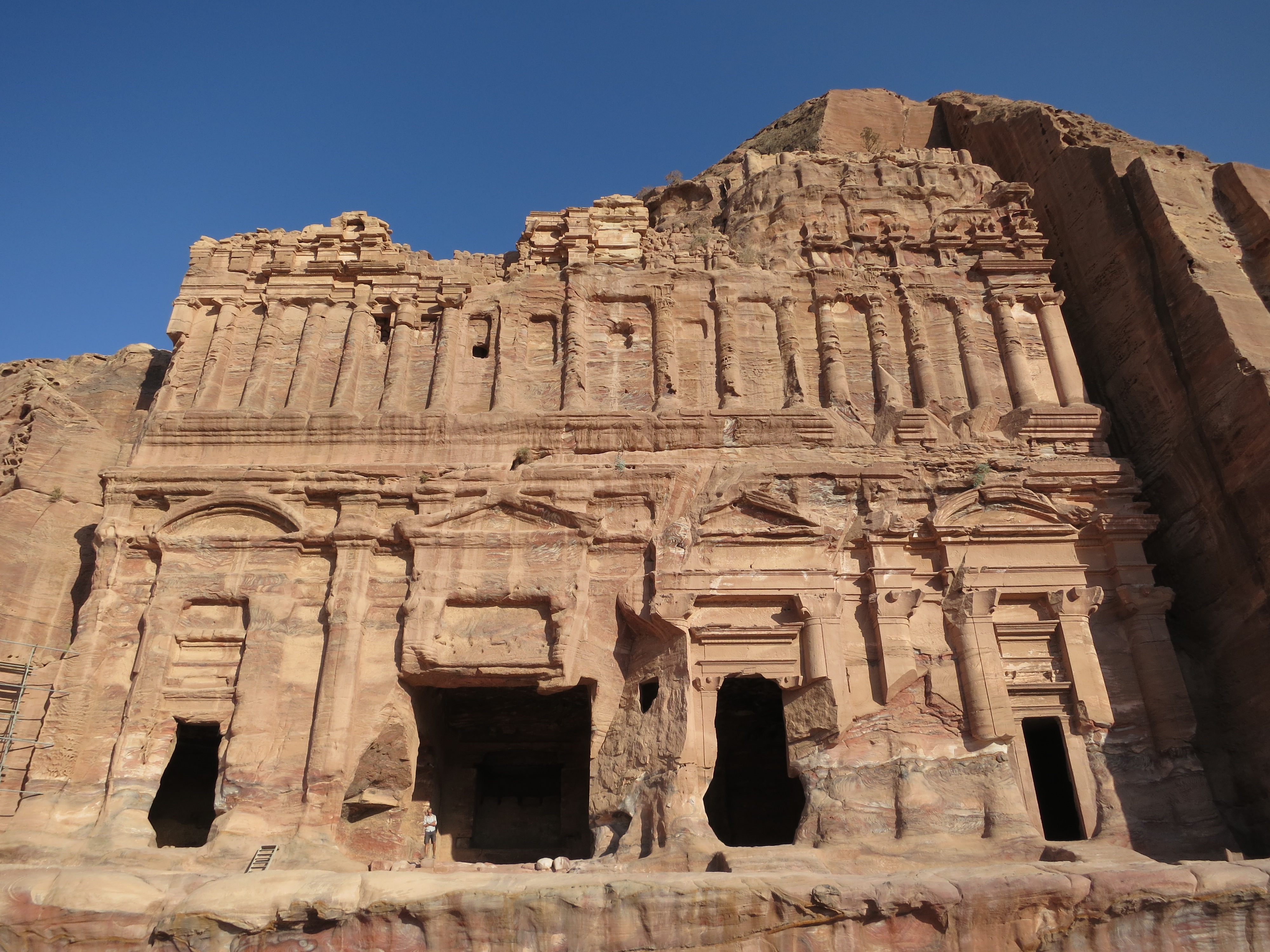
In front of the Palace Tomb, one of the Royal Tombs of Petra

Fancier than your average cliff face. For an indication of scale, that’s me just left of centre down the bottom.

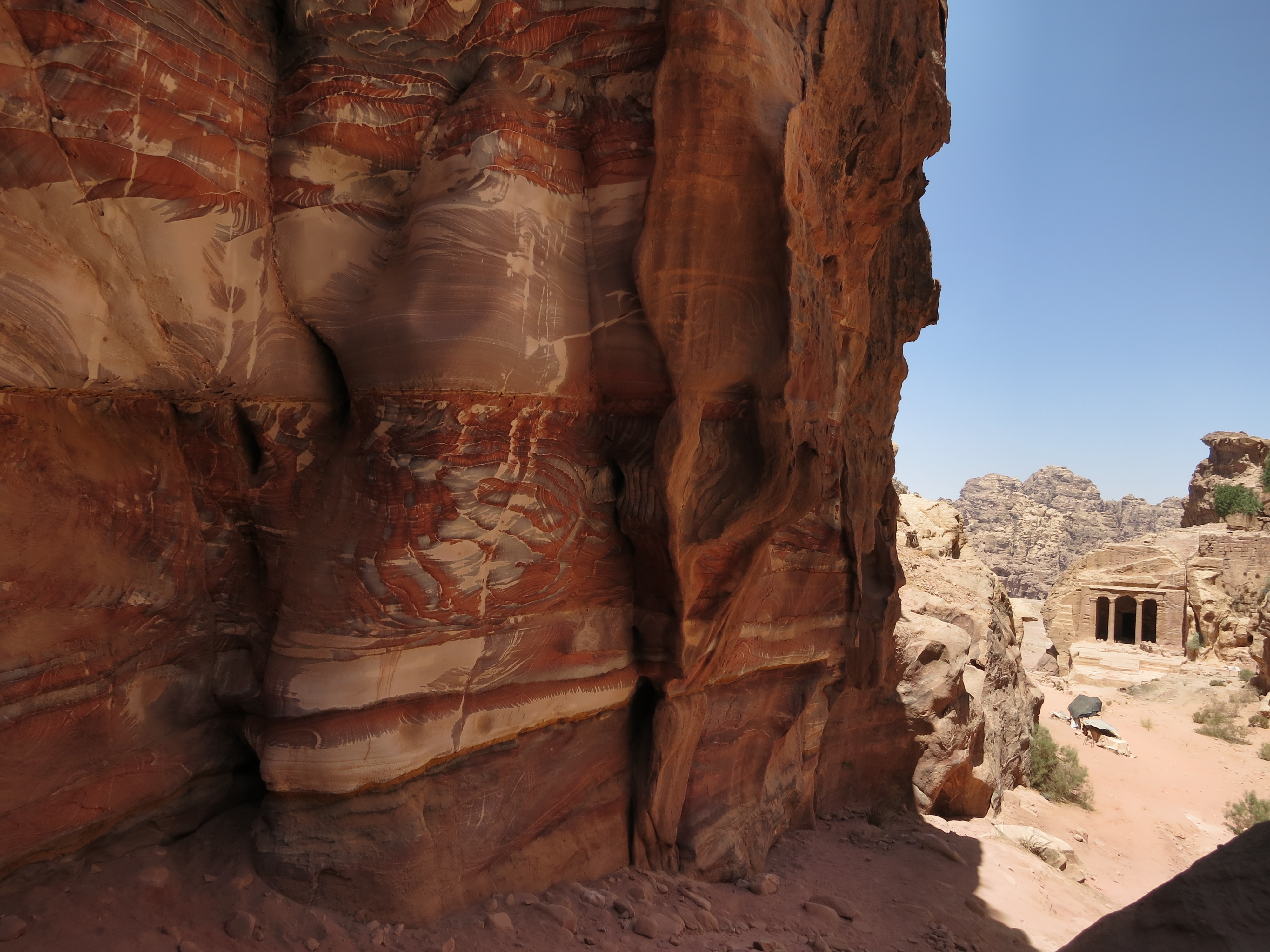
The beautiful colours of the rocks of Petra, in Wadi al-Farasa, with the Garden Hall to the right

No, that’s not paint on the left – that’s the natural colours of the rock. That’s what they carved the tombs out of. Beautiful, no?

It’s a big site.  We bought the three-day ticket, and spent three eight- to ten-hour days exploring pretty much every little corner of it.  And not once did we get bored.  (Hot, yes.  Exhausted, yes.  Bored, no.)

The main tourist route takes you through the Siq, past the Treasury, along the Street of Façades (or ‘Outer Siq’), past the Roman amphitheatre, and down along the main street of town (the ‘Colonnaded Street’) and up to the Monastery.  That was all pretty cool.

But if you just do that, then you miss out on the High Place of Sacrifice, the whole other valley of tombs (the ‘Wadi al-Farasa’), the cool walking trails through miscellaneous off-the-beaten-track gorges and ravines nearby the Siq (starting at ‘the Tunnel’, and making up your own path from there depending on your level of adventurousness and amateur rock-climbing ability), the clambering up rock faces up to the higher tombs off the Street of Façades, the view of the Treasury from above (from Jabal al-Kubtha), etc.

The rest of this post is just going to be pictures, because, well, Petra’s a visual thing.  All I can say is that if you go to see it, see as much of it as you can.  Go everywhere, and see everything, because it’s all stunning.  One of the most impressive things I’ve seen anywhere in the world – and I say that writing this post many many months after we visited, having seen an awful lot more stuff since then.

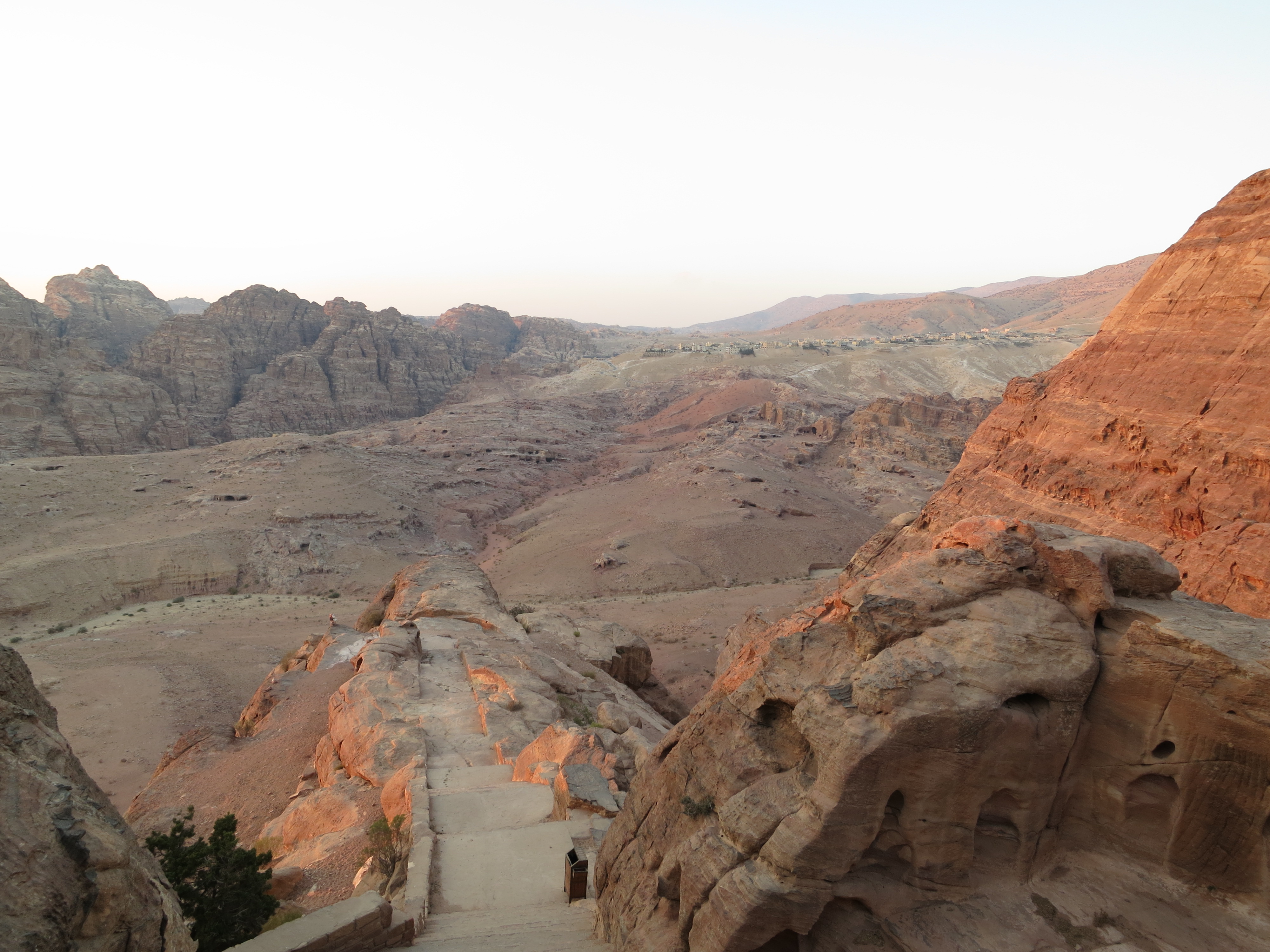
Sunset from Jabal al-Kubtha, seen while climbing back down from viewing the Treasury from above

Sunset from Jabal al-Kubtha, seen while climbing back down from viewing the Treasury from above

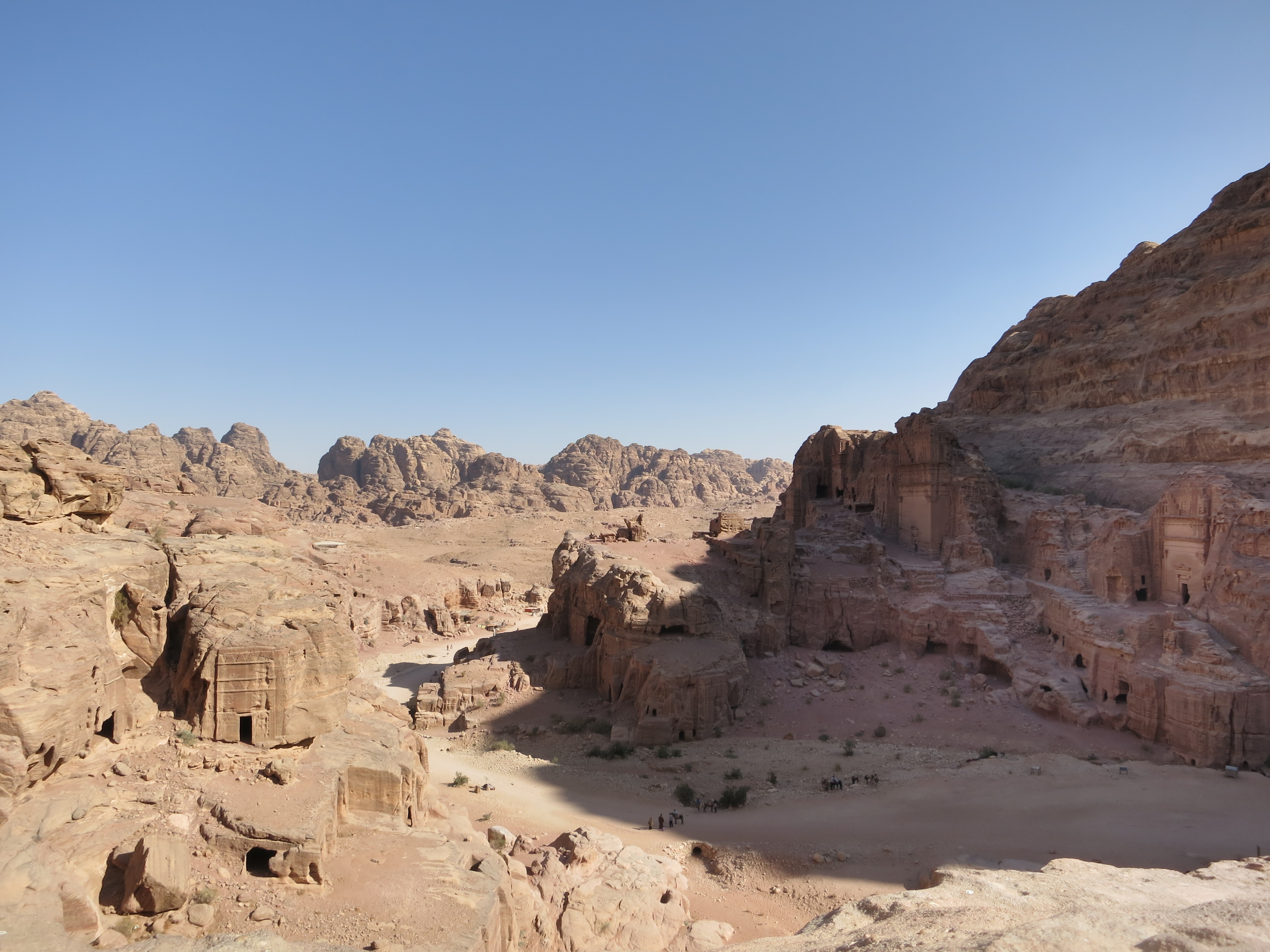
The view back towards the Street of Façades, or Outer Siq, from the climb up towards the High Place of Sacrifice

For an idea of the scale of the site, here’s a view back towards the Street of Façades. The tombs dotted around this photo are each really quite huge – but almost insignificant when viewed from up here!

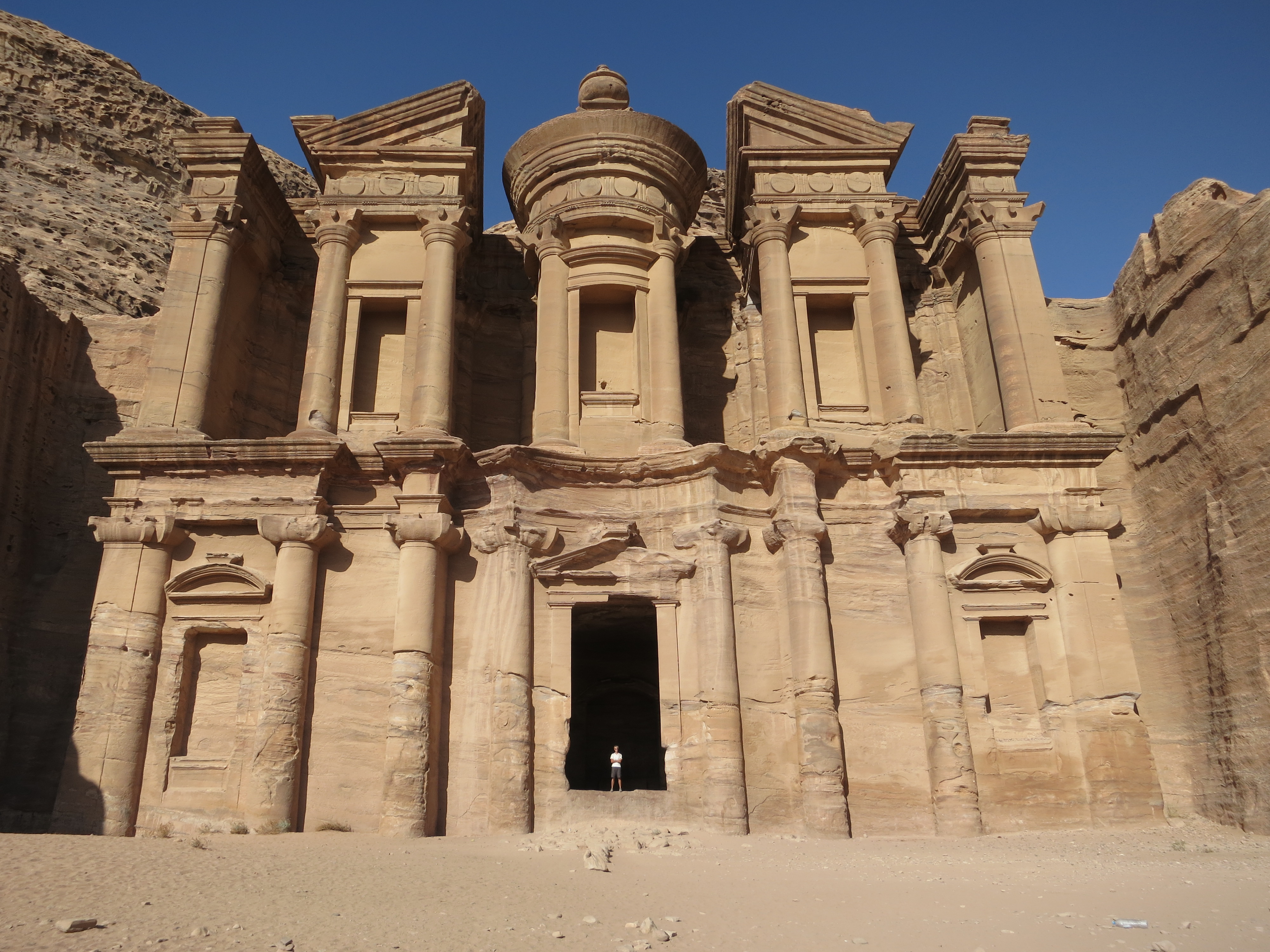
Me, in the doorway of the Monastery

Me, in the doorway of the Monastery

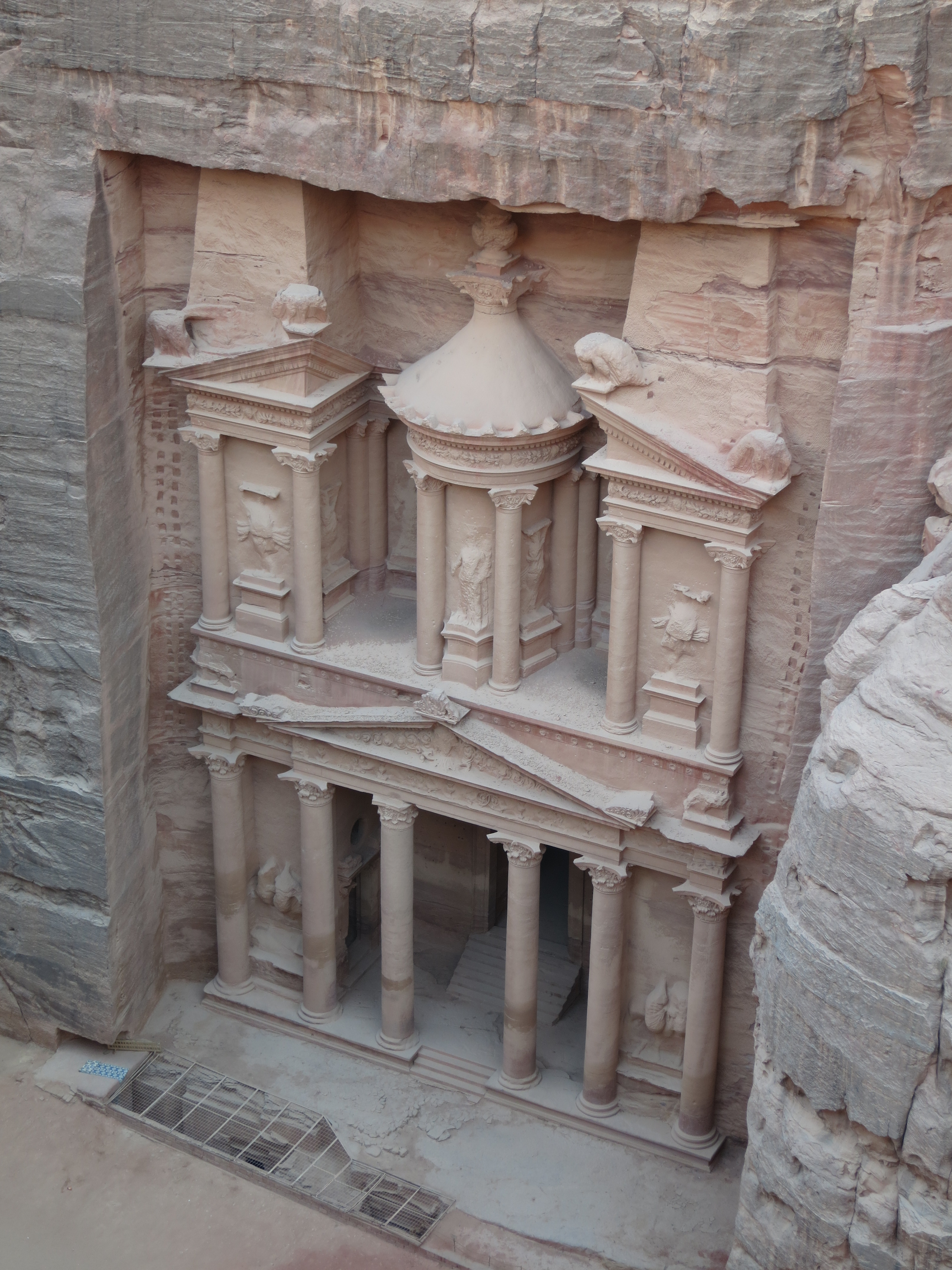
The Treasury from above -- the view down from Jabal al-Kubtha

The Treasury from above – the view down from Jabal al-Kubtha

Cairo

Strangely enough, one of the most memorable things about Cairo was just getting there in the first place.  We were coming from Luxor, and had decided to catch the train:  we were looking forward to a relaxed day spent reading and occasionally looking out the window to the splendour of the Nile.

As we knew from the Man in Seat 61 – the internet bible of all things train-travel related – catching the train in Egypt can be slightly cumbersome.  Officially – ‘for your safety,’ of course – foreigners are only supposed to be allowed to catch the overnight sleeper trains (which are, obviously, ridiculously more expensive – and which also mean that you miss any daytime sight of the Nile).  In practice, we’d had no trouble in Aswan just buying tickets from there to Luxor the day before we wanted to travel that segment.  We hoped that it would be the same story from Luxor, but alas…

We tried buying them at the train station three times during our time in Luxor (including as soon as we arrived), only to be told the train was full.  Various reports on the internet have it that this is what they tell you just to get rid of you, in the hope that you’ll then accept the offer of some friendly local (presumably friendly to the guy at the ticket counter, as well as to you!) conveniently at hand to offer to help you get what you’re after (at some substantially inflated price).  But we’d read, and were told by the man at the ticket counter (after we persisted in asking for long enough for him to spot that his tactic wasn’t working) that you could just get on the train and buy tickets from the conductor once on.  Excellent news, and that’s exactly what we proceeded to do.

Except that the train was full, at least in first class (other classes are, well, not recommended).  Though that’s not to say that I necessarily believe it was the first time we tried to buy tickets.

It wasn’t “you have to get off now” full, but it was “no seat reservation for you” full.  So we spent our ten hours of following the Nile mostly standing in the aisles, or hopping from seat to unoccupied seat as locals got on or off at stops along the way, each only to be replaced by a new puzzled-looking face holding a ticket for the seat, wondering why there was a tired-looking foreigner sitting in it.  First class is nice and all, but it’s definitely better when you’re not on your feet.

Anyway, having made it to Cairo, we basically had two tasks:  the pyramids, and the Cairo Museum.  (We also had a third:  find an internet café we could use to upload the millions of photos we were collecting to the internet, so they’d be backed up if the unthinkable happened – so far in Egypt our internet access had been spotty, to say the least.  But despite an hour or so’s searching on day one, we failed miserably at that task until we stumbled across one just around the corner on our last day in town:  the hordes of western coffee shops that Wikitravel had us expecting to fall over at every turn have presumably all closed up in the economic downturn and the chaos of the revolution.)

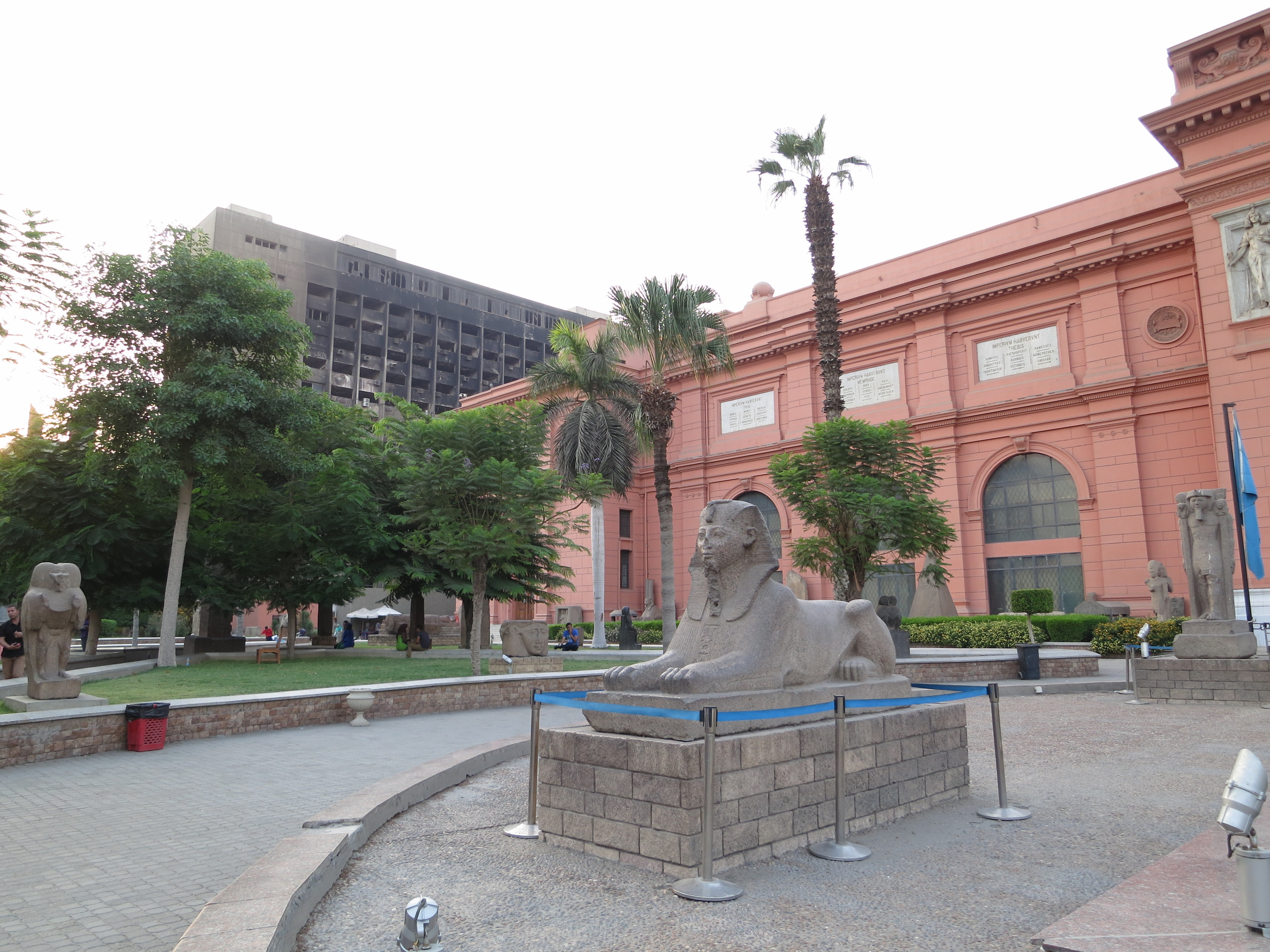
A blackened, burned-out building beside and behind the Cairo Museum

The Cairo Museum. I’m not sure specifically what the blackened building on the left is, but it’s somewhat typical of many of the buildings on Tahrir Square. This is not an area of Cairo you’re encouraged to visit when there are any protests happening…

The Cairo Museum left me in two minds.  There’s a lot of cool stuff there, but I’ve never realised before quite how important it is that a museum be logically set out and explained and labelled to tell a story.  The Cairo Museum is very much mummies, mummies, everywhere, but nought to stop to think [about].  To bastardise a vaguely inapt couplet.  It’s a collection of some very impressive pieces, I have no doubt.  Except that I have no idea what most of them were, or why I should care.

There are certainly some very grand-looking and beautiful artefacts (although unfortunately the spoilsports won’t let you take photos in the museum, so I have no pretty pictures to share, I’m afraid).  But rather than a fascinating learning experience, the Museum often feels like the religious relic equivalent of an old folks’ home – not the most interesting location, but somewhere you can put your assorted collection of otherwise-ignored old stuff and not feel too bad about it.

The Museum does house the contents of King Tutankhamen’s tomb, though, which was genuinely intriguing.  Especially since we’d been to the tomb itself earlier in the week.  The most fascinating exhibit by far, King Tut’s stuff takes up at least twenty times as much space in the Museum as there had been in the tomb itself.  Packing him up amongst the pretty, shiny stuff he was taking with him to the afterlife must have been an impressive effort in solving a 3D jigsaw puzzle.  With the added constraint of getting the stuff in there through the entrance tunnel.  Personally, I’m picturing King Tut asking his mates if they could help him with the couch when he moved in, although I’m sure that’s not the image that the exhibit is supposed to conjure up…

The Pyramid of Khafre

The Pyramid of Khafre

There’s not a lot to say about the pyramids, in many respects.  I’m guessing you probably all know at least roughly what they look like, so there’s not a lot to describe.  And while you can go inside two of them, you’re just seeing now-empty chambers that won’t benefit much from a wordy exposition.

We spent a whole day out at Giza – on foot, doing all our exploring by ourselves (without a tour group to constrain us), wandering all around for the full day politely – and sometimes not-so-politely – declining offers of camel rides all the while.  Especially rewarding was the walk out into the desert to see them from a distance, with Cairo in the background.  The pyramids are surprisingly close in to modern Cairo:  whenever I’d heard “Pyramids of Giza”, I hadn’t really understood that Giza is literally a suburb of Egypt’s primary sprawling metropolis.  But that’s on one side;  on the other, there’s a vast expanse of sand, which you can spend hours strolling off into to find the perfect vantage on the pyramids and their surrounds.

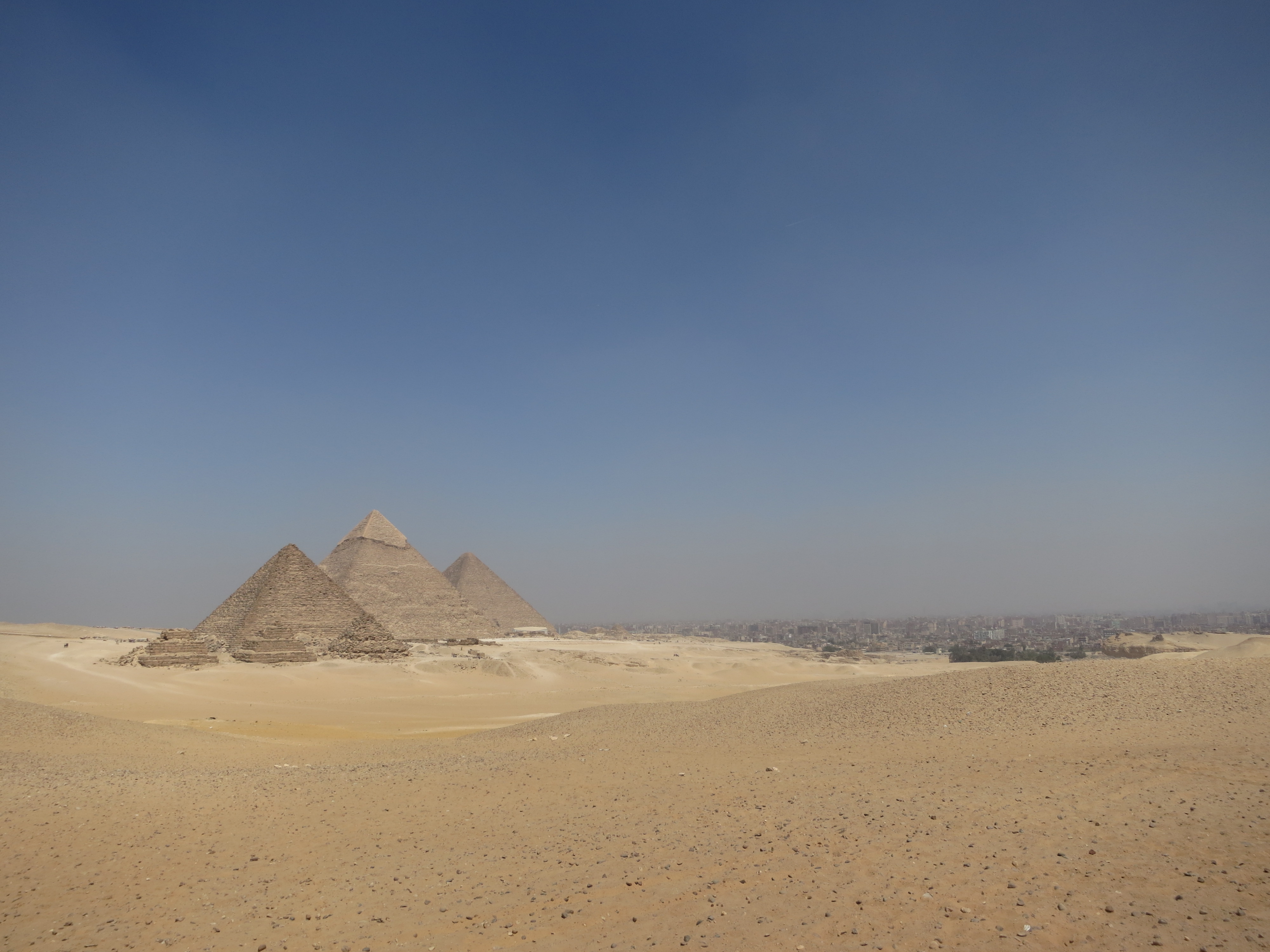
From front to back: the Pyramid of Menkaure with its three mini-pyramids, the Pyramid of Khafre, and the Great Pyramid of Giza

Pyramids on left, Cairo on right, vast expanse of sand everywhere else

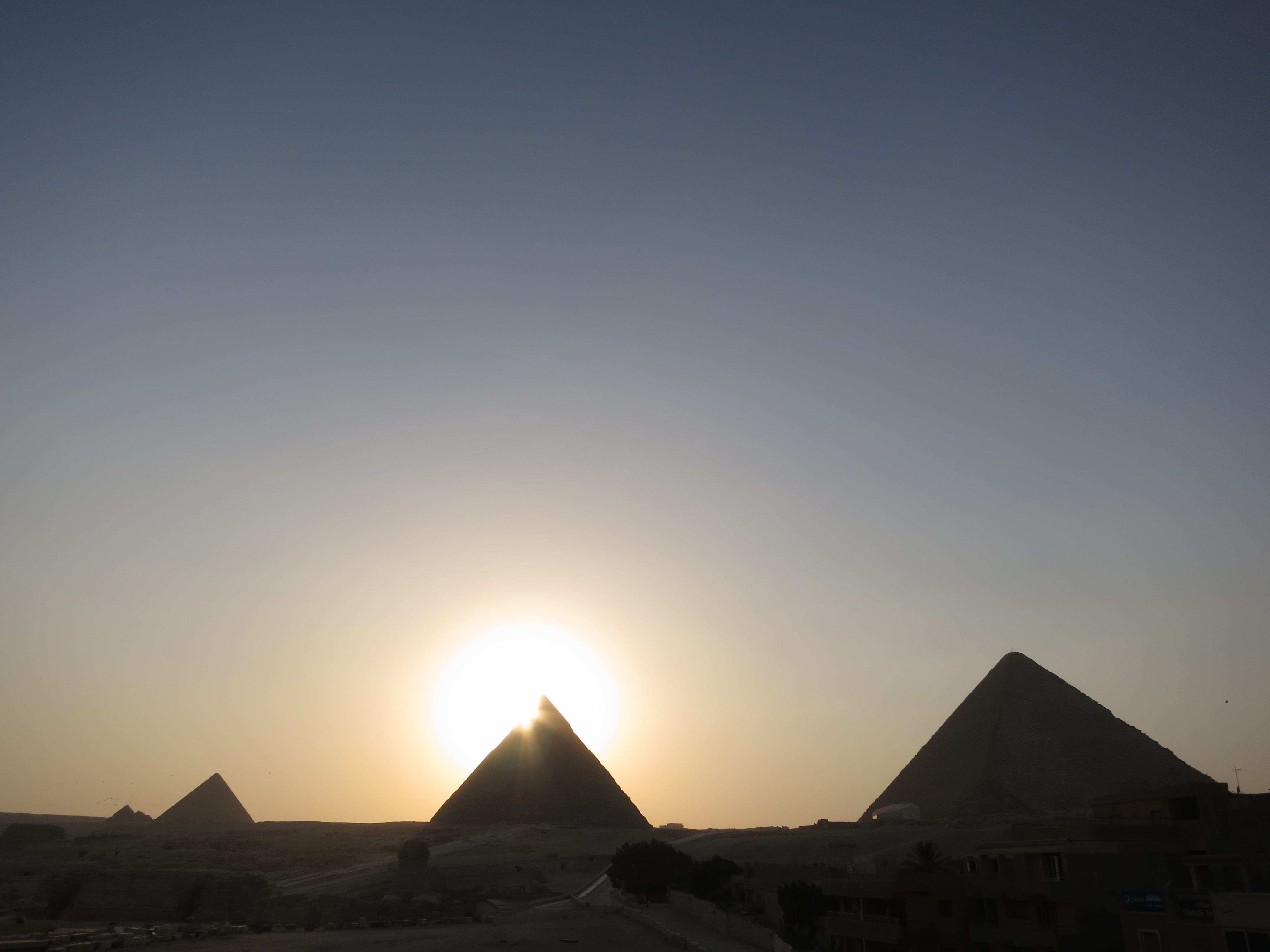
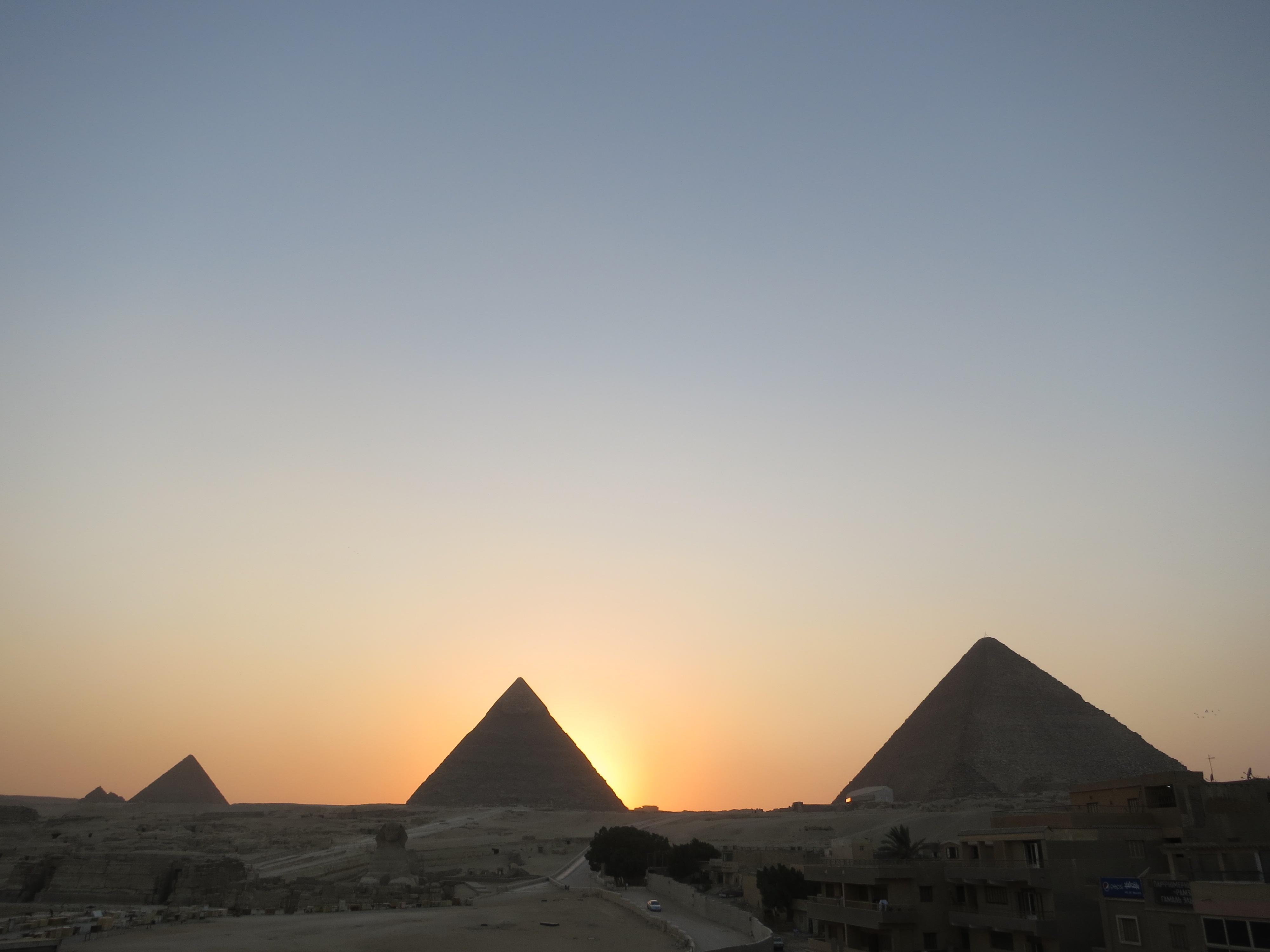
Having spent those hours wandering through the dunes, idly wondering just how far up a pyramid we’d be able to climb before being shot (or at the very least, loudly whistled at) by a bored-looking security dude, we headed in the direction of the Sphinx.  And once done with that, we headed out in the direction of the Sphinx’s gaze.  To Pizza Hut.  Right smack bang in front of one of the ancient world’s greater wonders, the apparent focus of the giant stone creature’s timeless gaze.  Having had our fill putting back in whatever fat the walk in the desert had taken out, we wandered back out and around Giza for a bit, before returning to the same establishment for dessert.  Well, not just for dessert.  Our actual purpose was fulfilled when we made our way up onto the fast food chain’s rooftop, to see the sun disappear behind the Pyramid of Khafre.

The sun setting behind the Pyramid of Khafre, with the Great Pyramid of Giza on the right and the Pyramid of Menkaure on the left

Sunset, as viewed from the roof of the Pizza Hut in front of the Sphinx

Which, we felt, was a fitting conclusion to our adventures in Egypt.

Dealing with touts in Egypt’s tourist hotspots

It’s a sad fact that tourism in Egypt is in desperate straits at the moment.  The global financial crisis and the recent revolution in Egypt have made people unwilling and afraid to go play meet the Pharaohs.  There’s actually no real reason to fear for your safety in the vast majority of the country – no more than there was before the revolution, anyway.  We had to watch carefully for pickpockets, sure, but otherwise we never felt afraid for our personal security.  (Actually, there was one time a random kid threw a well-aimed stick at the back of my head in Cairo.  But that was, well, strange – and, more to the point, atypical.  I don’t think there’s a plague of stick-throwing seven-year-olds you particularly need to watch out for.  Besides, I’m pretty sure I could have taken him.)

Despite what you might see on the news, it’s not like all of Egypt is holding violent riots every other day:  stay away from the one or two places where political rallies get held (predominantly Tahrir Square in Cairo), and chances are you’ll see nothing but a country peacefully going about its daily life.

But one consequence you definitely will see is the desperation of people on the streets of Egypt’s main tourist centres trying to eke out an existence which relies on tourist dollars that are no longer there.  Sure, market forces mean that you’ll get an absolute bargain on everything – and you’ll find the popular attractions far less crowded with other tourists than you might expect, too.  But assuming you look anything like the standard tourist fare, you’ll also get hassled mercilessly every time you venture outside your hotel.  In fact, if you don’t pick your accommodation carefully, it’s quite possible you’ll get hassled pretty mercilessly by your hotel themselves, too.  Make sure you check recent reviews on TripAdvisor before you book.  Some otherwise perfectly reasonable-seeming places seem to have some pretty unfortunate stories of hotels all but strong-arming guests into guided tours, taxis, transfers, etc., making for a really quite unpleasant stay.  You probably don’t want to end up there.

It’s worth noting at this point that all the advice in here relates to travelling as a normal tourist, doing the normal tourist things in Egypt in mostly-normal tourist ways, like we did.  If you’re way off the beaten track and taking the time to deploy your ninja language skills to blend in like a local, like Benny the Irish Polyglot, then all power to you – most of this is way below your level of awesome, and just won’t apply.

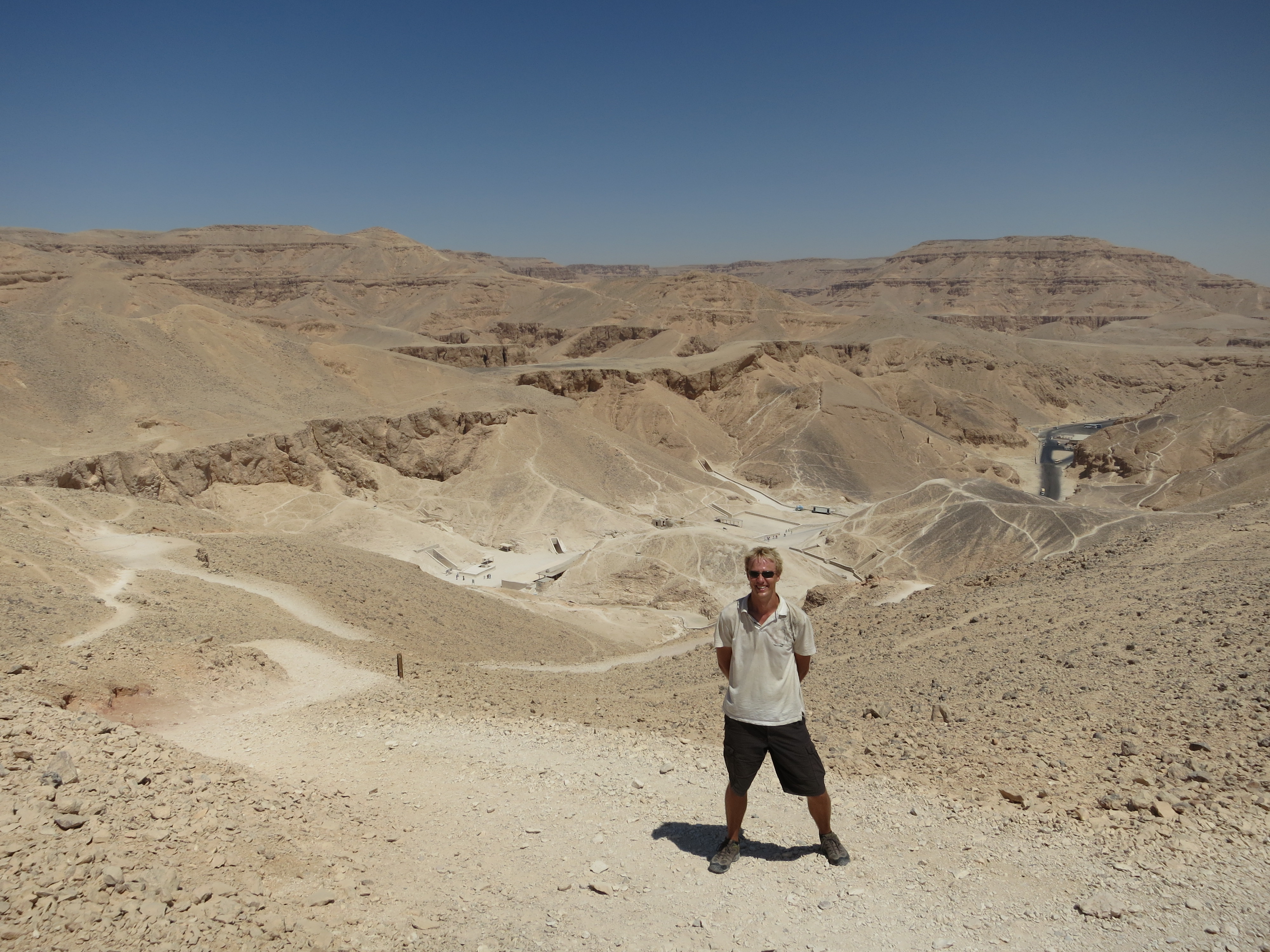
Me above the Valley of the Kings

What an annoying person in Egypt might look like

Once you’re out of your hotel’s front door, chances are you’ll find yourself strolling in a sea of street vendors, each competing vigorously to sell the obvious Westerners (in our case) food and drinks that you don’t want or need.  But at least they’re relatively stuck in one place, tending their stalls.  Mostly, it’s the touts that follow you around that will quickly become the bane of your existence:  the taxis, the horse-and-carriage drivers, the boats, the camels, the souvenir hawkers with their cheap tacky sphinxes with neon flashing lights, etc.  For them, the sheer paucity of potential customers makes it worth their while to shadow you around for ages, so long as there’s the slightest possibility, the remotest outside chance that you might change your mind.  We were hounded by a tout selling camel rides at the pyramids for literally twenty relentless, mind-numbing minutes.  There was simply no one else around for him to try to sell his rides to, and, well, there’s nothing else for him to do, so why not persist against all odds?  Even if it never works, it doesn’t cost him anything to try;  after all, the whole concept of opportunity cost relies on there being some other opportunity in the first place.

And to be honest, as understandable as it might be that the head of a starving family wants to do everything he can to earn some extra money from my assumed ample supply in order to feed his family, and as sympathetic as I’d like to be, it’s a right royal pain in the arse.  I still enjoyed our trip to Egypt, but at times, it sure did feel an awful lot like there were a large variety of people doing their absolute very best to make sure I didn’t.  I like to think we’re reasonably seasoned travellers, and able to shrug off most annoyances, but there were afternoons where, having done the sights we’d planned for that day, we simply didn’t bother venturing beyond the nearest KFC because we just could not be bothered dealing with the hassle.

And further, while most touts are aggressive and somewhat rude, it pains me to say that you really can’t assume that just because someone is polite or understanding or understated, or more affluently dressed, that they’re not trying to lure you into something just as bad as the more obvious in-your-face annoyances you just escaped.  We had a couple of occasions where someone appeared to be helping us out (with directions, or even with chasing touts away) and then after a friendly conversation tried to pressure us into this shop or that.  (Most conspicuously, if someone tells you his daughter is getting married tomorrow, walk away.  For some reason that seems to be a common hook, I suppose to make you feel like you’re being rude if you don’t agree to accept his generosity in showing you x or y, or inviting you in for tea, or whatever.)  So one of the most frustrating things about the whole exercise was to effectively destroy my tendency to assume the best of people – especially those trying to help out.

Anyway, this is my attempt at some advice for other travellers to Egypt.  I really don’t think that, as a fly-through short-term tourist, there’s much if anything you can do to get any less unwanted attention on the streets – although I’ll readily believe that a smattering of Arabic will prove very effective in demonstrating that you’re street-savvy or local enough to be not the standard tourist fare.  But, with any luck, this might help you convince a few antagonisers that you’re not worth the effort to keep hassling.

The single most important thing you can do to make your life easier is to know exactly what you want to do, and roughly how much it should cost (since you’ll be bargaining for everything).  Egypt is not a place where you can just turn up and go with the flow.  A little bit of research on the internet will save you a lot of grief:  the last thing you want to find yourself doing is umm-ing and ahh-ing as someone tries to railroad you into a list of suggested activities he can arrange for you for the low, low price of however many Egyptian pounds, no doubt with a free set of steak knives thrown in.  And, of course, a bit of prior research will also tell you what out-and-out scams you need to avoid.

But no matter how much you have planned, and what you know to do or avoid, though, you’ll still find yourself under siege once your feet hit the footpath.  It’s an unfortunate fact, and one that’s definitely not going to help Egypt’s tourism recover.  But, try telling that to a penniless tout, I suppose.

Lazy dogs sleeping out the heat of the day in the Temples of Karnak

This has nothing to do with anything, but on a lighter note, how funny are these dogs lying lazily in the heat in front of the Temples of Karnak?

So, on to some dispelling of hard-earned wisdom…

First, avoidance.  Obviously, if you can manage not to get approached in the first place, then the potential for hassle just goes away.

  • Choose the footpath on the side of the road with oncoming traffic.  That way, horse-and-carriage drivers and taxis can’t follow you down the road as you walk.
  • Look purposeful.  When you’re in a foreign country seeing the sights, if you’re anything like me, your natural inclination is to wander around checking everything out, stopping for photos, stopping to see what other people are doing, often looking quite aimless.  Unfortunately, there’s really no better way to scream “I’m a tourist and I really don’t know what I want to do or how I should do it, please come and offer to help me decide!”.  Even when you’re just walking the streets seeing what the place is like, you’ll find it worth your while if you try to make it look like you’re not.  You don’t have to bustle intently from one destination to the next carrying a frown and a phone to your ear, but you’ll get a lot less hassle if you look vaguely purposeful.
  • Don’t respond to any suggestion with ‘maybe later’, or give any sort of even vaguely non-negative reply to those same two words as a question.  This somewhat circuitously falls into the avoidance category, but it does belong:  there are so few tourists around that it actually will sometimes be worth some tout’s while to follow you around hassling you for longer trying to organise a time and place for ‘later’ – or even to tail you, or wait outside your hotel or restaurant or shop-you-stepped-into-to-get-away-from-the-annoying-people-on-the-street, until you’re done whatever you’re doing first and ‘later’ has actually arrived.  If you think you do want to do something later, then that’s great:  you’ll have no trouble finding someone who can take your money to do it when ‘later’ rolls around.  In the meantime, you want to avoid hassle now, so keep your future intentions to yourself.

But you certainly can’t avoid everyone.  So, once you’ve found yourself locked in someone’s sights:

  • If you don’t want anything from a tout who’s approaching you, don’t say anything, even to his initial approach.  Just shake your hand ‘no’ and shake your head.  There’s no need to be overtly rude about it – although you’ll probably feel a little uncomfortably impolite the first few times someone asks you a harmless ice-breaker type question (usually “where are you from?”) to goad you into conversation, and you just keep silent.  And there’s no need to pretend that the other person isn’t there.  But it’s a fairly fundamental fact of human nature that it’s much more psychologically difficult to keep talking to a person who isn’t talking back, even when you’re desperate to sell something.  Even your just saying ‘no’ is a level of engagement that makes it much easier for someone to keep on trying.
  • In fact, it probably won’t help to pretend that the other person isn’t there.  If they don’t think you’ve seen them, then they’ll just try harder to get your attention.  Make direct eye contact, and feel free to throw on a friendly smile, but make sure your body language is clear that you’re saying no, and keep moving on without pause.
  • For many touts, the above will get you past with a minimum of fuss.  We found that stopping responding verbally was the single most effective thing we did, even though it made us feel uncomfortable and even arrogant at first.  (And, as a bonus, you may get some entertainment from touts trying to guess what language you speak.  Mostly when I didn’t respond to English, the next choice was German.  But I was impressed to be addressed in what sounded like Swedish on a couple of occasions.  And given that I’m six foot four and very blond, I was sufficiently amused to be spoken to in Spanish several times that I almost broke down and responded.)  But there are some real persistent little buggers, and some will follow you awhile regardless.  At that point, your not-talking efforts have probably run their course.  Stop, turn and face them, and tell them you’re not interested, and would they please leave you alone.  That often won’t work, but if you then keep walking and deliberately ignore them completely from then on, your chances may improve.  Maybe.  Your mileage may vary.  It’s worth mentioning, by the way, that this is the point where you should be most alert for pickpocketing.  The occasions when we had someone attempt to pickpocket us were both after an attempt to sell us something, which we’d refused.  That was when the ‘selling’ became more aggressive as it actually turned into a cover for trying to slide a hand into a pocket or bag.
  • Finally, please, for the love of god, once you’ve said (or, following the advice above, mimed) ‘no’, and they’ve kept on trying, don’t change your mind.  If you’re negotiating over the price of something, then sure, walking away is a perfectly valid tactic, and will work absolute wonders – probably moreso in Egypt these days than anywhere else.  So go for your life.  But if someone’s touting something that you’ve indicated right from the start you don’t want, don’t suddenly change your mind after they’ve followed you down the road for fifty metres.  I don’t want to go all Pavlovian on you here, and especially I don’t want to treat the touts – as annoying as the worst of them can be – as some sort of sub-human brutes to be trained – but the last thing anyone should want to do is encourage the idea that persisting after a clear ‘no’ is worthwhile.
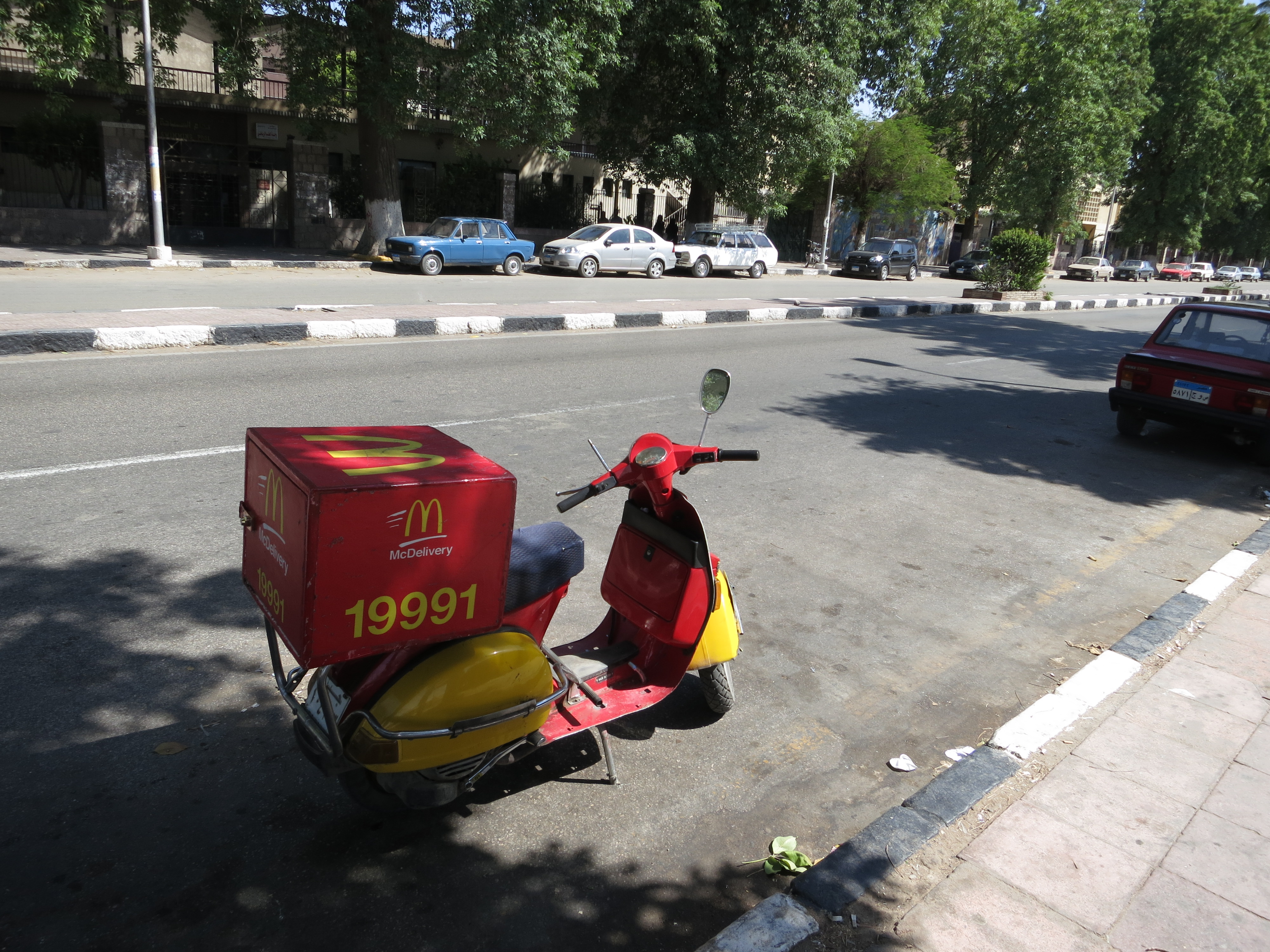
McDelivery in Aswan!

On a more enjoyable note, look what else they have on the streets of Egypt. Why doesn’t McDonald’s deliver in any of the countries I’ve ever lived in?!

And of course, sometimes you do actually want to part with some money and get something, whether it be bottles of water from the nearest street vendor or convenience store, or something a little shinier and gaudier to sit ignored on your mantelpiece for the next ten years.  (Speaking of stores, by the way, the vast majority won’t have marked prices, and will require bargaining from the initial rip-off tourist price you get quoted just like with the street vendors.  If you find a store with marked prices, I heartily encourage you to buy from there.  You’ll probably pay a little more than you could negotiate on the street, but the extra price is worth not having to expend that effort every time, and if that behaviour encourages more places to switch to signed prices, then so much the better.)

  • As above, know roughly what price you think you should pay in advance.  The initial price you’ll be offered will be some multiple – three, five, ten, fifty – of that price, and it won’t be consistent.  So you can’t just assume that your starting point in the negotiations should be, say, a tenth of whatever you’re first offered.  You’ll need to know.  I can’t remember what prices we paid for common things, to be honest, so I won’t give you a list here.  But a bit of googling should give you a good indication (the Lonely Planet forums and TripAdvisor are pretty handy resources, especially), or failing that, ask some other tourists.  If you do know what price you’re after, you have two options:  either start with something lower and work up, or offer your price and walk away if they refuse.  I normally went with the latter – it’s quicker, and they’ll almost always relent unless you’re offering something unreasonable.  In which case:  stop being a dick and just pay the poor guy a fair price.
  • Often, you’ll be well served not to make a counter-offer at all.  Just ask how much, and then when you get quoted something laughable, laugh and walk away.  Nine times out of ten you’ll be followed down the street and offered lower and lower prices as you go.  Those prices will converge towards something reasonable after a little while.  Offer that, and you’re probably set.  This worked pretty well for us for ferry rides across the Nile, in particular.  Sometimes, you’ll find you’re ending up with what feels like a ridiculously, unreasonably low price.  The three of us got ferried across the Nile on a private boat for five Egyptian pounds once – that’s around fifty British pence, or eighty Australian or US cents.  And I wouldn’t be surprised if we were the driver’s only customers for the day.  I have no idea how he can make a living that way – he probably can’t, but he doesn’t have any other options.  If you find yourself in that scenario, where you’re offered a much lower price than you’re willing to pay, again, don’t be a dick – once you get there, pay more.  You’re not trying to break their balls and deny them a living just because they’re annoying in their desperation.  You’re trying to avoid getting opportunistically ripped off.
  • This sounds stupid, but make sure you confirm that the price you’re being quoted is in Egyptian pounds.  Evidently a popular scam with some touts is to give you your boat or ferry ride or taxi trip or whatever and then express surprise that you didn’t realise that the quoted price was in British pounds (around ten times more expensive).  Once you’ve already taken the trip, you’re in a much worse position to insist that no, you’re only paying the price in the currency that was obviously actually intended.

Finally, if you do find yourself overly harassed, or in trouble with an aggressive tout, or whatever, there are always the tourist police, whom you’ll see around and about on the streets and at the major tourist sites.  They’ll be the ones with the big guns which they may or may not be using as pillows at the time.  (Seriously, at the Tombs of the Workers in Luxor, we actually saw one of the tourist police having a nap and using his AK-47 – or whatever they are – to rest his sleepy head.  Gives you a lot of confidence in their ability to safely handle their weapons under slightly more stressful circumstances, no?)  We never had cause to seek them out, and from what I can gather, they’re of varying usefulness (and are varyingly corrupt).  But you might find a knight in shining armour – and even if you don’t, the threat of the tourist police might be the final straw that gets rid of a particularly annoying aggressor.

The sun setting behind the Pyramid of Khafre, with the Great Pyramid of Giza on the right and the Pyramid of Menkaure on the left

Why you might want to go to Egypt despite the hassle. How cool are pyramids?

So, I hope the above all helps someone.  I hope it doesn’t put you off travelling to Egypt.  (Although, if it does, you might want to consider Petra in Jordan instead – blog post to come.  It’s not the pyramids, but it’s pretty much as awesome, and after our experiences in Egypt, we found the touts there so friendly and respectful that we wanted to go give them all a big hug.)  But it might help you to be a good boy scout and be prepared.  If so, job done.  Enjoy your travels.

Luxor: your in-the-flesh textbook of ancient Egyptian history

Whereas Aswan was a base for Abu Simbel, and itself had only the Tombs of the Nobles, Luxor is a smorgasbord of ancient sites.  (Well, Aswan itself had only that if you consider just the things we bothered to see – we skipped the gardens on Lord What’s-his-face’s island in mid-Nile and a couple of other minor attractions, blaming a hearty reluctance to give enough of a crap to bother dealing with the touts we would have had to navigate en route.  More on them in the next post.)

There’s the Valley of the Kings (including the tomb of King Tutankhamen), the Temple of Hatshepsut, the Mortuary Temple of Ramesses II (more glibly known as the ‘Ramesseum’), the Colossi of Memnon, and the Village and Tombs of the Workers, all on the west side of the river, in the Theban Necropolis.  So that would be the ‘monuments to dead people’ side of the river.

Then there are the Temples of Karnak and the Luxor Temple on the east.  The ‘praying for a little longer before ending up on the other side’ side of the river, perhaps?  A couple of long days in the sun, and we did it all.  Oh, and the museum, too – also on the east.  (That part of the day obviously wasn’t long in the sun – in fact, I couldn’t help but laugh when I saw that many of the museum’s more gushing reviews on TripAdvisor seemed to go on at quite some length praising the quality of its airconditioning.)

The pictures don’t convey the full awesomeness of being at the sites, surrounded by history that’s pretty much as tactile as it gets.  (Not that you should actually go too overboard on the tactile experience, of course.  No overenthusiastic rubbing away the remaining artefacts of ancient Egyptian culture, please.  Although I’m sure for a suitable ‘tip’ to the nearest ‘guard’, you can probably buff yourself vigorously against whatever relic comes to hand, if you really want to.)  More than that:  history you can walk through, and around, and between, and under.  History that’s standing in the same place it was put thousands of years ago.  For all the hassle and annoyance of travelling in the tourist centres of Egypt, standing in the desert amongst such ancient grandeur was worth it.  In such an amazing place full of amazing monuments.

… But any description that I could give is going to fall far short of bridging that gap, so to some extent, at least, the pictures’ll mostly have to do anyway.  Except for the actual contents of the Valley of the Kings and the Tombs of the Workers – no pictures allowed there, I’m afraid.  (Probably for the best, or we would have been there happy-snapping for days.)
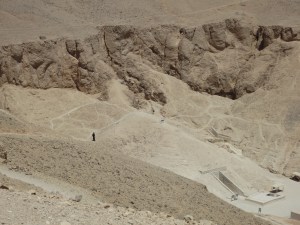
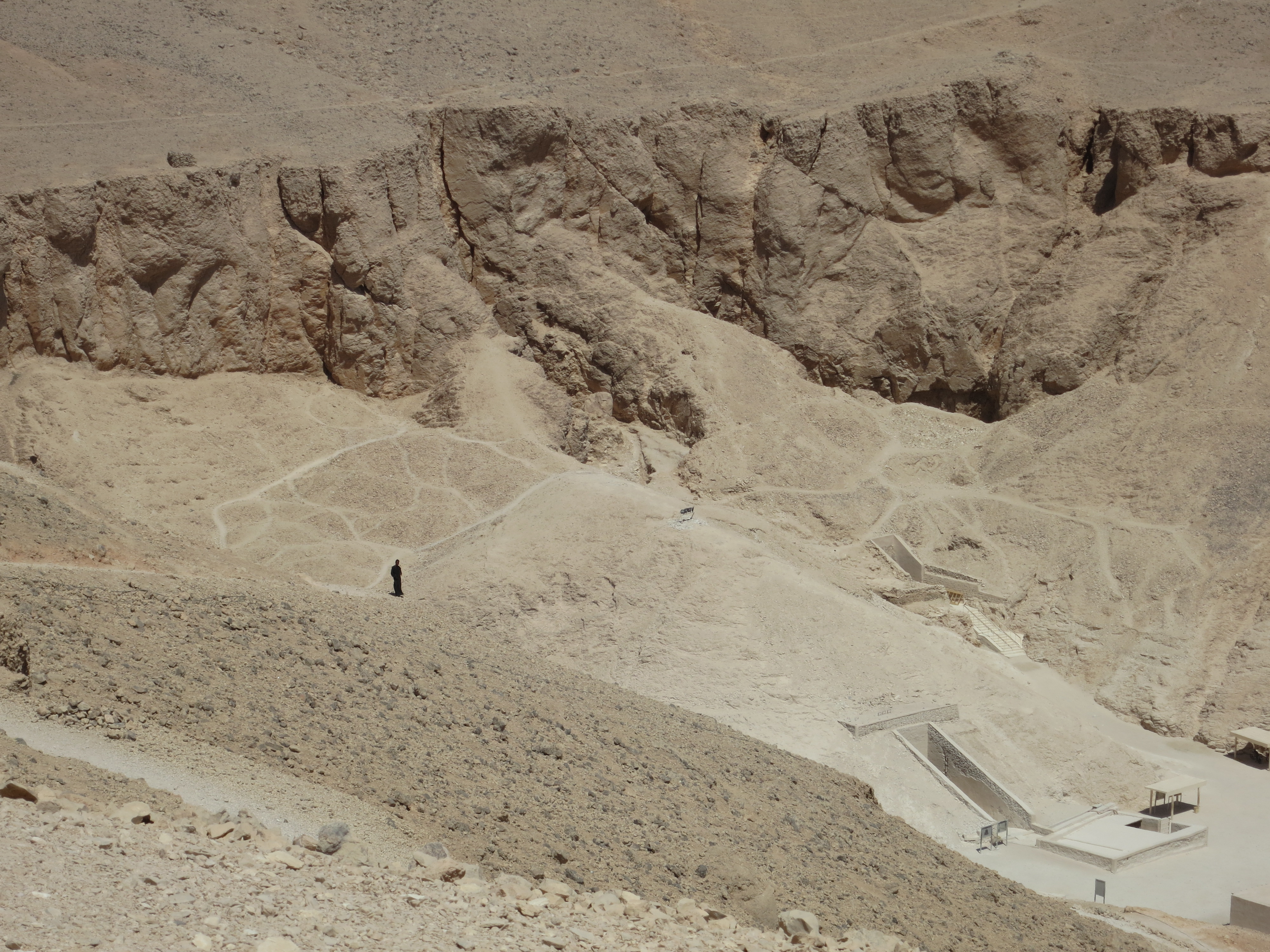
A lone black-robed hawker on a hill above the Valley of the Kings

A lone black-robed hawker on a hill above the Valley of the Kings

We started our first day early, finding a taxi on the street to take us around the dead-people sites (ie on the west side of the river).  We would have organised it through our hotel just to save time and to avoid the hassle of dealing with people on the street, but the night manager was evidently try to scam us by quoting hugely higher prices than the hotel owner’s starting price had been, so we decided to give that a miss…  Score one for doing things yourselves:  we easily negotiated a price on the streets well below what the hotel was promising, and paid less than we would have had the hotel owner organised it, even after a substantial tip to the driver at the end of the day.

We got to the Valley of the Kings around 7.30am, and were glad we did.  Although there were a few hardy souls who had got there at the crack of dawn and were already leaving, there were still very few others around, and we got to enjoy many of the tombs completely by ourselves.

That included the tomb of King Tutankhamen (designated KV62), which, after handing our separately-purchased additional ticket for the tomb to the remarkably Morgan Freeman-lookalike guard outside, we were able to experience with not even a hint of any other people around.  So the three of us stood alone in front of the King’s mummified remains – just his head and feet poking out from under a white blanket in a glass case – before exploring, in bizarrely air-conditioned comfort, the remarkably small space that he’s inhabited for most of these last three thousand odd years.  And noting that there seemed to be an awful lot of baboons depicted on the walls, among other animals and humans.  I wouldn’t have picked ancient Egypt as a baboon-rich environment, myself, but there you have it.

The other big highlight of the morning – the double tomb of Ramesses V and Ramesses VI (KV9) – we also got to ourselves.  Well, but for the guard constantly and annoyingly pointing out blindingly obvious features – “that’s Anubis”, “that’s a cow”, “that’s a bird”, “here’s Ramesses V”, “here’s Ramesses VI”, the last two repeated ad nauseam – in broken English in hopes of a tip.  (Solution for those travelling in a group:  split up.  There were three of us, and with each of us in a different part of the underground tombs, the guard could only annoy one of us at a time, at most!)  The double tomb was clearly a substantially bigger enterprise than Tutankhamen’s frankly miserly effort:  a long entrance chamber of brightly coloured hieroglyphics, with then a two-part extended corridor leading along and then sloping gently down to a large main chamber with a huge broken stone sarcophagus.  This is the sort of tomb that announced power and privilege, and somehow even sarcophagus’s brokenness contributes to that effect.

The interior decorators for the double tomb seem to have chosen snakes as the feature animal, rather than King Tut’s simians, and so the entranceway is adorned with quite a number of enormously long footless reptiles, with even a few snake-headed people mixed in amongst the more usual dog- and bird-headed fare.  Quite a handful of scenes of men riding snakes, too;  perhaps some of the less practical depictions, to my admittedly uneducated mind.

Having seen the two big-ticket (and separately-purchased-ticket) items first, we then had to pick three of the eight or nine other tombs in the valley which happened to be open at the time.  (Your standard entrance ticket to the Valley comes with three tombs included, none of which can be King Tut or the double tomb.  Other tombs sold separately.)  We tried to pick a reasonably varied choice from the descriptions we’d researched the night before.

First, KV11, the tomb of Ramesses III – a huge tomb, but with its four large chambers at the bottom completely ruined, with broken ceilings and with their plastered walls almost completely worn away.  Like a number of others in the Valley, the tomb has been open since antiquity, and has clearly suffered for it.  But enough remained to pick out more snakes in the decorative elements – this time including some, strangely, with legs – and the upper section of the entrance corridor (before the bit where they accidentally broke into KV10 – whoops! – and had to clumsily dogleg around before continuing on to the main chambers) still survives enough to make out the staple of hieroglyphics, eagles, birds, dogs, etc.

Next, KV16, the tomb of Ramesses I, this one very deep, down a few steep sections of stairs to a small chamber well underground.  Unlike King Tut’s version, there was no airconditioning here, so the incredibly colourful chamber was somewhat hot and sticky.  But that didn’t much affect our appreciation of the large central red stone sarcophagus and the bright hieroglyphics on the walls – here simply painted onto a background painted on the wall, not carved in as in most of the other tombs.

And last, KV47, and finally someone back to someone not named Ramesses – this the tomb of Siptal.  Again we were alone as we wandered down the long corridor to the burial chamber ruined long ago by flooding.  And we remained alone as we studied its detailed rose-coloured stone sarcophagus, decorated with intricate engraved hieroglyphics on the sarcophagus itself, all the while appreciating that the location and orientation of this particular tomb kept it nice and cool – a welcome contrast to Ramesses I’s hole in the ground.
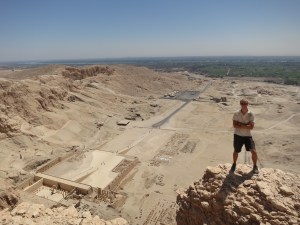
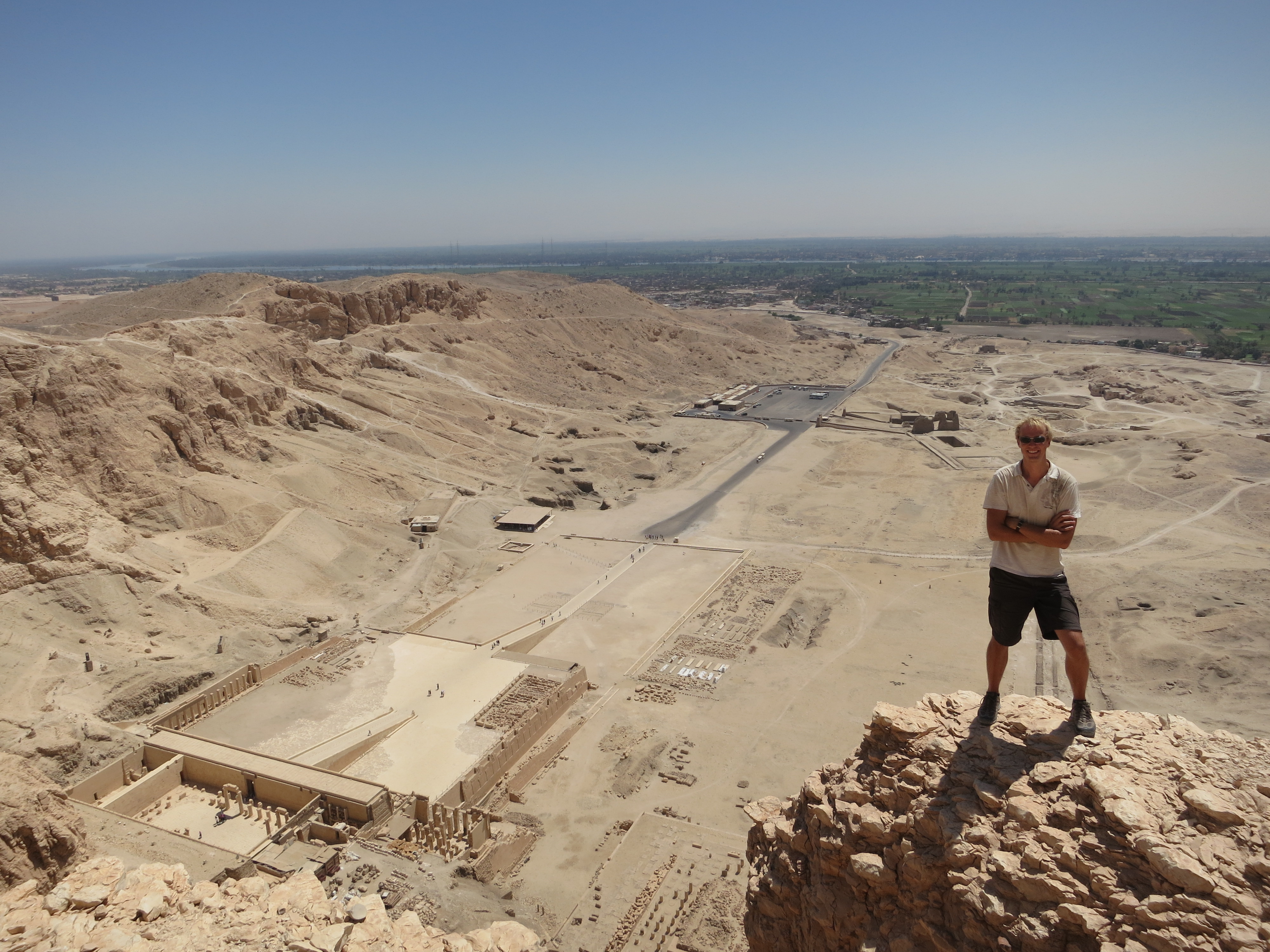
Above the Temple of Hatshepsut

Above the Temple of Hatshepsut, on the ridge between the Temple and the Valley of the Kings

Once the Valley of the Kings had thus been suitably explored, we ventured up the hill (up the sort-of-marked path past the ‘no climbing’ signs) and over the ridge to the east, to overlook our next destination for the day:  the Mortuary Temple of Hatshepsut.  We checked that out from our perch up on high, and enjoyed the view across the thin green strip of land astride the Nile, before returning through the Valley of the Kings to find our taxi and drive round to wander through Queen Hatshepsut’s impressive monument, which, at least, we could explore with cameras at the ready.
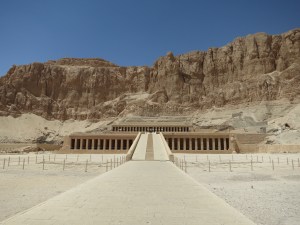
The Temple of Hatshepsut

The Temple of Hatshepsut. Our wander from the Valley of the Kings had taken us to the edge of the cliff on the skyline directly above the temple.

From there, it was off to the equivalent structure for Ramesses II:  the ‘Ramesseum’.  A slightly less intact edifice, this one.  I guess that’s what you get for building your ‘temple of a million years’ on the Nile flood plain, perhaps forgetting that a million years means really quite a lot of water movement through the area, which I imagine doesn’t do great things to the structural integrity of your foundations, even if the building itself doesn’t normally flood.  But anyhow, the giant stone head – of the Ozymandias colossus – is probably much more interesting and imagination-provoking lying on the ground than it would be on a still-preserved statue, so the ruins were impressive regardless, and we spent a good hour picking through them while our taxi driver wandered off to find his lunch (somewhat incredulous that we weren’t doing the same;  not only that, but also that we intended to keep going for the rest of the day without stopping – presumably most of the tourists passing through have a little more difficulty with the heat and effort of wandering around in the sun all day!).

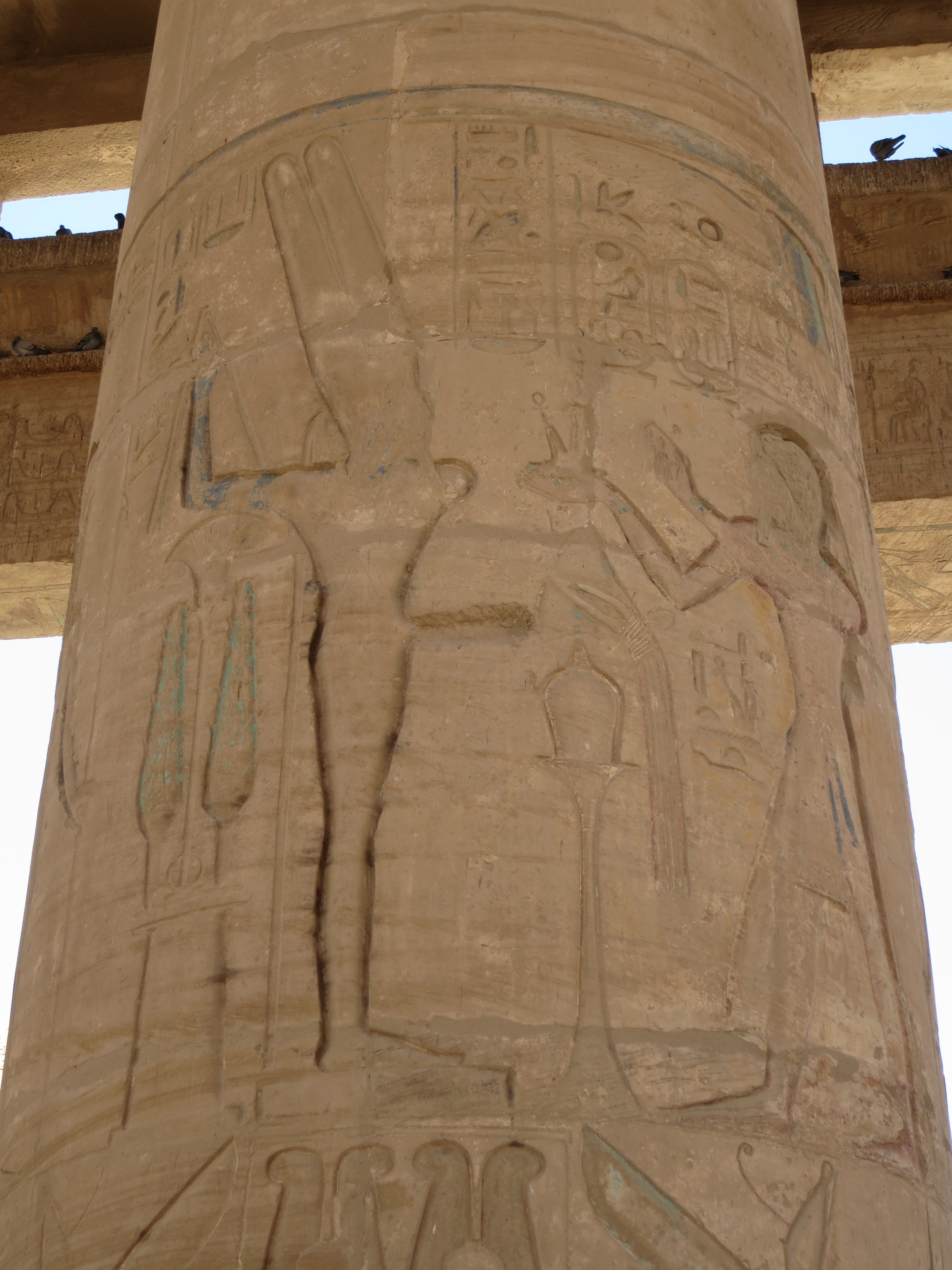
We also amused ourselves giggling at perhaps the most ridiculous aspect of the day:  the valiant attempts of Catholic missionaries to scratch the large phalluses off the fertility figures on the pillars.  Of course, having scratched away as they did, all they really succeeded in doing was leaving a series of even more obvious, slightly larger, vaguely dick-shaped indentations, so I’m not quite sure what they thought they were achieving.  But it’s the thought that counts, I suppose.
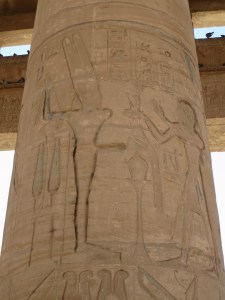
An excited ancient Egyptian, with member rather unsuccessfully erased

An excited ancient Egyptian, with member rather unsuccessfully erased

The penultimate – but yet still quite substantial – attraction for the day was the Village and Tombs of the Workers.  The ancient village of Deir el-Medina housed the masons and other artisans who worked on the tombs of pharaohs and nobles in the Valley of the Kings and elsewhere around the Theban Necropolis, and in what I can only imagine must have made for an incredibly morbid existence, in what little time they had to spare from building big rich people tombs, the more well-off of those masons and artisans built small poor people tombs for themselves and their families.
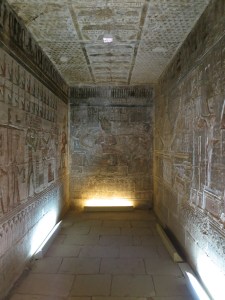
Ornately decorated walls inside a temple in Deir el-Medina (the Workmen's Village)

No photos allowed in the tombs, but here are some ornately decorated walls inside a temple in Deir el-Medina (the Workmen’s Village)

While much smaller than many of the more grandiose tombs in the Valley of the Kings – as you’d expect – some of these more humble final resting places are incredibly well preserved.  So although Deir el-Medina may not be a staple of the main tourist track through Luxor, it’s most definitely worth a visit.  The intricacy of the beautifully painted tomb interiors here far exceeds what we saw in the thoroughly-looted tourist hotspots earlier in the day, to the extent that we were almost saddened to see that we seemed to be the only people bothering to visit them.  The walls and ceilings are vividly painted with scenes every bit as detailed and colourful as the better-preserved parts of the tombs of the Kings.  And the much reduced size gives the tombs an intimacy that the Kings’ tombs can’t rival.

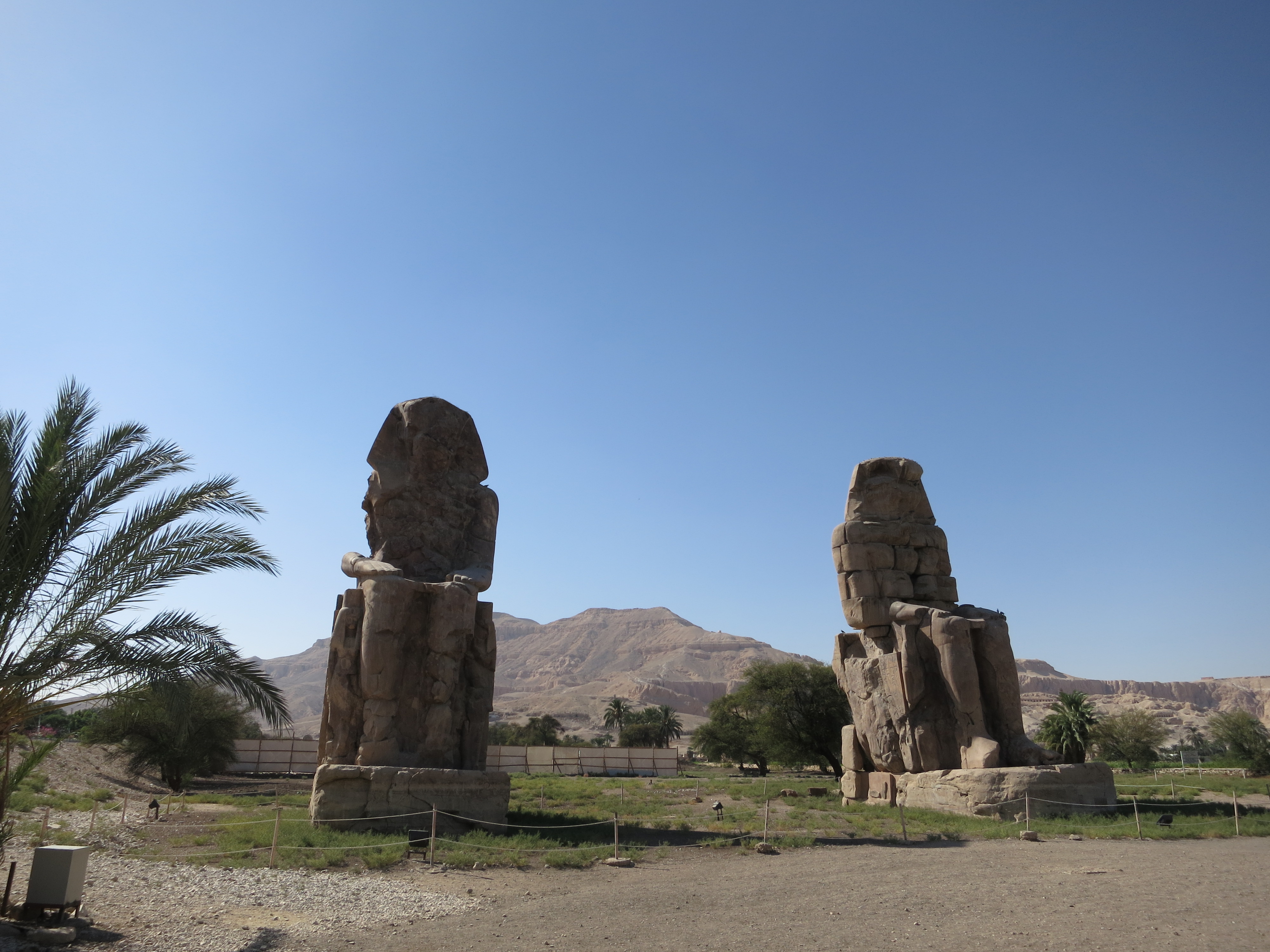
Finally, to round out the day, a brief stop at the Colossi of Memnon.  Wikipedia tells me that the Colossi’s original purpose was to stand guard at the entrance to an even bigger temple than the Ramesseum, or any other temple in Luxor.  But you wouldn’t know it these days:  they’re out by themselves in the middle of nowhere, with Amenhotep’s Mortuary Temple having survived the inundations of the Nile even less well that Ramesses’.
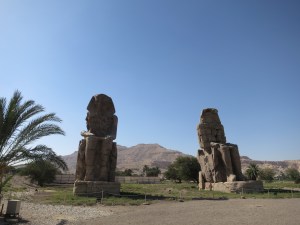
The Colossi of Memnon

The Colossi of Memnon

And thus we completed day one:  a fantastic day of epic history and stoic water consumption in the blistering sun.

Day two had a shorter itinerary, but the main item – the Temples of Karnak – was pretty much a whole-day event.  The Temple complex is enormous and quite varied.  We started with the towering pillars of the Great Hypostyle Hall, and spent a large chunk of the day making our way on a long circuitous navigation through a variety of other temples, obelisks, halls, etc, right out to the lonely statue of a scarab beetle out back.  You’ll know you’ve got to it when you see the surrounding hordes of tourists walking endlessly around it, in imitation of the ancient tradition to circle it seven times counter-clockwise for good luck.  I was subsequently told that what the tourists generally don’t know is that this was the good luck charm you used if you’d tried everything else but hadn’t been able to find a suitable wife or – more frequently – husband.  This made it all substantially more amusing, considering the number of couples striding purposefully around, just because the tour guide told them to.
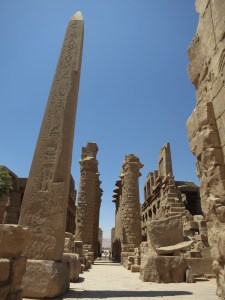
A view down the central axis of the Temples of Karnak, from between the two great obelisks, right back towards the entrance

A view down the central axis of the Temples of Karnak, from between the two great obelisks, right back towards the entrance

After most of our day was spent at Karnak, we did indeed enjoy the airconditioning of the Luxor Museum.  Also, it was a pretty good museum:  somewhat small, but well-labelled and informative, and with some interesting and well-preserved artefacts (yes, including two mummies) to gawk at.

The Luxor Temple, the last item on our to-do list, we gave a miss, satisfied with simply observing it from the outside on our several walks past, and not feeling a pressing need to endure the mass of hawkers at its entrance to see from the inside what we could already see from the street.

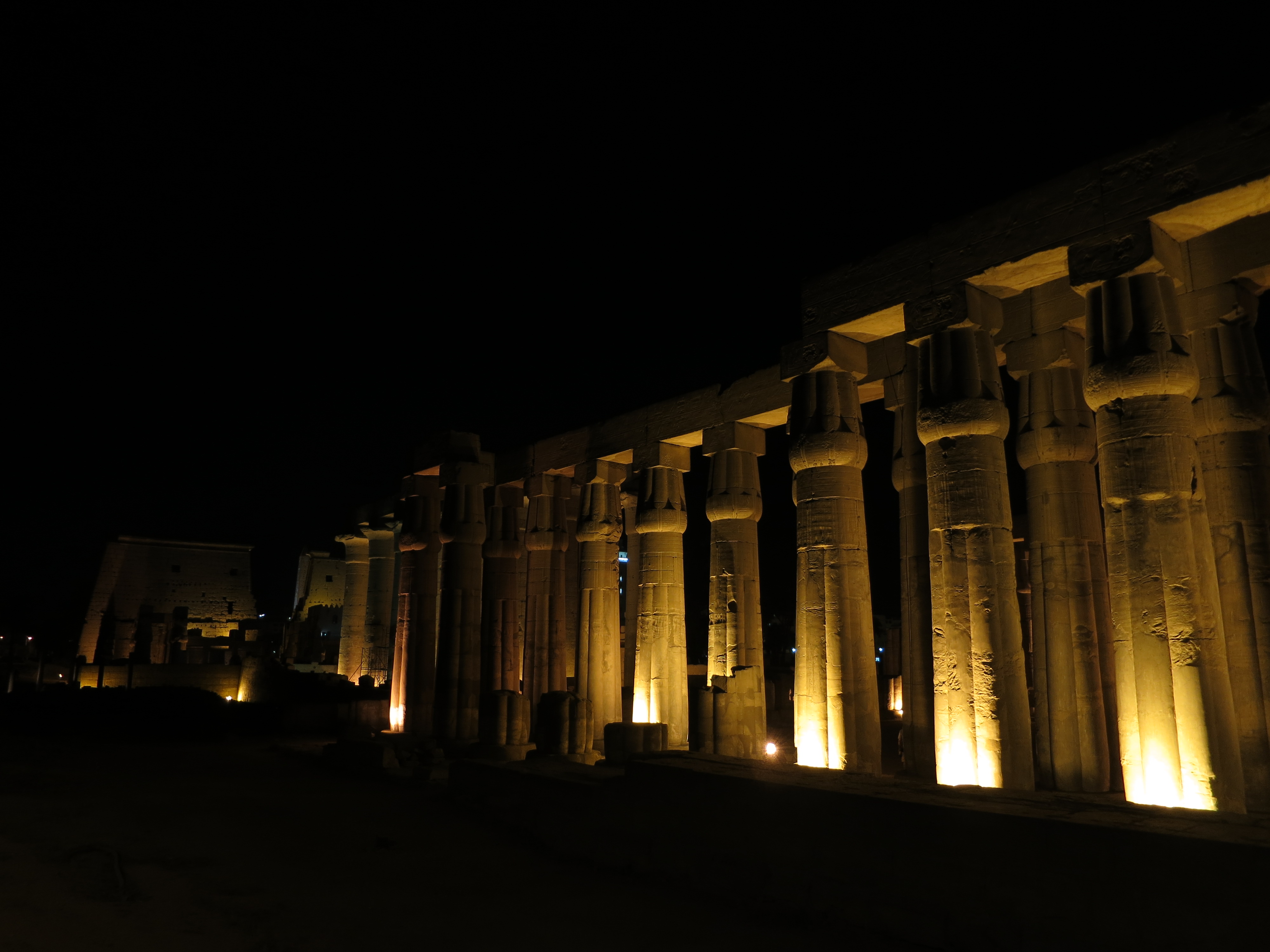
The Temple of Luxor at night

The Temple of Luxor at night

And then, several visits to McDonald’s later, we were done with Luxor, and off for what we hoped would be a comfortable and scenic train trip up to Cairo…

Aswan: our introduction to Egypt

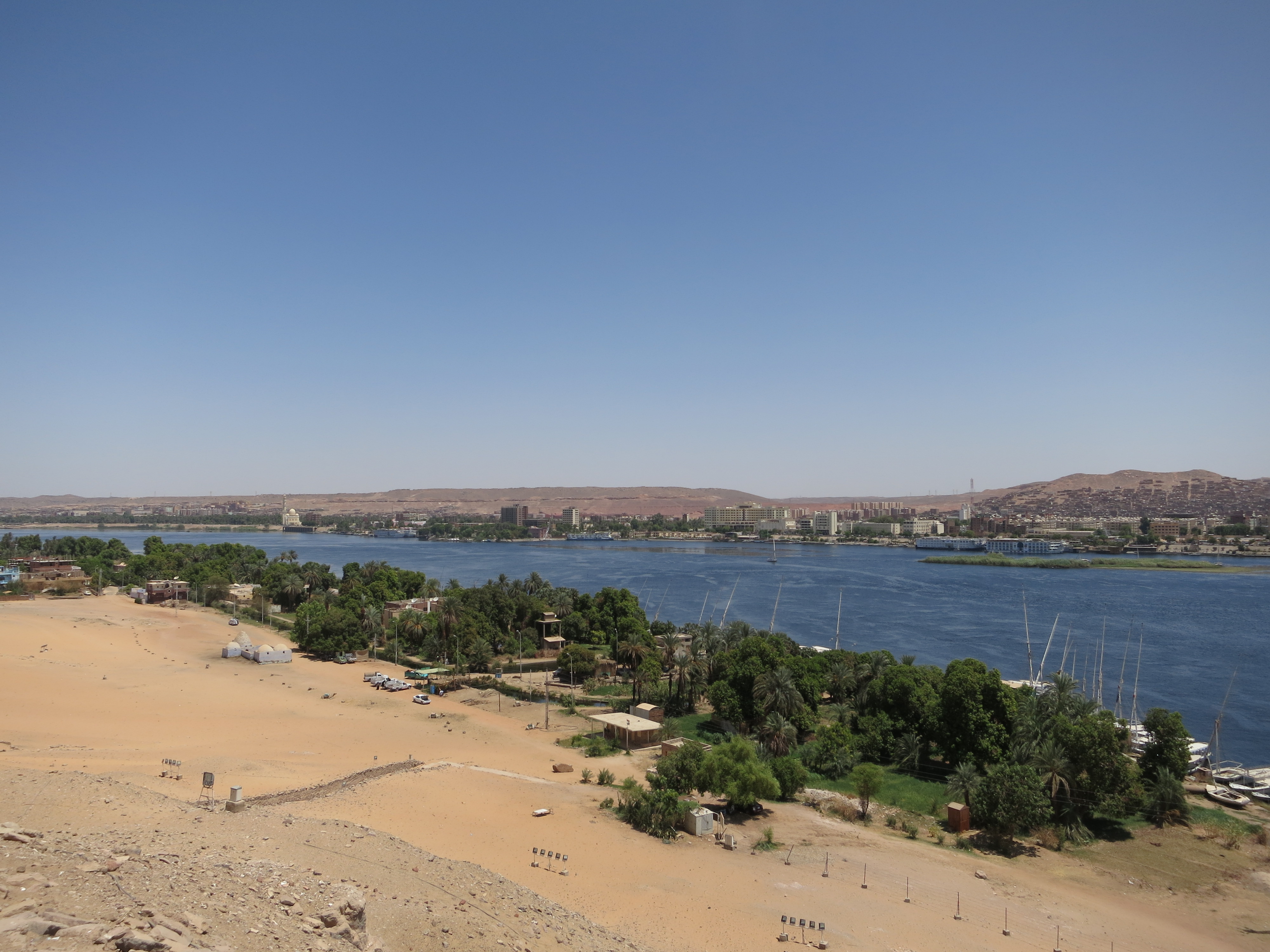
Aswan, seen from across the River Nile, from amongst the Tombs of the Nobles

Aswan was our introduction to Egypt.  It introduced us to heat – forty degrees plus, but dry, much like I remember South Australian summers growing up, albeit with a lot more sand.  It introduced us to the up-close-and-personal wonders of visiting the world’s archetypal archaeological destinations – the ones you’ve always associated with exotic far-off lands;  the ones you don’t really imagine as things you could stand beside, or inside, or staring in the face of.  It introduced us to an unreasonably large number of trips to McDonald’s – if only to get a salad we could trust had been washed in water that wouldn’t make us sick.  (Of course, given that we were there, it seemed silly to pass up the opportunity for a side of burger, chocolate milkshake and sundae.  Possibly two sundaes.)  It introduced us to Egyptian drivers’ novel use of headlight and horn as a method of communication – at times seeming as though we were witnessing some complex courtship ritual conducted entirely via the flashing of lowbeams.  And it introduced us to the utter desperation of locals trying to survive in a country almost entirely dependent on tourism, but which has seen tourist numbers fall off a cliff over the last two years, since the beginning of the revolution.  That introduction basically consisted of being hassled mercilessly and constantly every time we ventured onto the street.  But more about that in another post.

We were in Aswan for Abu Simbel.  That despite the rather blatant fact that Abu Simbel isn’t in Aswan – it’s a four hour drive away.  But it’s four hours’ drive in the direction of Sudan, through a part of southern Egypt that’s not generally considered a great place to be.  Which is made obvious when you get up at 4am to meet your minibus for the daily police-escorted convoy, all off to see Ramesses the Great’s famous monument to himself and his wife.  (Well, one of his wives.  He was a pretty popular guy, it turns out.)

Once we got past the bizarreness of that convoy – and the early-ness too, for that matter – we got on with gaping and gawking at the history sitting right there in front of our noses.

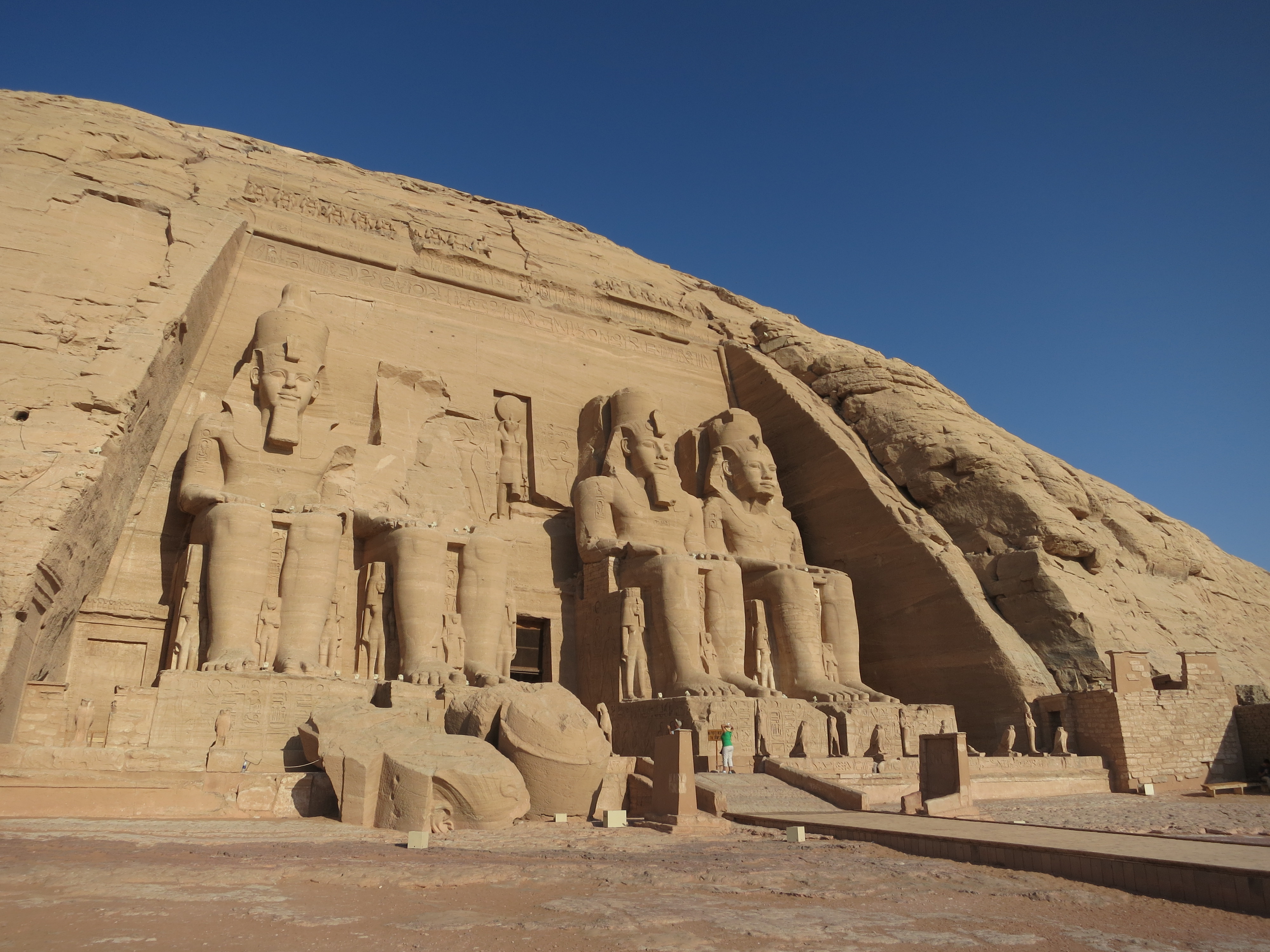
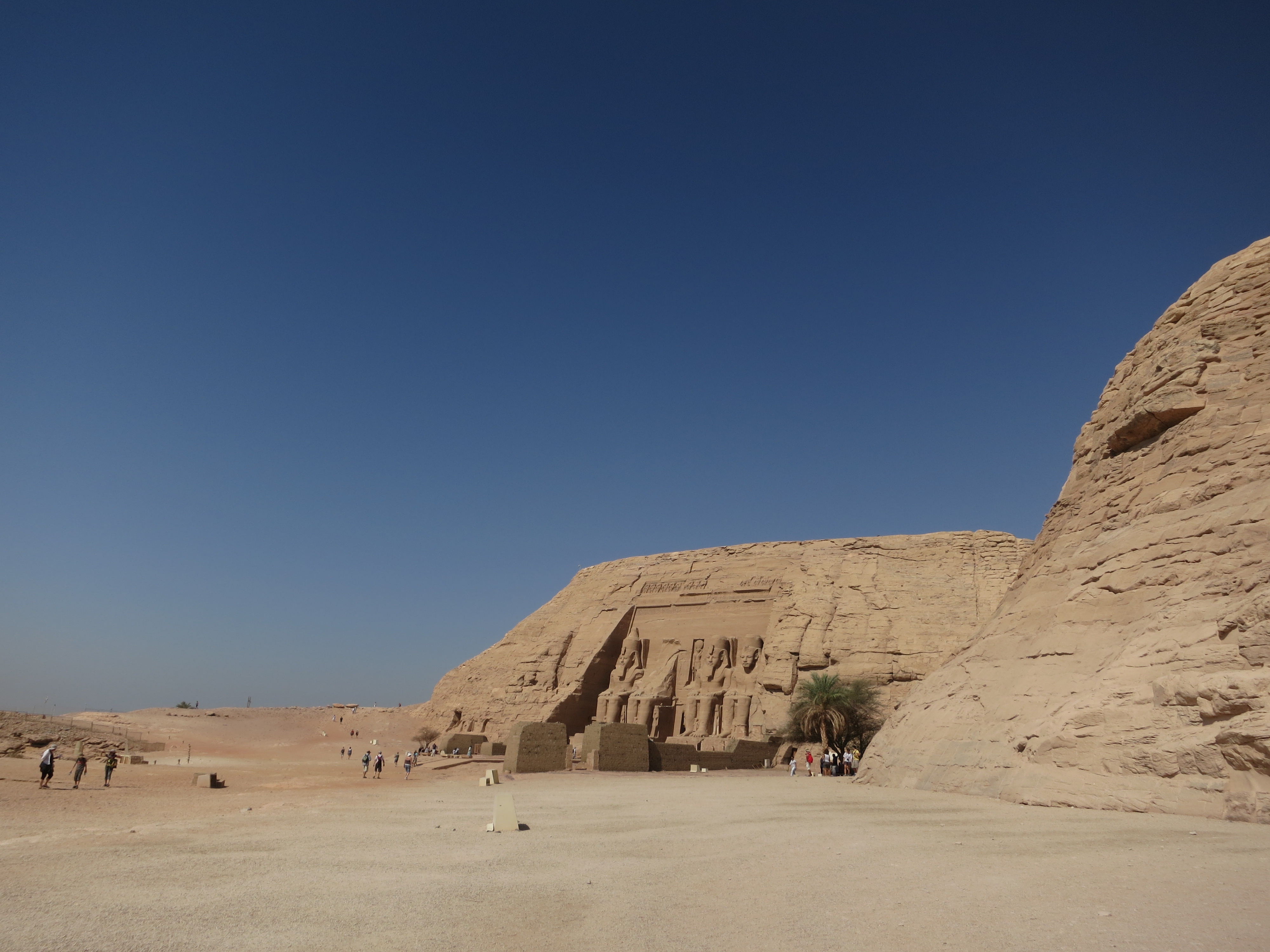
The main temple, dedicated to Ramesses the Great, at Abu Simbel

Abu Simbel is two temples carved into the rockface built to face (and overawe, presumably) Egypt’s potential invaders to the south.  One temple for Ramesses II (aka Ramesses the Great), and one for his wife Nefertari, of whom he was evidently rather fond.  (Moreso than one imagines were the slaves tasked with the more menial aspects of demonstrating Ramesses’ devotion, anyhow.)

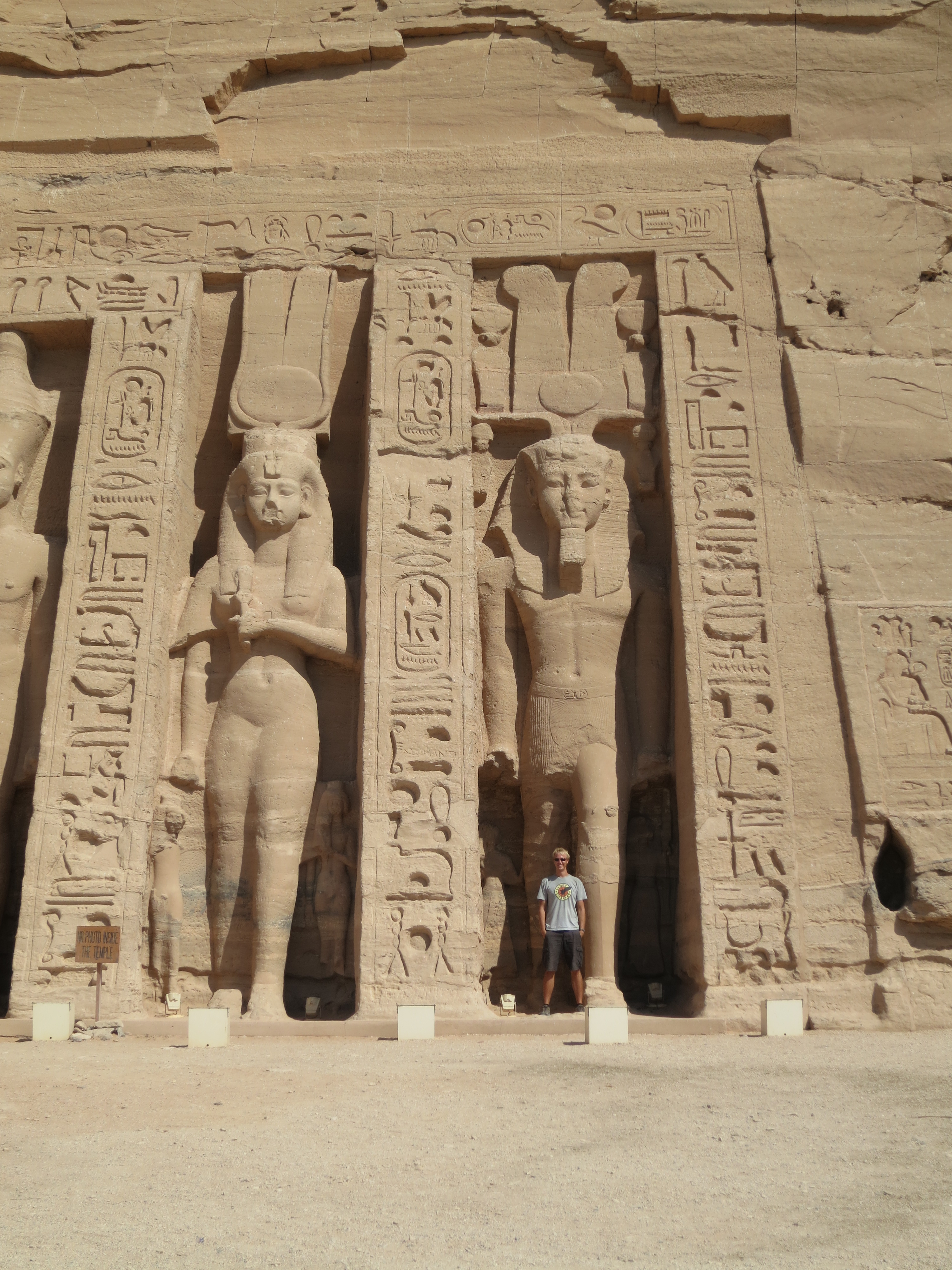
In front of a statue of Ramesses the Great in the façade of the Small Temple

The pictures will convey the impressiveness much better than any descriptions I can give…
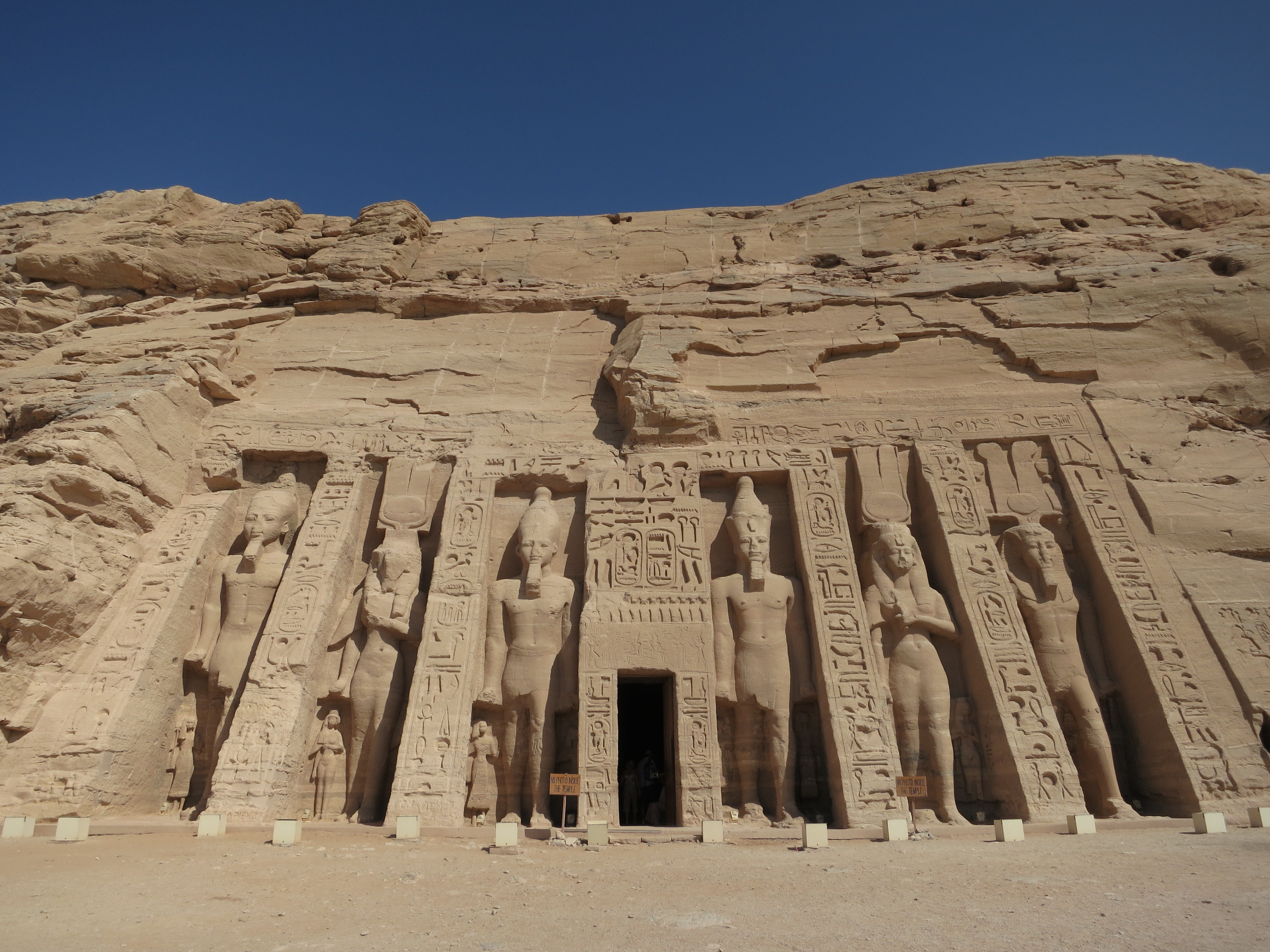
The façade of the Small Temple

… except for one thing the pictures don’t show:  the temples are not where Ramesses had them built.  There’s a dam there now.  So in the 1960s, while building said dam, they also relocated Ramesses and Nefertari en toto.  Quite a feat, which the visitor’s centre impresses on you well.  Then you realise that you’re being impressed by the job they did in the late twentieth century.  With, y’know, bulldozers and cranes and stuff.  Carefully relocating an original that was built three and a half thousand years earlier.  With, y’know, slaves and little rock hammers that these days don’t have much greater utility than to test your knee reflexes.

The Great Temple, seen from in front of the entrance to the Small Temple. Yeah, looks like a bugger to relocate, doesn’t it.

Other than Abu Simbel, we did little in Aswan other than acclimatise to the heat and to the wearyingly relentless attempts to sell us this, take us for a ride on that, and generally find a way, any way (legitimate or otherwise), to get as much money as possible from my pocket into someone else’s.  We did get a boat across the river to explore the Tombs of the Nobles – that was before Abu Simbel, and was interesting both as our first live experience of Egyptian history and because it also offered some good views across and up the Nile.  But other than that, once our police convoy safely delivered us back from our meeting with Ramesses, we relaxed and got ourselves ready for a train ride up to Luxor.  Job done, next bit of history, please…

A falluka sailing down the Nile, in front of the Tombs of the Nobles

Sunsets aplenty in the Greek Islands

The Greek islands were our last stop in Europe before moving on to tackle Egypt and the Middle East, Nepal and south-east Asia.  This was my third trip there, all within a year:  the first was a much-needed and thoroughly enjoyed holiday in the form of a sailing jaunt with my parents, the second a long-anticipated birthday celebration for an Australian friend.  Both of those occasions had been a blast, so I knew I was unlikely to find any way not to enjoy my time in the sun and the water and the whitewashed guesthouses and cafés and tavernas.

We had a week to relax and just enjoy where we were:  no big-ticket tourist sites to navigate, no running around with careful plans to fit the most we could into each and every day.  Just a nice spot to chill out.  That’s not to say that we didn’t do anything:  just that we didn’t have to.  The most detailed plan that we had for each day was typically “where should we watch the sunset from tonight?”.

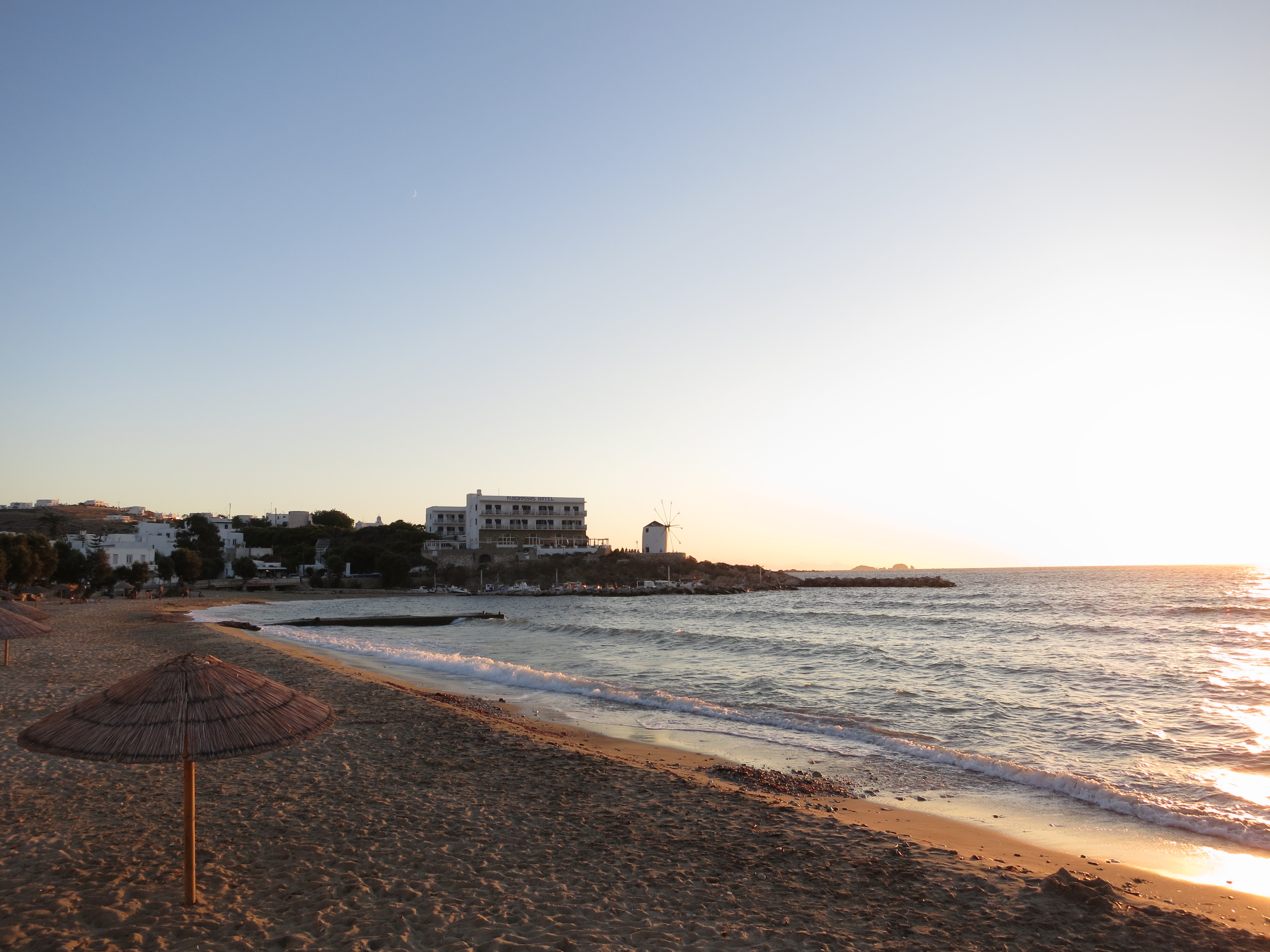
A beach in Parikia (Paros) as the sun begins to set

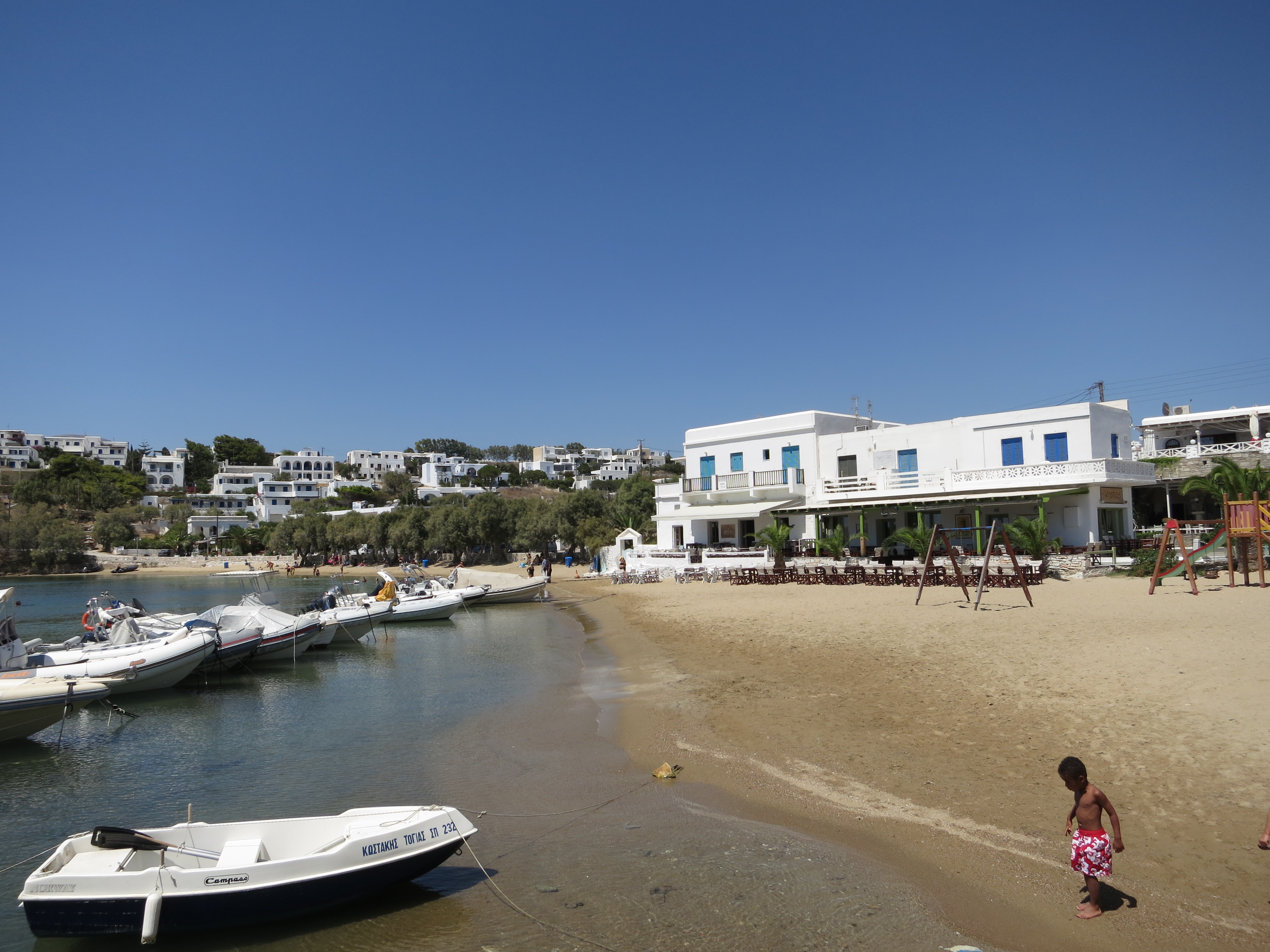
We divided our time on the islands between Paros and Santorini.  For all our laziness, we actually explored each of them pretty thoroughly.  We spent a day hopping on and off local buses, making our way around the small, quaint white-walled villages and quiet sandy beaches all over Paros.  Through Lefkes, in the centre, with just enough time before the next bus came to walk a circle around town and fit in an iced coffee (or was it a milkshake?) and the most sugary-looking of the cakes in the bakery window.  On to Piso Livadi, to enjoy a lunch of fried seafood by the beach, in a scene that’s just begging to be called ‘splendid’.  On foot around the point to see what beaches we might find, before bussing a little farther around – again in search of beaches – and then back to Parikia for sunset.

See, ‘splendid’, no?

And we followed that up by then ferrying across to Paros’s smaller sibling, Antiparos, to explore its (not especially interesting) cave, to wander around its sleepy harbour, and to amuse ourselves watching the kitesurfers flitting back and forth between Paros and Antiparos.  (Note to self:  must learn to kitesurf, it looks awesome.  Note to self and everyone else:  if you’re looking for somewhere to put your feet up in the Greek islands for a week or so of doing not much, it looks like you could do a lot worse than the small resort-like places on the northern tip of Antiparos.  Not that we had any complaints about Parikia, which was also a great spot.)

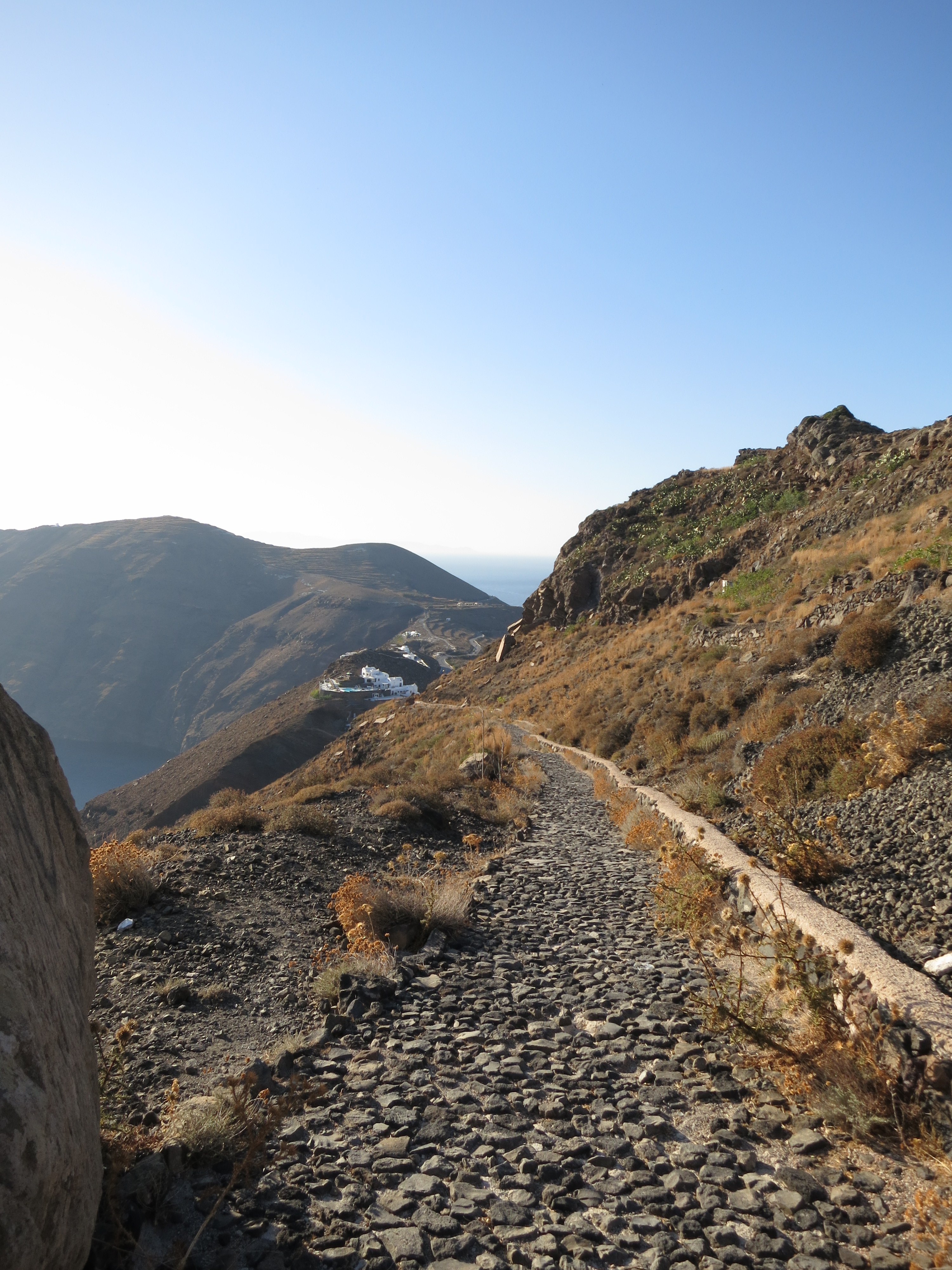
One of many stunning vistas from the walking trail from Fira to Oia, on Santorini

Santorini we explored with quad bikes as our trusty steeds, roaming across the crater of an island, checking out the beaches (nothing special), the archaeological site at Akrotiri (pretty boring), and the various vantage points around the island (definitely worth hunting out).  And in my case, at least, the survey of Santorini also featured a decent chunk of footwork:  walking the trail from Fira to join my somewhat lazier comrades (they took the bus) at Oia for possibly the world’s most famous sunset.

A part of the walking trail from Fira to Oia, on Santorini

(This was the second time I’ve been to Santorini, and the second time I’ve wandered my way along that trail:  it’s a charming – and quiet – walk along the cliffs, through the towns, and over the hills, and it has easily the best views of the island, if you ask me.  A welcome escape from the tourist crowds across much of the rest of the island.  A few hours well spent, and I’ll happily do it again if I ever find myself back there.)

Sunset at Oia, Santorini

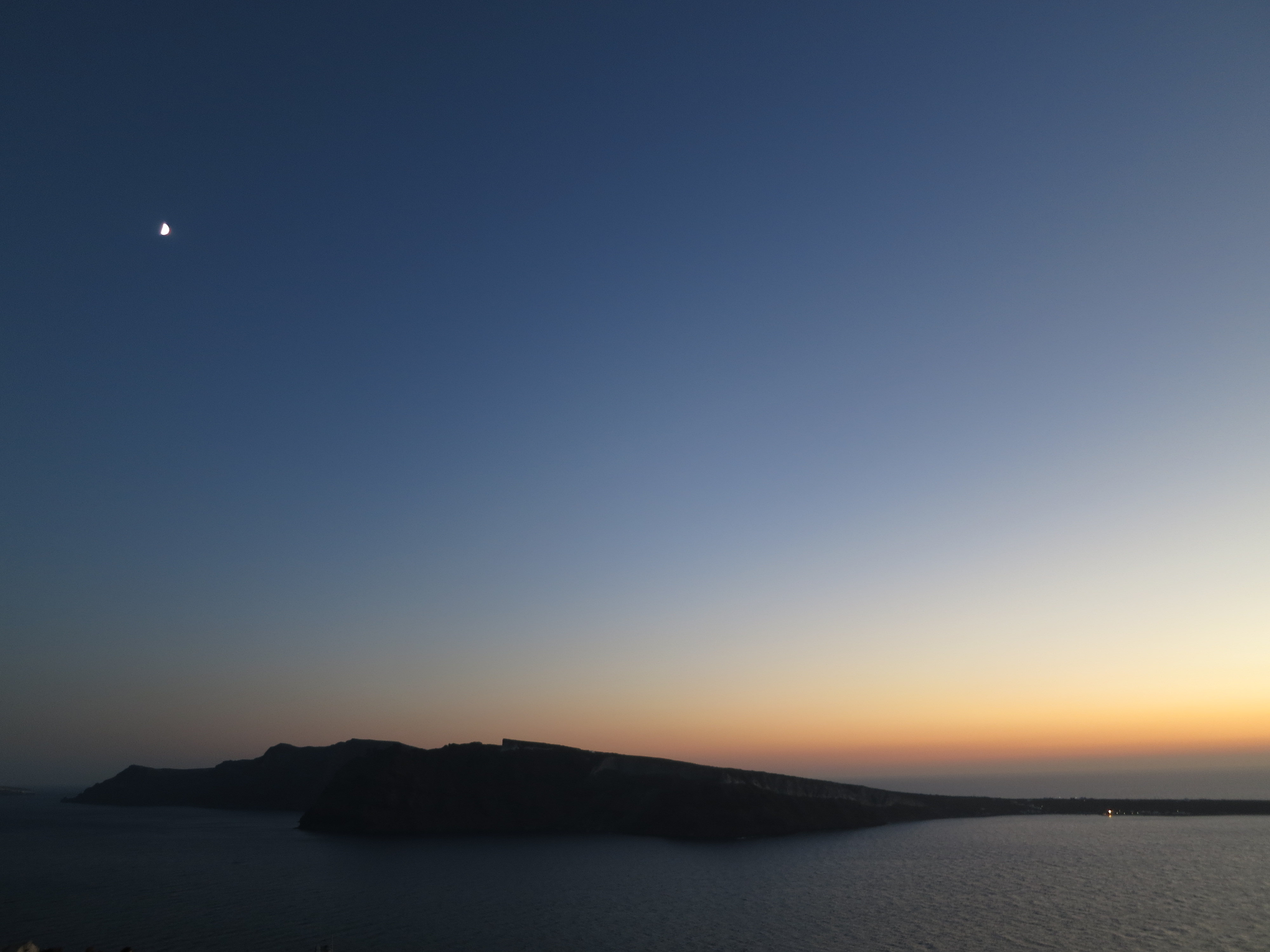
Other than that, all that really remained was to spend our evenings looking out across the sea, watching the sun disappear beneath the water, or behind the islands, or behind a town, depending on where we’d picked for our viewing spot that particular night.  Not a bad way to spend a week.

Yet another of many spectacular sunsets in the Greek Islands

Secluded monkery in Metéora

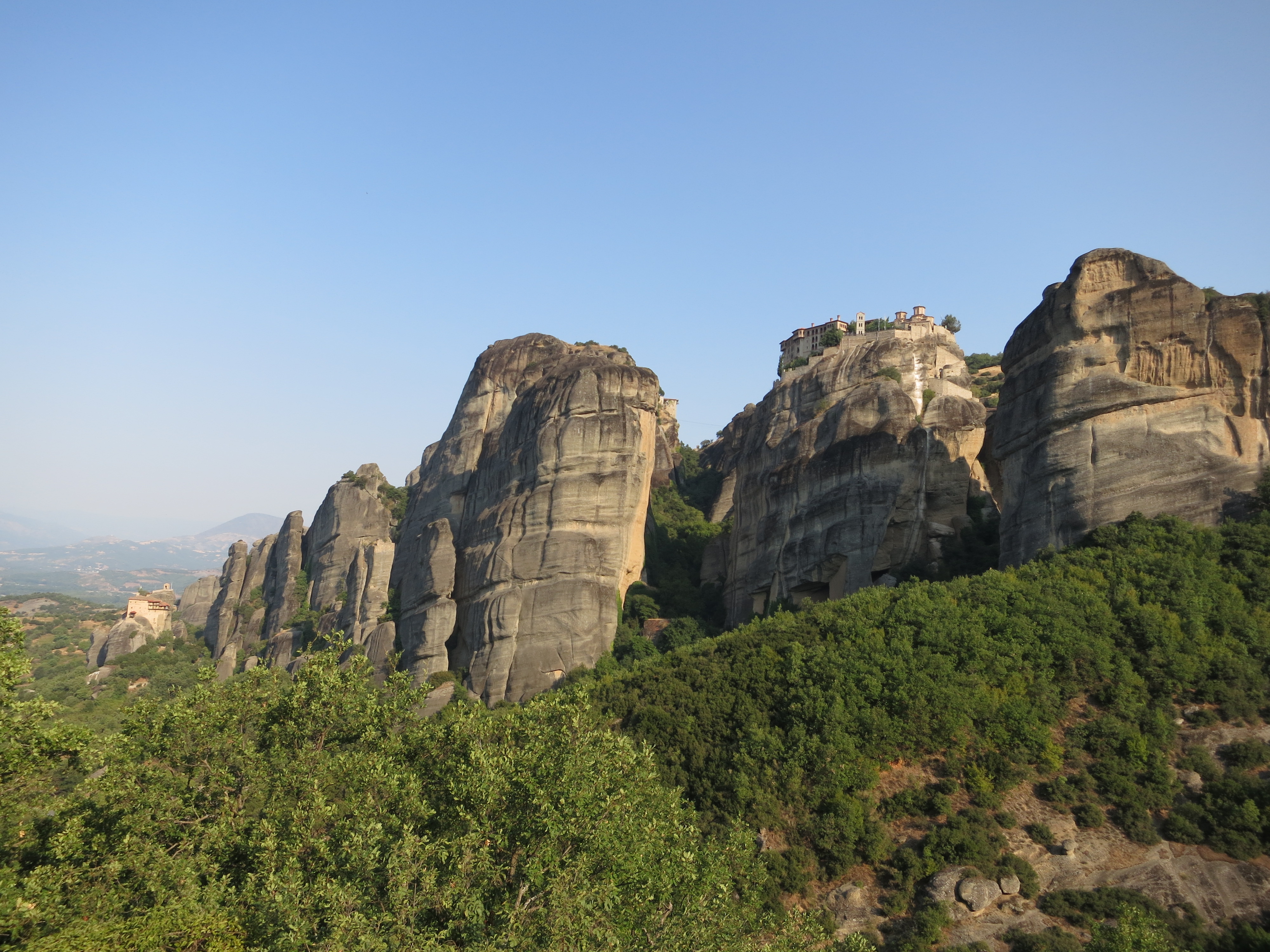
Some destinations you visit for the culture;  some you visit for natural beauty;  some you might visit for a particular activity or maybe for the nightlife or beach scene.  Some, you visit just because they’re something a little different and perhaps a little more obscure than most typical round-the-world big-ticket items.  So we found ourselves a few hours’ drive north of Athens, in the relatively unremarkable town of Kalambaka, for one night only, to spend a morning exploring the lonely monasteries of Metéora, atop their giant sandstone plinths.

Approaching Metéora: the Holy Monastery of Great Meteoron perched atop its sandstone pillar

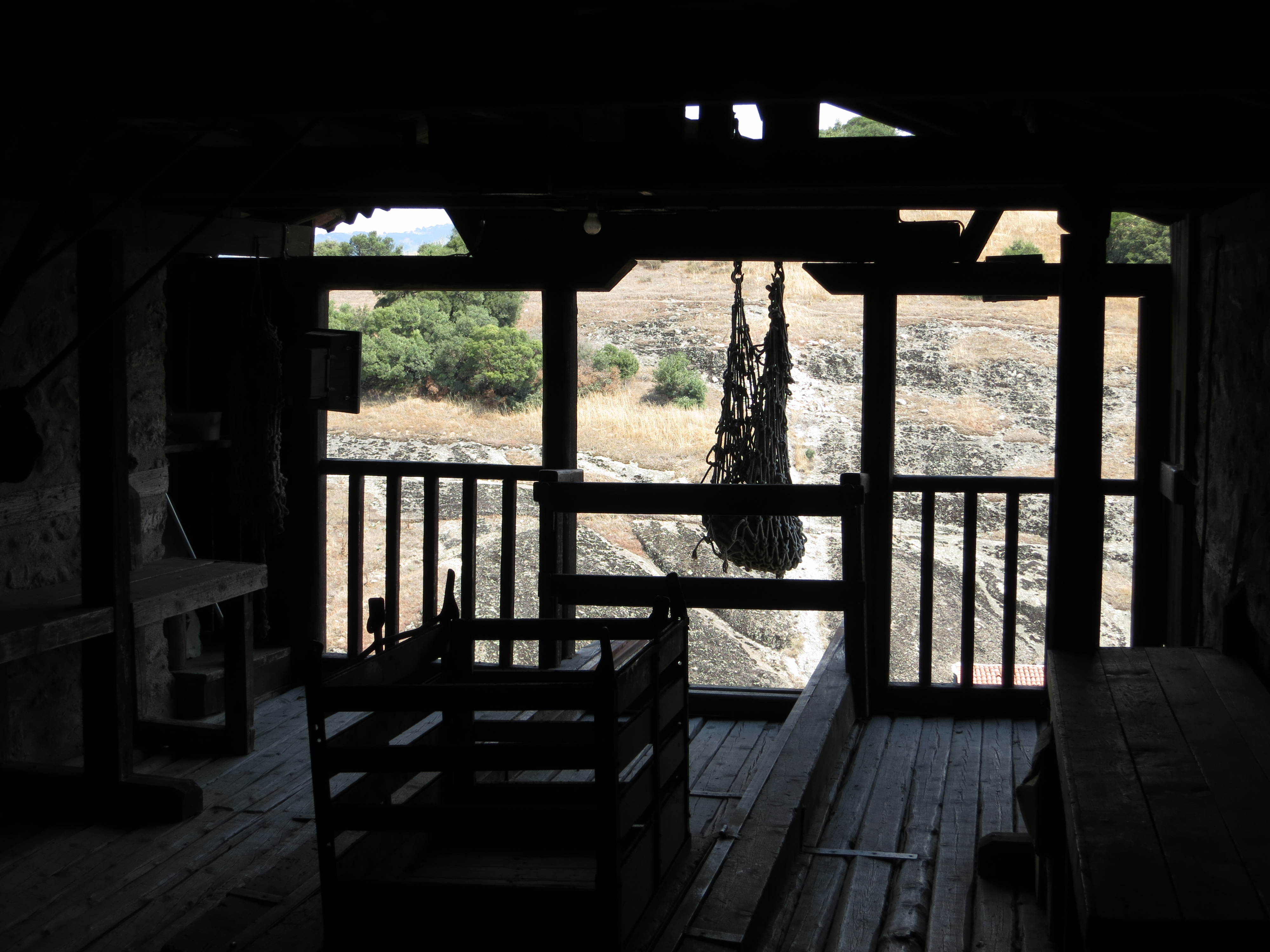
Evidently the monks of the area, centuries ago, decided that they weren’t really big fans of contact with the rest of us.  Escaping political and religious conflict, they built their new houses of God in the most inaccessible locations they could, and retreated to a life separate from the world below.  They weren’t completely cut off – monks could and did climb up ropes from the ground below, either directly on the rock face, or in a cage or net drawn up by a crane in the monastery.  (The story goes that they wouldn’t repair or replace the ropes when they frayed, even to mere threads, instead trusting to God to decide who should fall when they eventually broke.  Bunch of geniuses, it sounds like.)  But in their isolation, they built something quite special, which we thought were worth a look.

The net used to bring up supplies to the Holy Monastery of Great Meteoron, Metéora

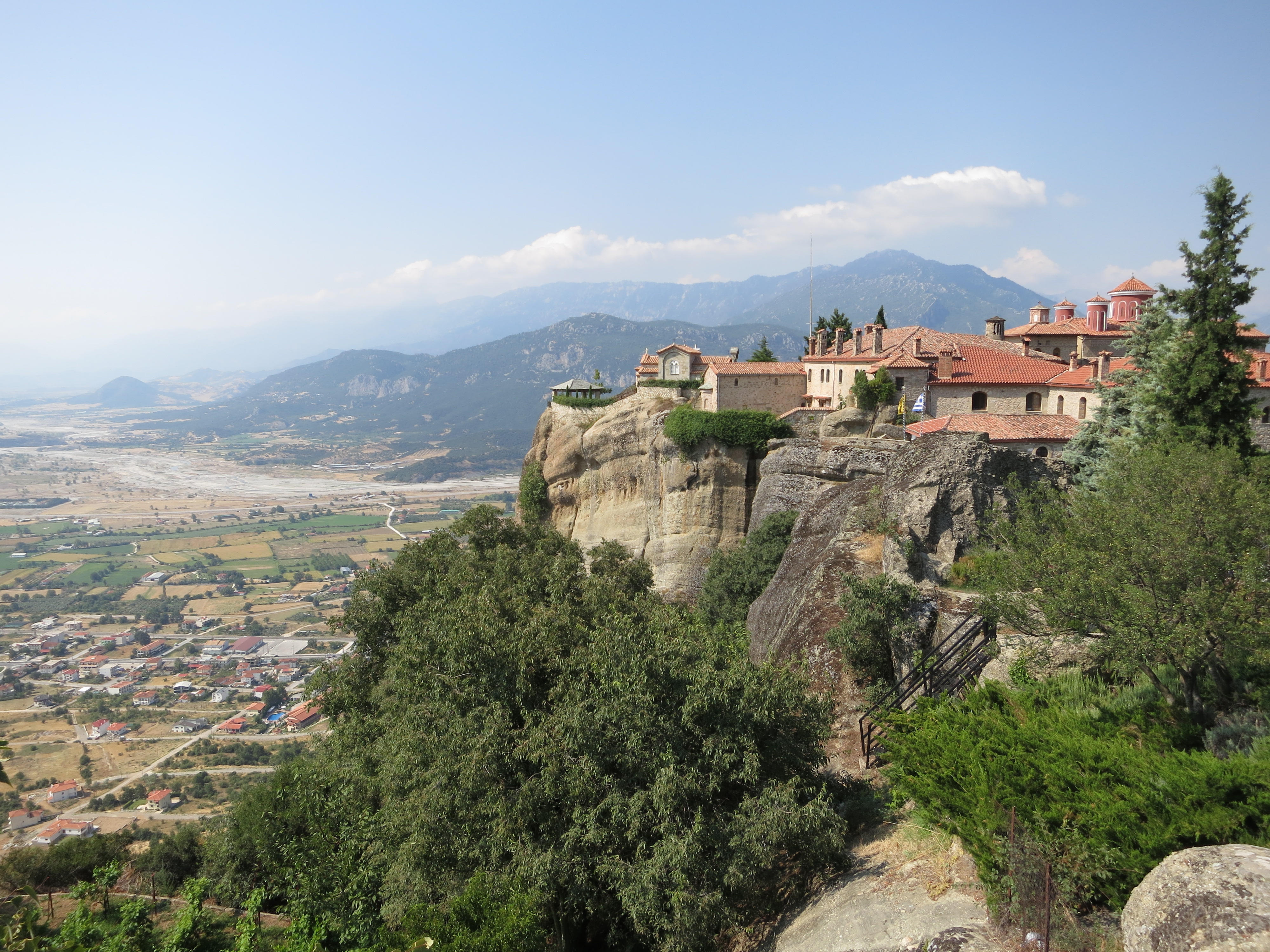
While a number of the monasteries are still monastic (or now nunnified, or whatever the appropriate adjective is), others are open to the public, and some are both.  They seem to have become somewhat of a tourist magnet (albeit perhaps not for the type of tourists we normally run into on our ‘let’s go see the world’ gap-year-like travels) – and perfectly reasonably so.  They’re a good wander through, but really, it’s the location and the simple fact of their existence that’s the drawcard, rather than any particular detail of the monasteries themselves.  The views from one to the other, and out among the sandstone hills, make Metéora well worth a short trip, to see something that little bit different.

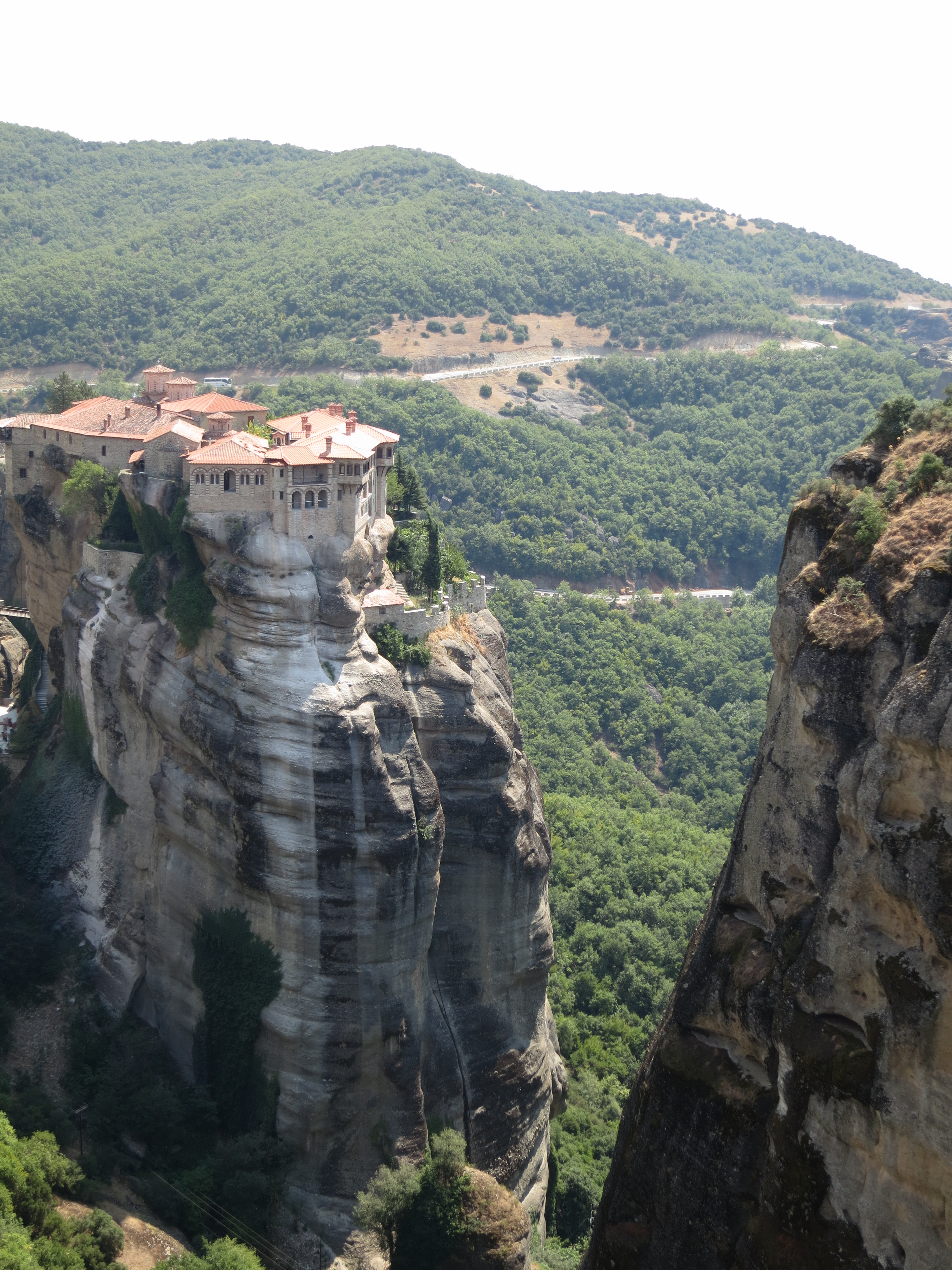
The Holy Monastery of Varlaam, as seen from the Holy Monastery of Great Meteoron, Metéora

The Holy Monastery of St Stephen in Metéora, looking out over the town of Kalambaka