Easter Island

Easter Island is a strange place.  It’s small – only about 22km across, and it only has one town, with a permanent population of not that much over three thousand.  It’s a little out of the way:  South America is some three and a half thousand kilometres to the east, the nearest inhabited island is Pitcairn Island, around two thousand kilometres to the west, and the nearest inhabited island that anyone actually cares about is Tahiti, a good distance beyond that.  And it’s fascinating.
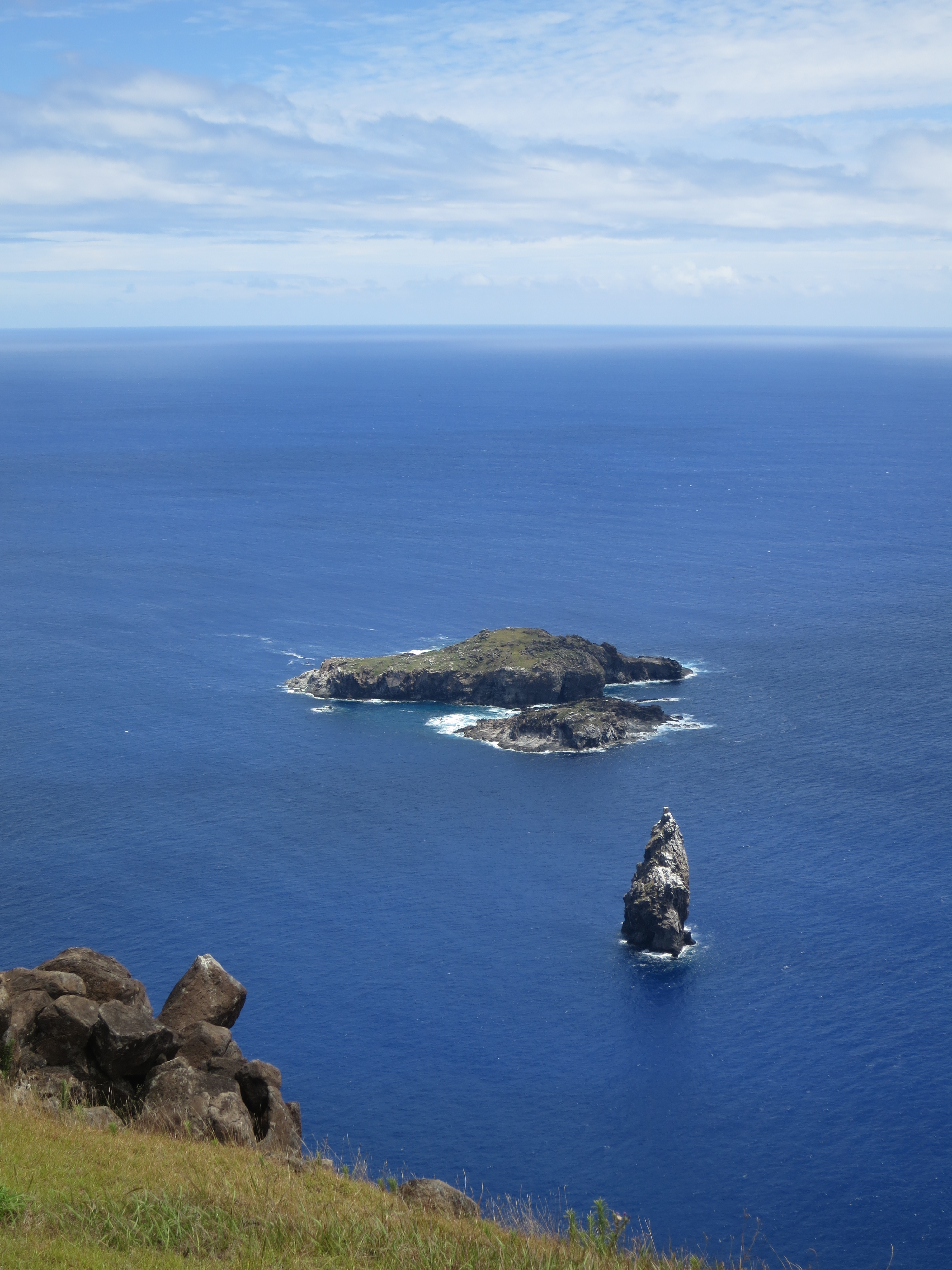
The islets of (closest to farthest) Motu Kao Kao, Motu Iti and Motu Nui, south-west of Easter Island

Two tiny islets next to Easter Island, where the Bird Man ceremony (see below) was held. Beyond that, a few thousand kilometres of ocean, then some other small islands.

It’s understandable, I suppose, that it’s not typically the sort of place people come more than once in their lives.  It’s also obvious that for many, this is very much the trip of a lifetime:  you could tell from the number of photos taken on the twenty-odd metre walk between the plane door and the plane-side entrance to the airport terminal.  And beyond that, you could tell from the sheer quantity of baggage that came off the plane, combined with the utter chaos of the scrum at baggage collection, that this is a trip considered worth taking even for a lot of people who, err, don’t get out much.  (That, and this is still South America after all.  There’s a reason that international flights through this part of the world automatically get double the usual baggage allowance, and it’s not because Brazilian string bikinis take up a lot of space in your suitcase.)  And you can see why:  Easter Island is a fascinating place.

But the thing about Easter Island, of course, is that there’s only that one canonical attraction to see here:  the moai, aka giant stone heads.  Well, there are other things too, I guess:  petroglyphs (primitive rock art), the old stone crater-side dwellings of ’O Rongo, and other artefacts of the island’s history.  Those things, however, are boring.  Especially the petroglyphs:  clearly other people disagree, but I find it remarkably hard to get excited over the cultural magnificence of a rock carving just because it’s old-ish – the resemblance to a three-year old’s finger painting is just a little hard for me to surmount.

(I’m calling things “old”, by the way, rather than, say, “ancient”, because the island’s human presence – and the artefacts and traditions that followed it – only originated around probably 1000 AD.  Well older than the European history of Australia, sure – Captain Cook was reporting differences in the state of the islands compared to previous British encounters with it shortly after he turned and headed home from his second mission to explore the seas down under – but still, nothing compared to the age of many of the other archaeological artefacts we’ve seen on our travels.  Enough so that “prehistoric”, while potentially accurate, also sounds deceptively inappropriate.)

Nor do I find myself intellectually titillated by how much the squiggles tell us about the important features of tribal life on the island.  Yes, they drew a lot of pictures of fish and fishing and boats.  Yes, that’s because the sea was important to them.  This is not a cultural revelation;  this is fairly predictable consequence of the fact that they lived on an effing island, surrounded by a lot of effing water, and they ate a lot of effing fish.  Err, hmm, anyway…  (There was a particular site on the north of the island – Papa Vaka – with a path which toured a collection of petroglyphs, and which offered nothing else but included some especially gushing praise for some intriguingly uninteresting subject matter.  It got on my nerves.)
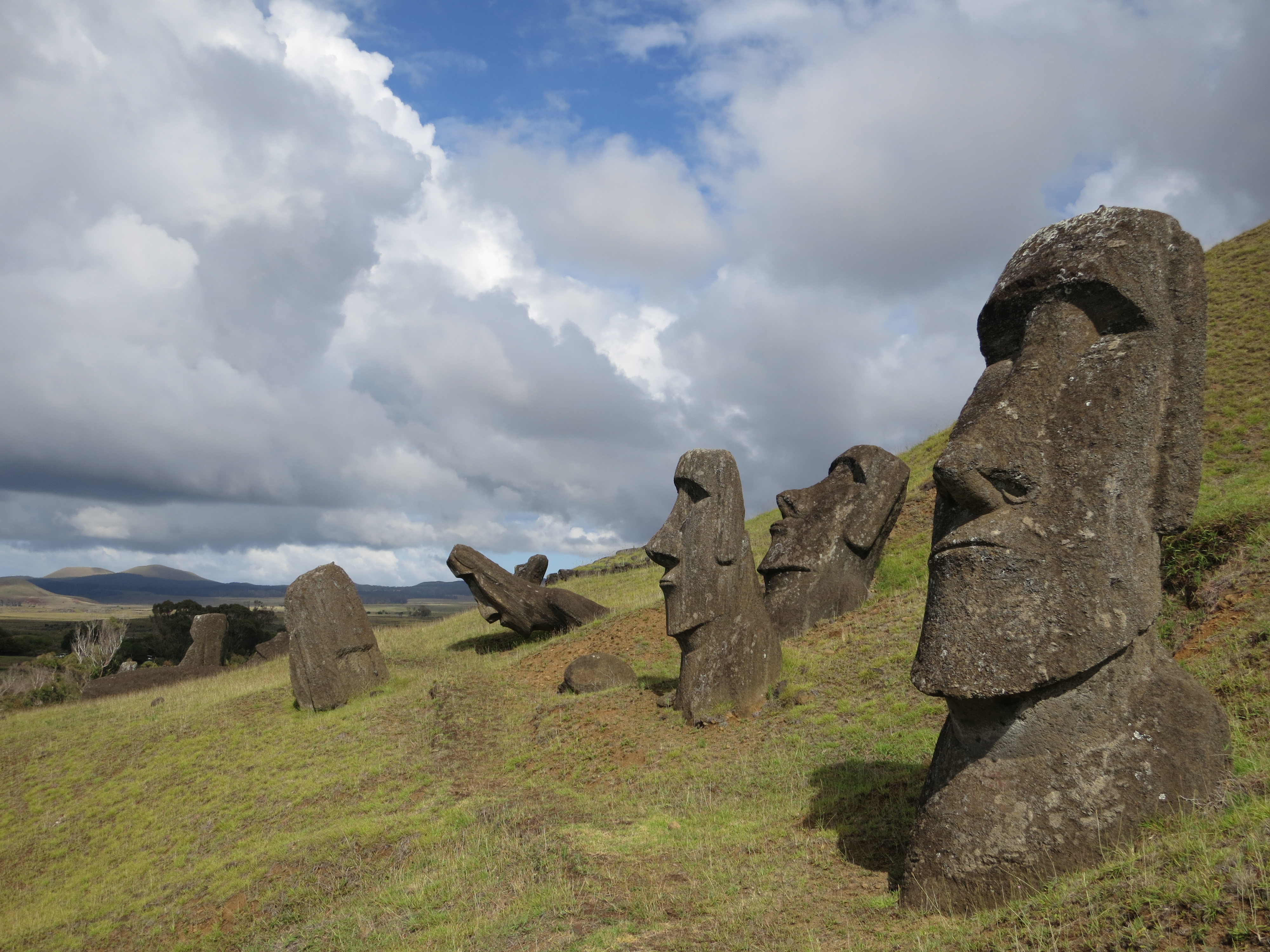
Moai on the gentle slopes of Rano Raraku

Moai on the gentle slopes of Rano Raraku

So, basically that leaves the moai.  Oh, and a description of the old Bird Man ceremony, in which islanders would swim out to the little islets pictured in the first photo above, camp out for a few days, and steal the first egg from returning migratory birds, in order to win local acclaim.  Then the victor would get to live in complete isolation for the next year as a prize – which presumably has to cast at least some entertaining doubt on the contention that the islanders were a friendly and admirable society from whose cultural and spiritual development we have a lot to learn.  “Good work, Jim.  As your reward, you get to not have to put up with the lot of us for the next year.  Enjoy your splendid respite.”

As I was saying, the moai…
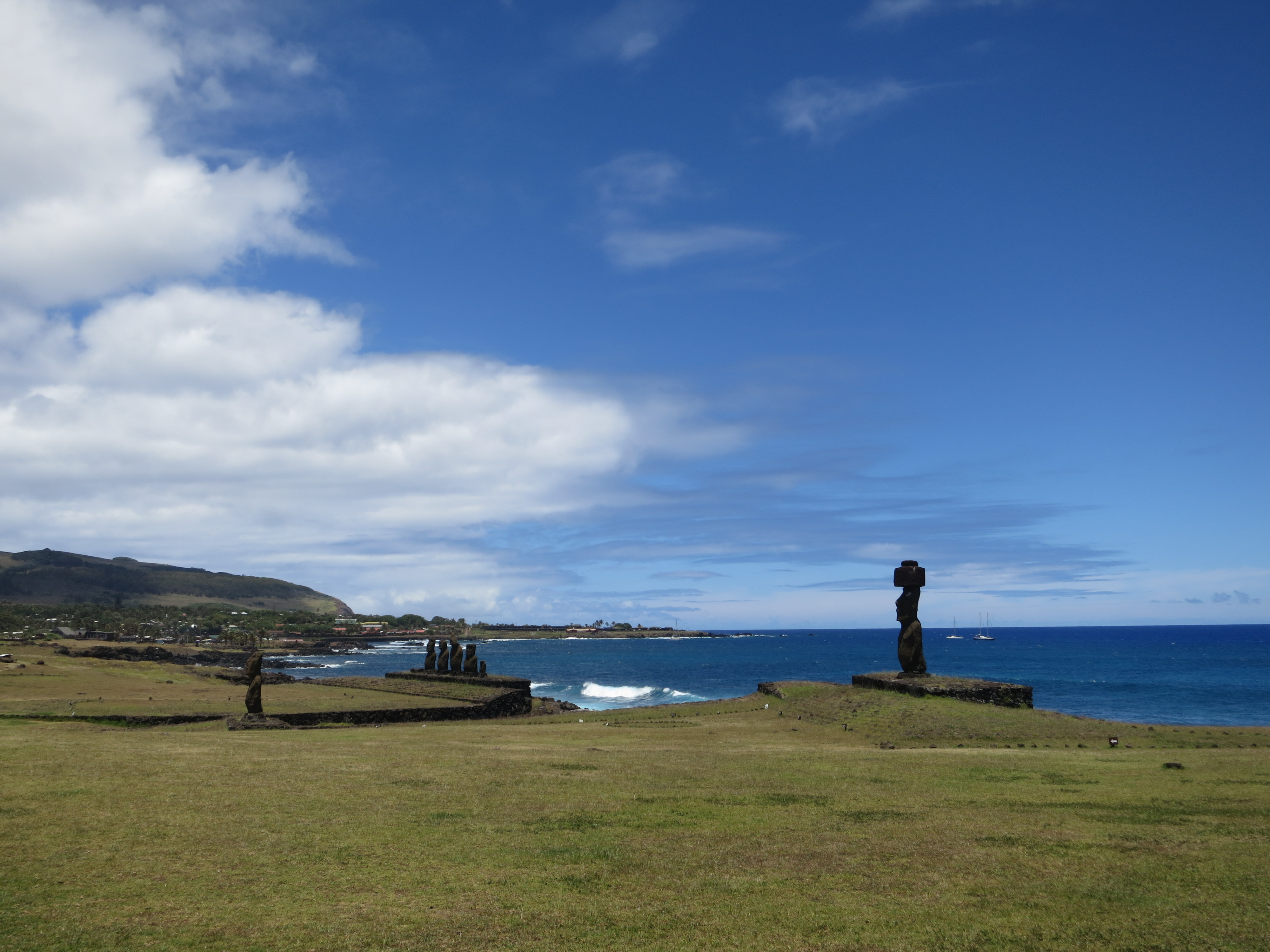
Moai just north of Hanga Roa (left), including Ahu Tahai (the line of moai on a platform, just left of centre)

Moai just north of Hanga Roa (left), including Ahu Tahai (the line of moai on a platform, just left of centre)

The moai are a product of the islanders’ ancestor worship.  Also, no doubt, of their boredom and isolation.  With a very few exceptions, each stone bust (they’re not actually just stone heads – they all have at least torsos, and a handful have legs too) was carved out of volcanic rock on the sides of Rano Raraku, one of the island’s three volcanos, and somehow – no one actually knows for sure how – transported to its present location on the island, where it was generally erected on a ceremonial stone platform called an ‘ahu’.  Each bust represents a deceased chief or head of family, and the point of erecting them was to maintain a link with their ancestors, who could look over their descendants and protect them.  Turns out all that looking-over and protecting didn’t work very well:  in the 17th century it became the done thing for tribes to push over their opponent tribes’ moai, with the result that fairly shortly, there was not a single one left standing, other than some of the many that had never found a home outside their birthplace at Rano Raraku.
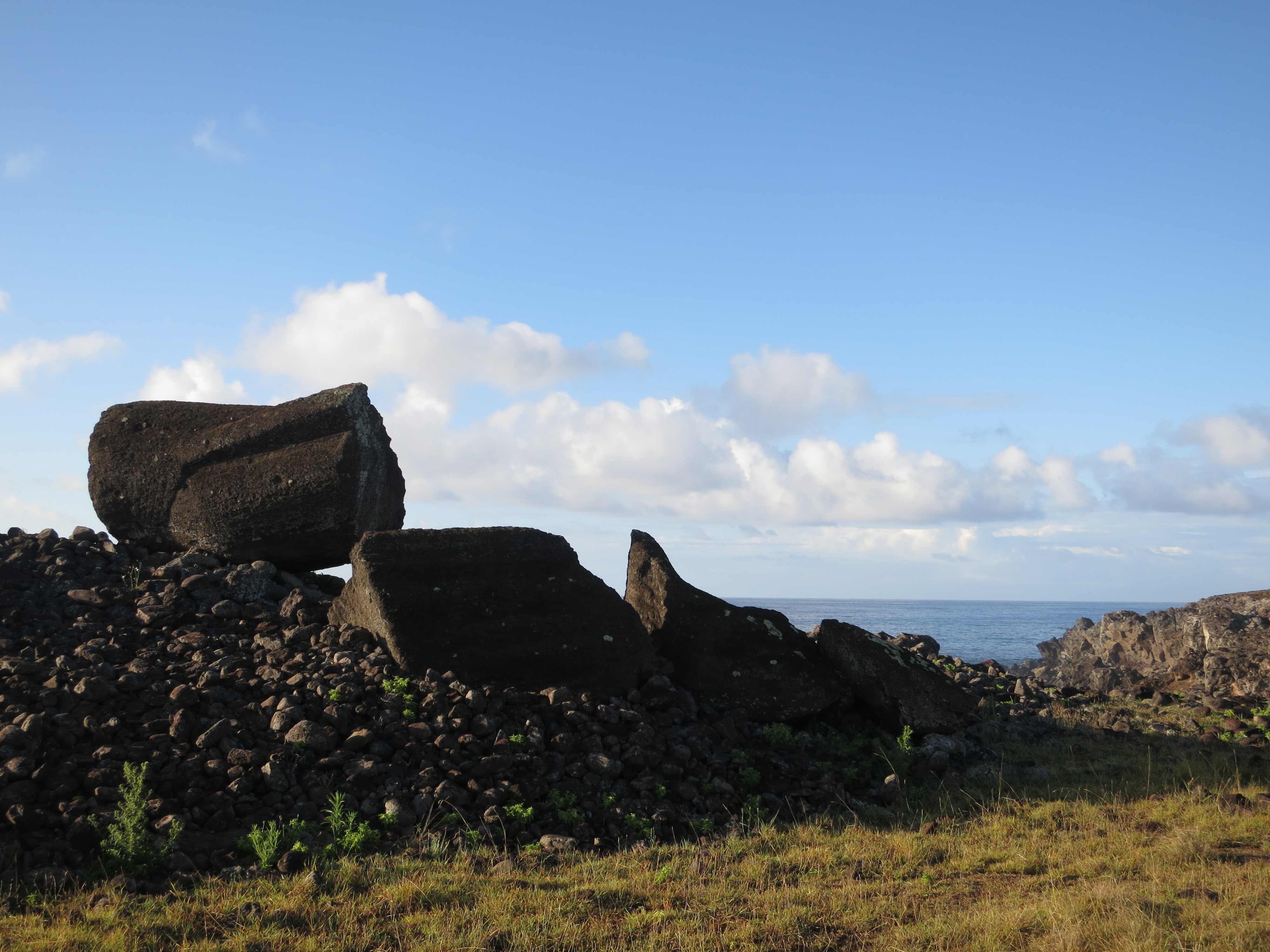
A moai lying broken on its ceremonial platform – this one Ahu Tetenga – near the shore

A moai lying broken on its ceremonial platform – this one Ahu Tetenga – near the shore

Fortunately for us tourists, quite a few of them have been put back up now.
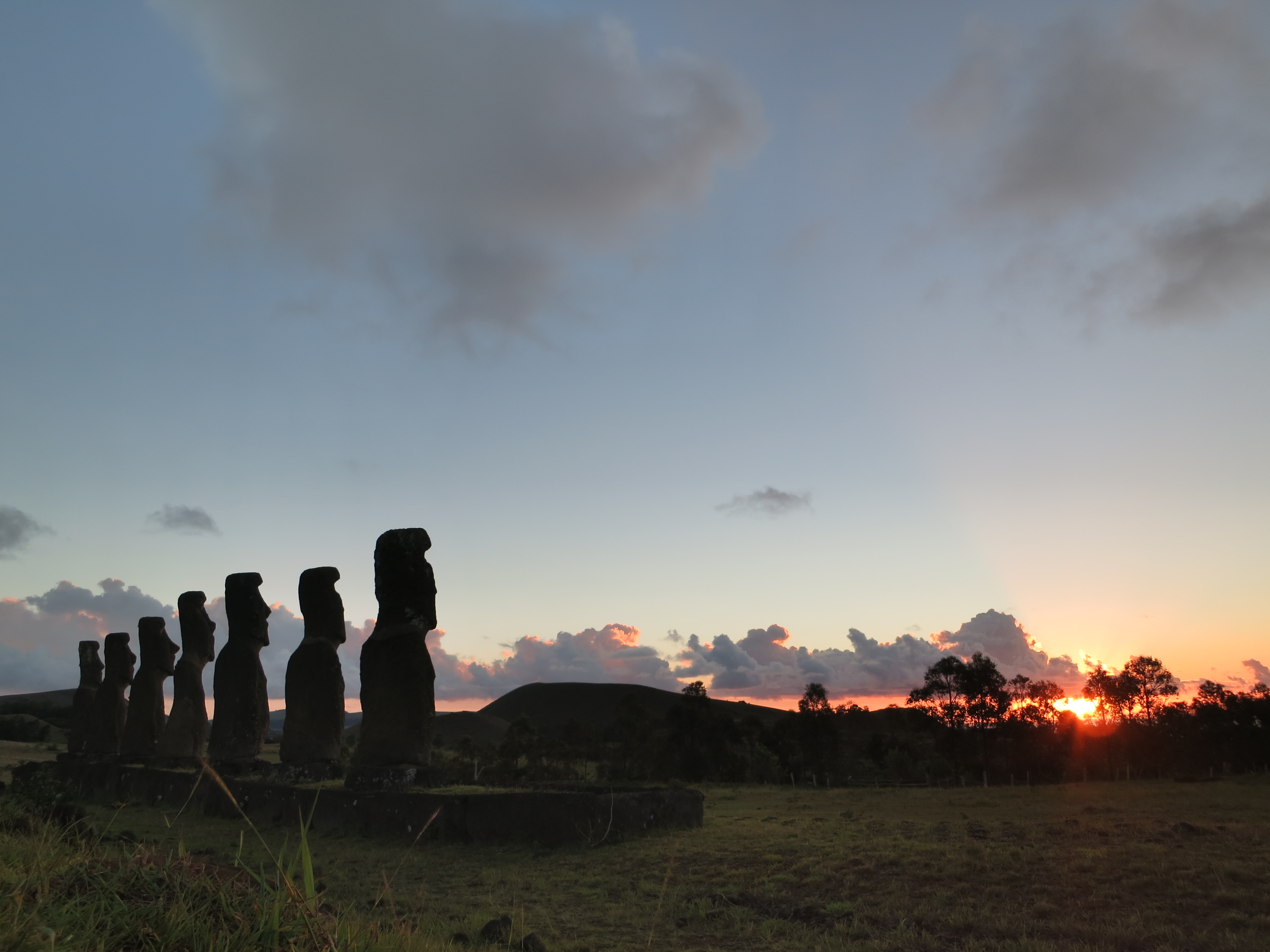
Moai at Ahu Akivi at sunset

Moai at Ahu Akivi at sunset. These are the only moai which face the ocean, and, tradition has it, represent the seven explorers who first came to Easter Island.

We were on Easter Island for a full week, which was excellent, because you really only need two or three days to do it all:  one day for the ones near town (which you can walk to, so long as you don’t mind some time spent on foot), including ‘O Rongo (yes, you can walk to that too), and one day to hire a car to start up at Ahu Tongariki at sunrise before making your way around the rest of the island over the course of the day.  As I said, there’s really just the moai;  once you’ve gone round the island and seen them all (or at least the main ones), there’s actually very little else.  Barring some quite beautiful rocky coastline, the island itself is not really very attractive, especially since its denuding of pretty much any tree cover centuries ago – a result which lead to the wiping out of the majority of animal life on the island, and severely impacted the dwindling human population as well.  And other than the moai, the island’s main claim to fame is that its airport has an unnecessarily large runway:  it was extended in 1986 to serve as an emergency landing facility should the Space Shuttle need to abort its mission shortly after launch and subsequently be retrieved on the back of a 747.

(Lest anyone think this post has too negative a tone, I actually find it quite fascinating that a society that was in most other ways remarkably unremarkable could produce something so unique:  as I also said, this is obviously the trip of a lifetime for a  lot of people, and I really can’t say I can fault their reasoning on that one.  It’s a very cool place, and one that I highly recommend visiting.)

And frankly, in our week there, we had a fantastic time appreciating the moai, and to top it off, I appreciated some time just bumming around.  (You’d be surprised just how many of the blog posts that appeared here from mid-January onwards were written with the aid of a few cold beers out on a rest day or two on that little speck of dirt with no other land – or fast internet – in sight.)
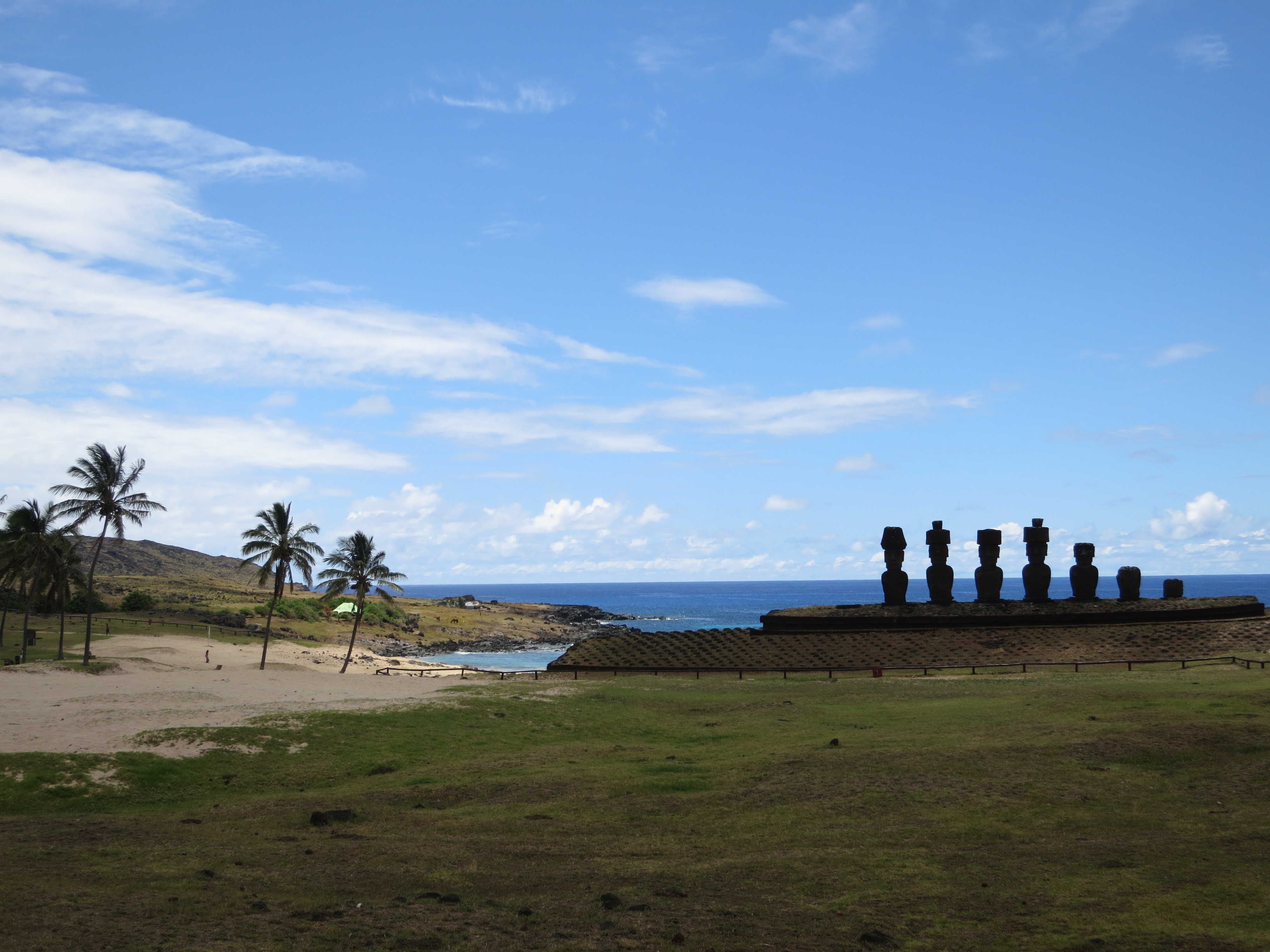
Moai at Anakena

Moai at Anakena, in front of Easter Island’s only real beach

Anyway, just as there’s not actually that much time required to see all there is to see on Easter Island, there’s really not much more to say about it either.

Other than perhaps that if you go, you should try the enormous, delicious hamburgers at “Club Sandwich” in the middle of the main strip, and that you should probably not leave your acquisition of sufficient cash until right before you really need it, given how annoying it is to find yourself unable to pay cash and so facing a 10% credit card fee to pay for your accommodation on your last day because all three of the island’s ATMs are down.  (Speaking of accommodation, Camping Mihinoa is where you want to find yourself.  I suggest you don’t camp – the tents you can hire are apparently unbearably hot pretty much whenever the sun is up – but the rooms are cheap.  Which can’t really be said for anywhere else on the island.)

So without further ado, my favourite photo of the week…
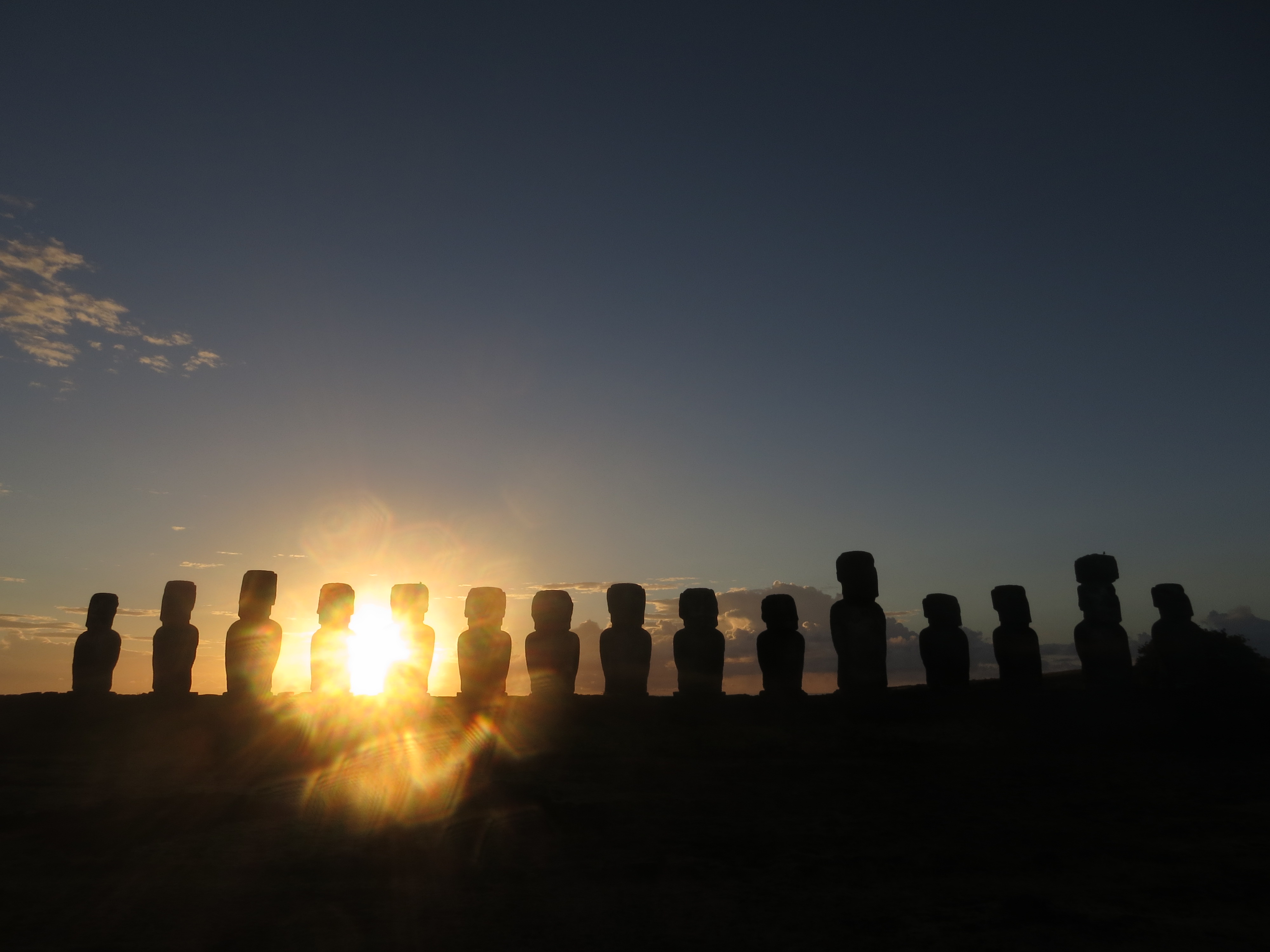
The moai of Ahu Tongariki – the largest currently standing moai on the island – at sunrise

Amazing what effect a dirty lens can have on a nice into-the-sun sunrise shot! The moai of Ahu Tongariki at dawn.

… and with that, pretty much, we’re done!
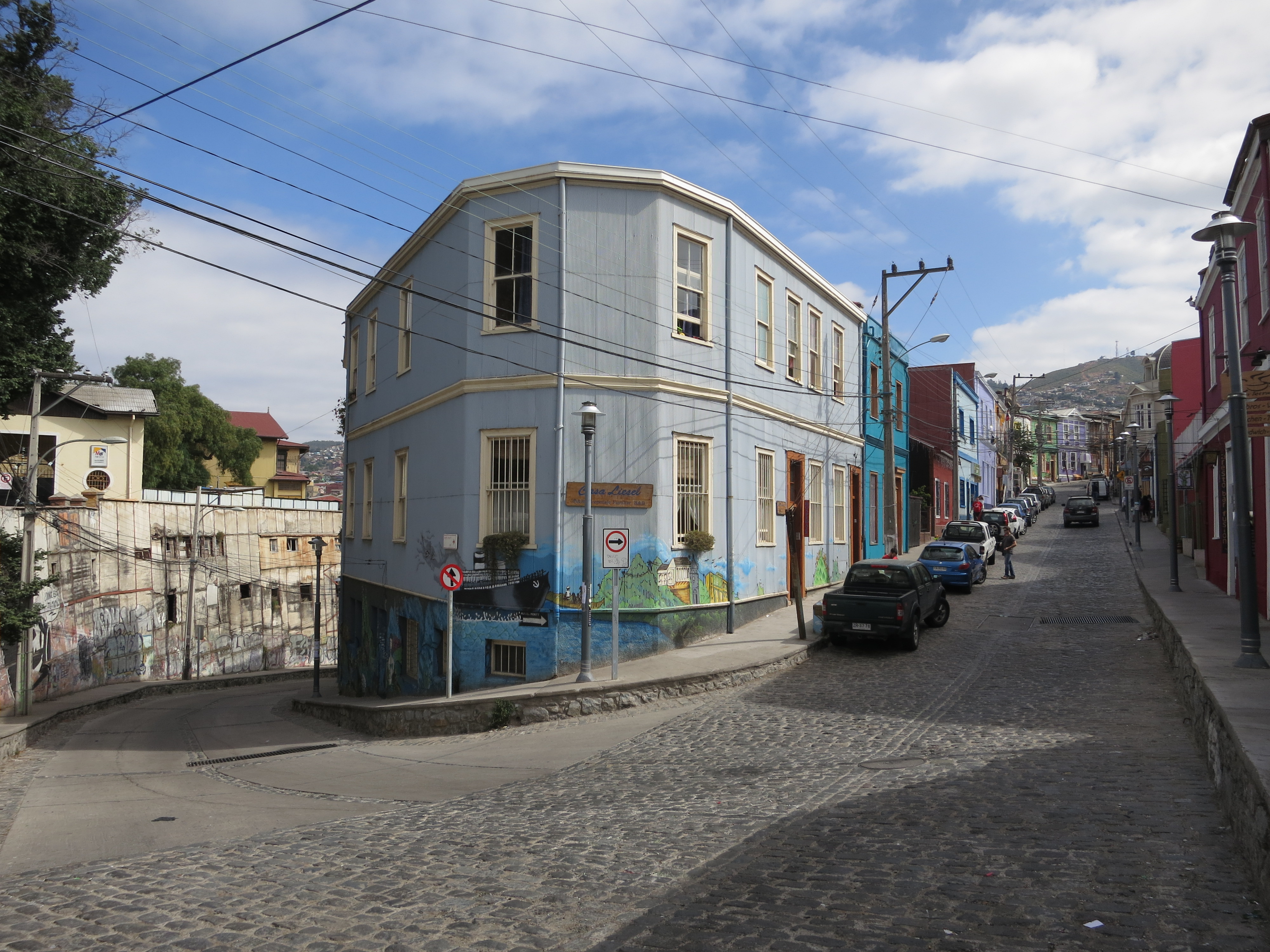
Colourful Valparaíso

Months later as I write this, I still can’t figure out whether I really liked Valparaíso or whether it’s destined to fall away in my memory as just another stop on the way.

I definitely liked the bright, colourful houses:  corrugated iron constructions made of unloaded ballast from ships that, in Valparaíso’s bigger boom times, landed with other goods that otherwise unbalanced the cargo.  The iron was thus an unwanted (and therefore free) material, and the colours, our effervescent walking tour guide told us, are from the leftover paint that the shipping lines used to paint their vessels.

A visual summary of Valparaíso:  bright colours and steep hills

A visual summary of Valparaíso: bright colours and steep hills

I liked the hills, too, in a sort of gleefully masochistic way.  The entire city, pretty much, consists of a conglomeration of actually quite separate neighbourhoods who just happen to be in close proximity – each perched on the sides and top of one of the many, many quite steep hills that line the coast.  They’re impressively good exercise – except if you cheat and use the funiculars – and they give the city a lot of character, giving each area a distinct identity that more geographically homogeneous cities don’t always develop.

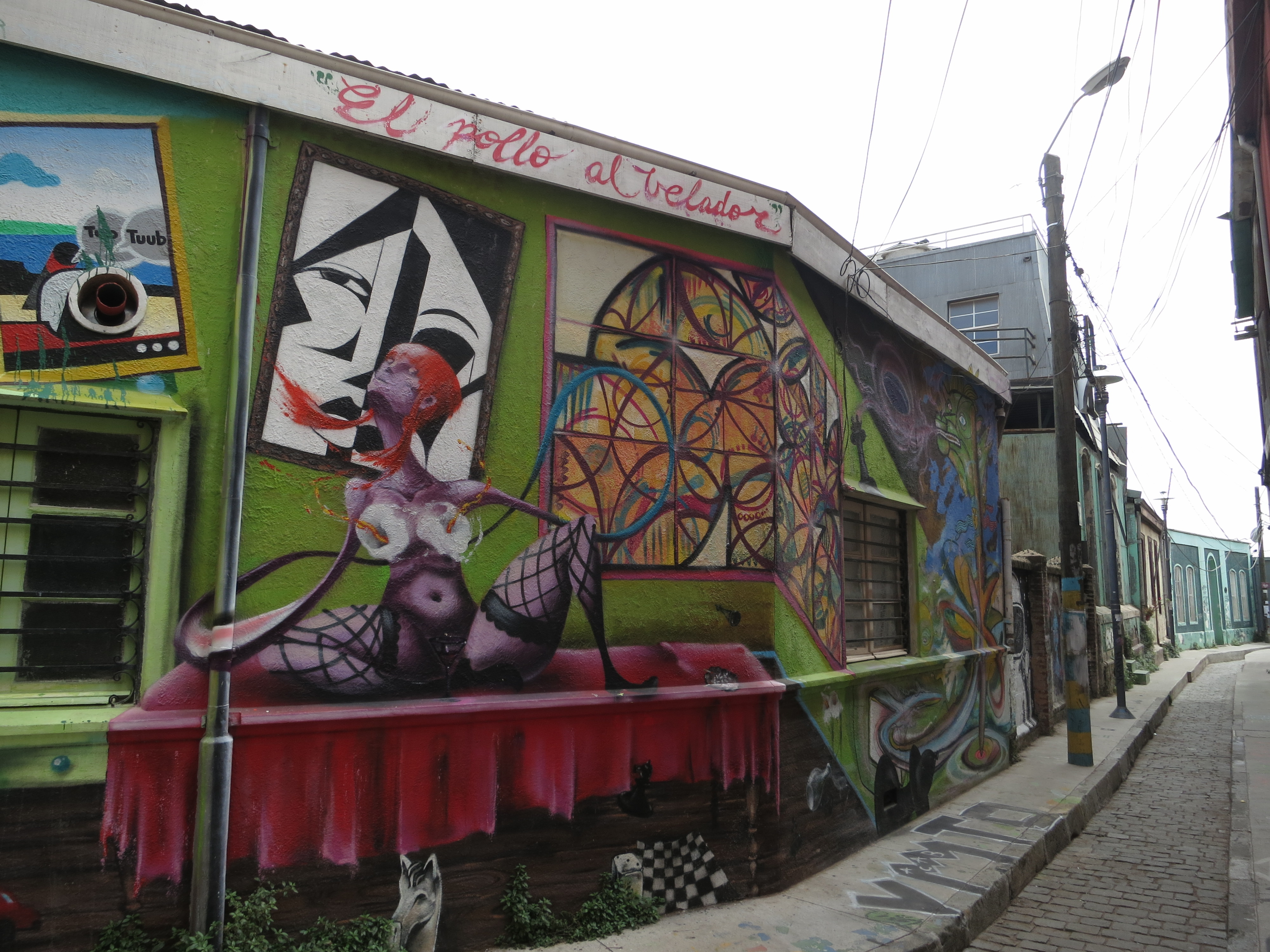
The colourful street art is charming and, I’m told, frequently references some quite involved stories for reasonably complex local meaning.  Such as the “chicken on the bedside table” mural we saw, which apparently describes a distinctly local way of referring to sexual liaisons between workmates:  a tryst which occurs during lunch breaks, necessitating the provision of food along with by-the-hour accommodation.

‘El pollo al belador’:  “chicken on the bedside table”.  A mural in Valparaíso.

El pollo al belador’: “chicken on the bedside table”. A mural in Valparaíso.

I also particularly liked one of the cafés we located:  Baker St Café, on Cerro Concepción.  The presence of a good café is always going to be a big plus in my books.

And I was fascinated to see a city that suffered such a dramatic decline after a long reign as a prosperous power in South America, falling from grace after the opening of the Panama Canal as it was no longer needed as a convenient stopping point for ships before or after rounding Cape Horn on their journey from one side of South America to the other.  It was especially interesting that no one seemed to have seen that coming:  we walked past the decrepit shell of a hotel which was abandoned before completion because the town died and has remained that way over the several decades since, unsold and unsellable.  How could they not have predicted that the growth wasn’t going to continue?  Did no one tell them about this fancy new canal over the many years it took to construct?

But, cool as much of it was, Valparaíso had its downsides, too.  It smells like piss in a way that few other cities can manage.  Not in the way that Bangkok just smells like an open sewer.  But definitely a stale urine sort of whiffiness that’s not entirely pleasant, and is slightly hard to ignore.

Viña del Mar:  a disappointed Chilean Gold Coast in the making?

Viña del Mar: a disappointed Chilean Gold Coast in the making?

And Viña del Mar, the beach strip a short metro-style train trip away, has a lot of the tacky aspects of being Chile’s very own Gold Coast in the making, without convincing me that it has the aspects that make the tacky bits worthwhile.

At the end of the day, who knows?  We were only in Valparaíso briefly, and maybe just not long enough to get a good enough feel to pass judgement.  Maybe it’s just somewhere I’ll have to return to.  Or maybe a quick reminisce with some colourful photos every so often is enough, sandwiched between memories of the thieving excitement of Santiago, and the singular uniqueness of our next stop:  Easter Island.

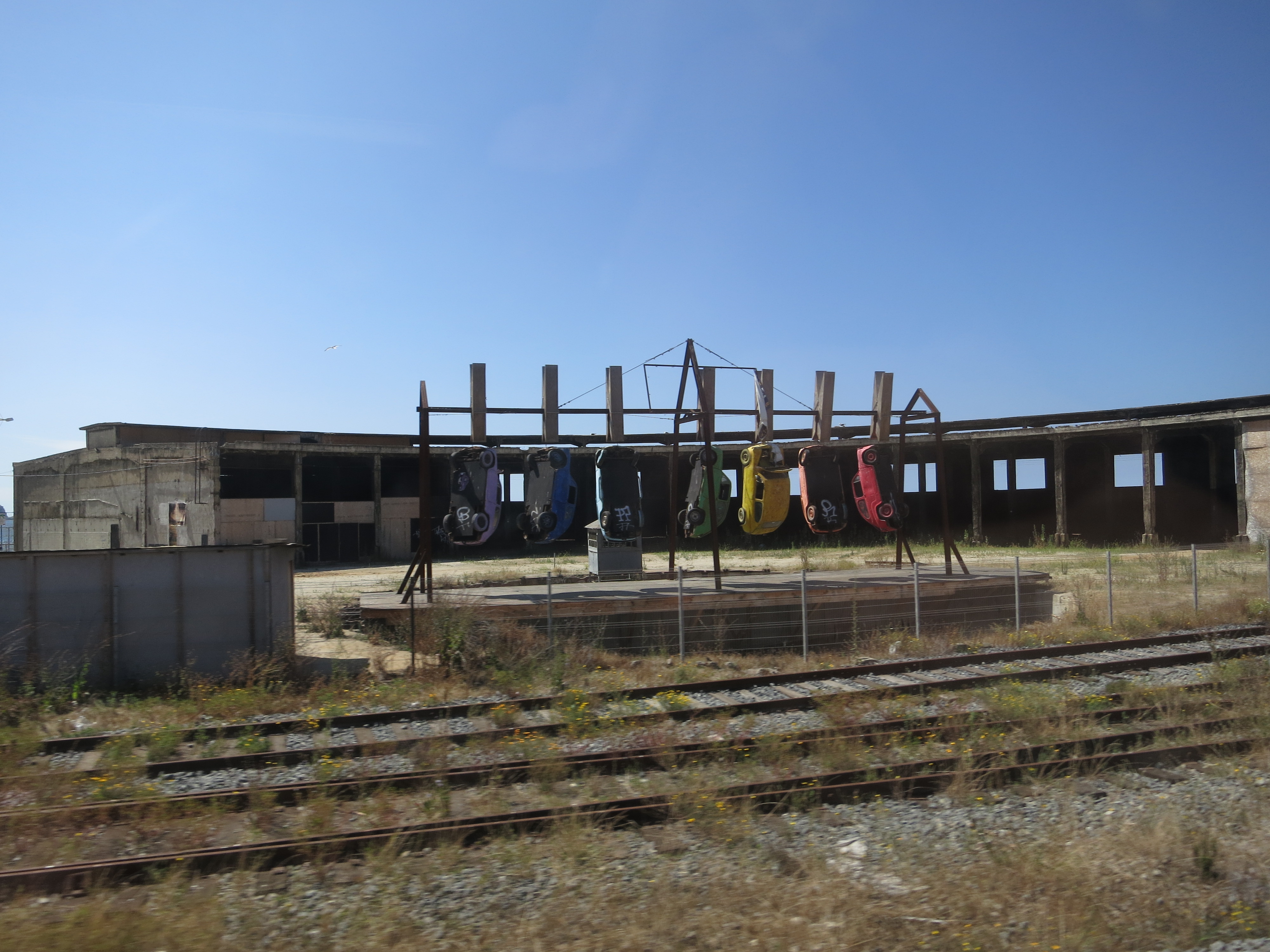
Installation art by the train tracks to Viña del Mar:  clothespegged Mini Minors

Installation art by the train tracks to Viña del Mar: clothespegged Mini Minors

On the road again in Santiago

Santiago wasn’t my preference for starting off in South America.  I’d hoped (for no particular reason, I have to admit) to start in Buenos Aires.  But in early 2012, Qantas stopped their SYD-EZE flights and replaced them with SYD-SCL, so there was nothing for it but to accept that our oneworld explorer was taking us to Chile first.  (A pity:  the Sydney-Santiago flight is basically east from Sydney;  the shortest way to Buenos Aires is over Antarctica, which would have been a much more interesting way to spend the thirteen or so hours.)  But having said all that, I certainly had no reason to expect anything but good things from Chile, and so we arrived excited to be in South America (finally!).  And tired.  We arrived very tired.

After a ‘break’ in our travels in Adelaide, we’d once more hit the metaphorical road courtesy of the 6am flight to Sydney, on New Year’s Eve.  Then we left Sydney, as scheduled, on a 11.25am flight, on New Year’s Eve.  And we arrived in Santiago, as scheduled, at 10am.  On New Year’s Eve.  Damned international date line.  Obviously, this meant we were looking forward to New Year’s in South America.  Right after a good long afternoon nap.

And New Year’s did deliver.  We missed the fireworks, as it happens.  We figured that ordering a simple dinner at 10.30pm at a pub was probably leaving plenty of time to get back into town ten minutes’ walk away for the bright lights at midnight.  It turns out that was a little ambitious – not really leaving quite enough time for South American service to kick into gear.  So we wished the bar staff a feliz año nuevo moments after finishing our food, and contented ourselves with just listening to the fireworks display.  But we’d walked through town earlier in the evening, before dinner, and amused ourselves with all the party hats and confetti rockets on sale on the street.  And as we walked back against the prevailing foot traffic as it returned from the celebrations, we got enough of a feel for the festivities to keep us heartily entertained for the evening.  Especially since by that stage we were pretty keen on getting back to some shuteye anyway.

And we enjoyed the rest of our time in Santiago, too.  Admittedly on January 1 we didn’t leave the hostel:  it turns out the jet lag from flying due east for pretty much sixteen hours takes a while to get through:  the encore to the previous day’s afternoon nap was a little more time-consuming.  But our walking tour around town on the 2nd showed us a friendly and pleasant, if unremarkable, town.

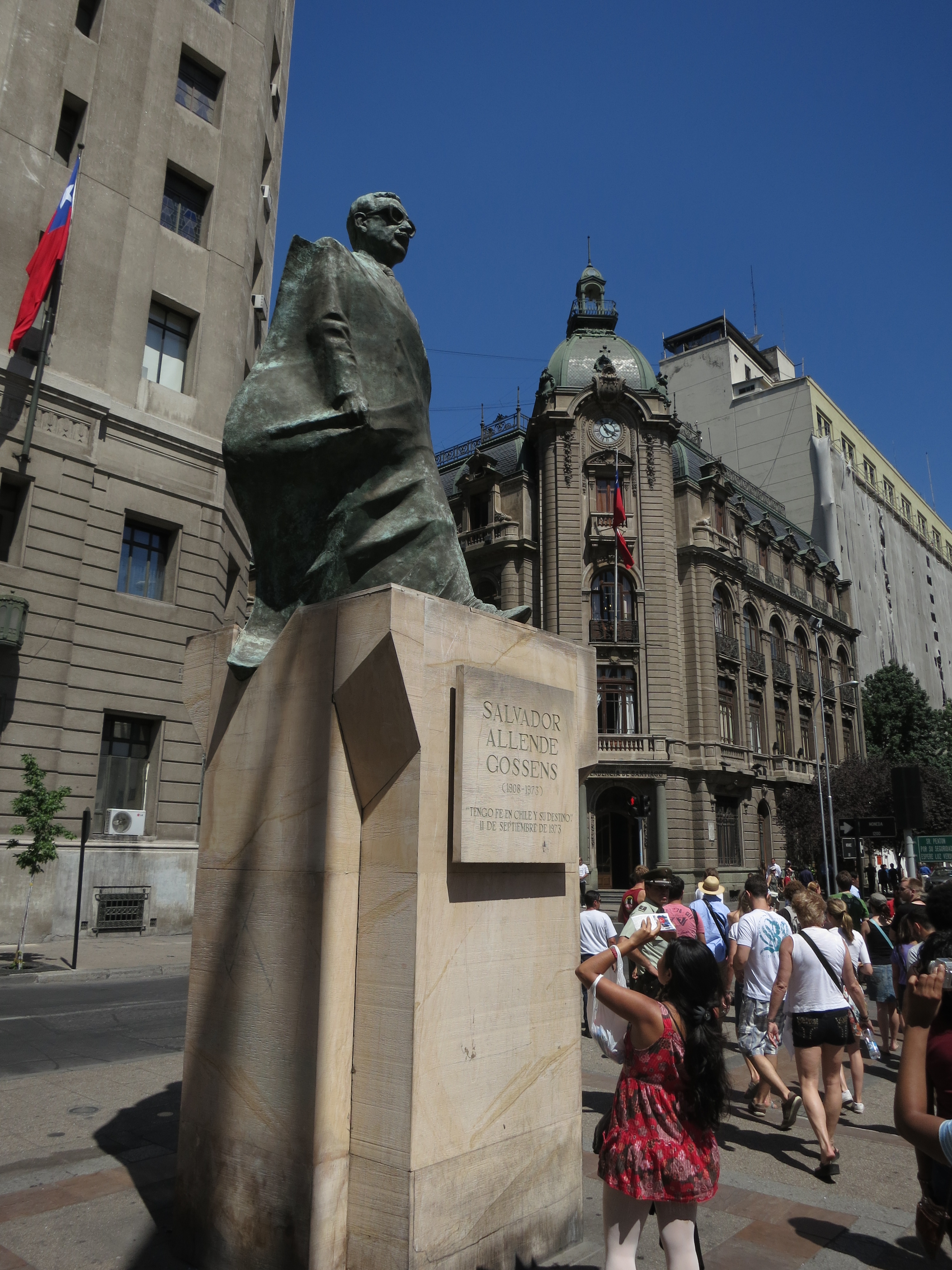
Statue of Salvador Allende Gossens

Encountered on our walking tour: a statue of Salvador Allende Gossens, presumably the inventor of hipster glasses, if the statue is anything to go by. Apparently, we were told, the glasses were quite symbolic: Allende’s secretary kept them after his death and handed them to the first democratically elected Chilean president in honour of his election.

Although when I say unremarkable, I’m overlooking one thing which was described to us which I should most definitely remark on:  the apparently quite Chilean feature that is ‘café con piernas’ or literally ‘coffee with legs’.  From what I gathered, it’s basically the strip club equivalent of coffee:  blackened windows on a café, so that from outside you can’t see the ridiculously scantily clad women serving espresso.  Apparently some things in South America are done a little differently than elsewhere.

Still, even despite our jet lag, we’d been easily capable of appreciating the relaxed café (not, not those cafés) and bar culture – especially in the Bellavista area, near our hostel.  Also of appreciating the carbohydrate-laden goodness of the chorrillana, a French fry + steak + sausage + onion + egg concoction which is perhaps best described as “the late-night kebab place’s leftovers, aux frites”.  Or perhaps it’s best described in mouth-watering picture form:

Chilean chorrillana at a restaurant in Santiago

The chorrillana. Surprisingly, despite this candidate for national dish, there weren’t all that many fat Chileans walking the streets. Odd.

But the most entertaining aspect of our visit – and certainly the one I’ll remember most vividly, for better or worse, came a few days later, passing through Santiago again after visiting Valparaíso and before flying out to Easter Island the next day.  Sitting at a table in a trendy-ish pub in a trendy-ish area of Santiago, out on the street mid-afternoon on a trendy-ish Saturday evening, I had my phone literally snatched out of my hand from behind as I was drinking a beer and reading a cached copy of the Wikitravel article about Easter Island.  And I’d only just started the beer, for heaven’s sake.

Anyway, the guy bolted, and I bolted after him, to the bemused looks (I’m told) of everyone else in the pub.  About a kilometre later, after an entertaining sprint across a whole heap of bitumen (I was barefoot, having kicked off the thongs/flip-flops I started in at around the same time I managed to gulp down the mouthful of beer I was halfway through imbibing on what was apparently the start line), we got ’im.  I say “we” because it wasn’t actually me that caught the guy.  I was about five metres behind at the time.  The guy got caught by a random onlooker who’d been driving by and seen me chasing and heard me shouting, and – as he told me later, after a bit of a dilemma concerning who was the good guy and who was the bad guy, a dilemma he resolved by observing that I was chasing in bare feet which were now bleeding relatively obviously – quickly turned his car around, followed the guy towards the park he was (stupidly) running towards, and jumped out to join the chase.  Before grabbing José (yes, it turns out the bad guy’s name was José – congratulations must go to my friend Simon for being the first to get in a “no way, José” joke on Facebook) in a headlock and holding him there until the Carabiñeros de Chile arrived.  (In addition to this very gentlemanly gentleman, there were a tonne of others who had helped as well:  driving cars up onto the footpath to get in José’s way, for example.  Muchas graçias to all of them.)

So actually my outstanding memory from Santiago is of running hell-for-leather through its streets yelling ‘ladrón, ladrón’ (‘thief, thief’) before eventually running down some guy with a dirty porno mo who subsequently complained – in some torrent of Spanish I mostly didn’t understand, when finally in police custody – about how horrible we Americans are.  But hey, it was a particularly satisfying experience.  As was driving in the cop car back past the pub where it all started, looking for Chris so I could get back the stuff I’d left behind at the pub, only to be given a generous and full-hearted round of applause by most of the street as I waved my retrieved phone in response to their questioning looks as to whether I’d caught the guy.

And hopefully, the next five hours that I spent waiting in a police station and the Ministry of Justice were worthwhile – with any luck, the guy will have been convicted of ‘robo por sorpresa’ (robbery by surprise) at his court date the next morning.  At least, I’d like to think that’s what will have happened.  Otherwise the only benefit to those five hours will have been my amusement at being thrown into the first environment where I really actually genuinely needed to be able to understand Spanish:  trying to communicate a sworn police statement, when the police officers spoke no English at all, and the Justice Department lawyer spoke little enough English that his preferred method of self-expression was to type stuff into Google Translate.  (This was the point when I realised that maybe I knew more Spanish than I realised:  when I noticed that it was easier to read what he typed in in Spanish than it was to try to figure out the slightly mangled English that Google Translate was producing in response.)

In any case, I doubt I’ll ever find out whether that evening of Español was in vain, though.  Around the time of José’s court date, I was already en route to the airport to fly out to Easter Island.